QUESTION IMAGE
Question
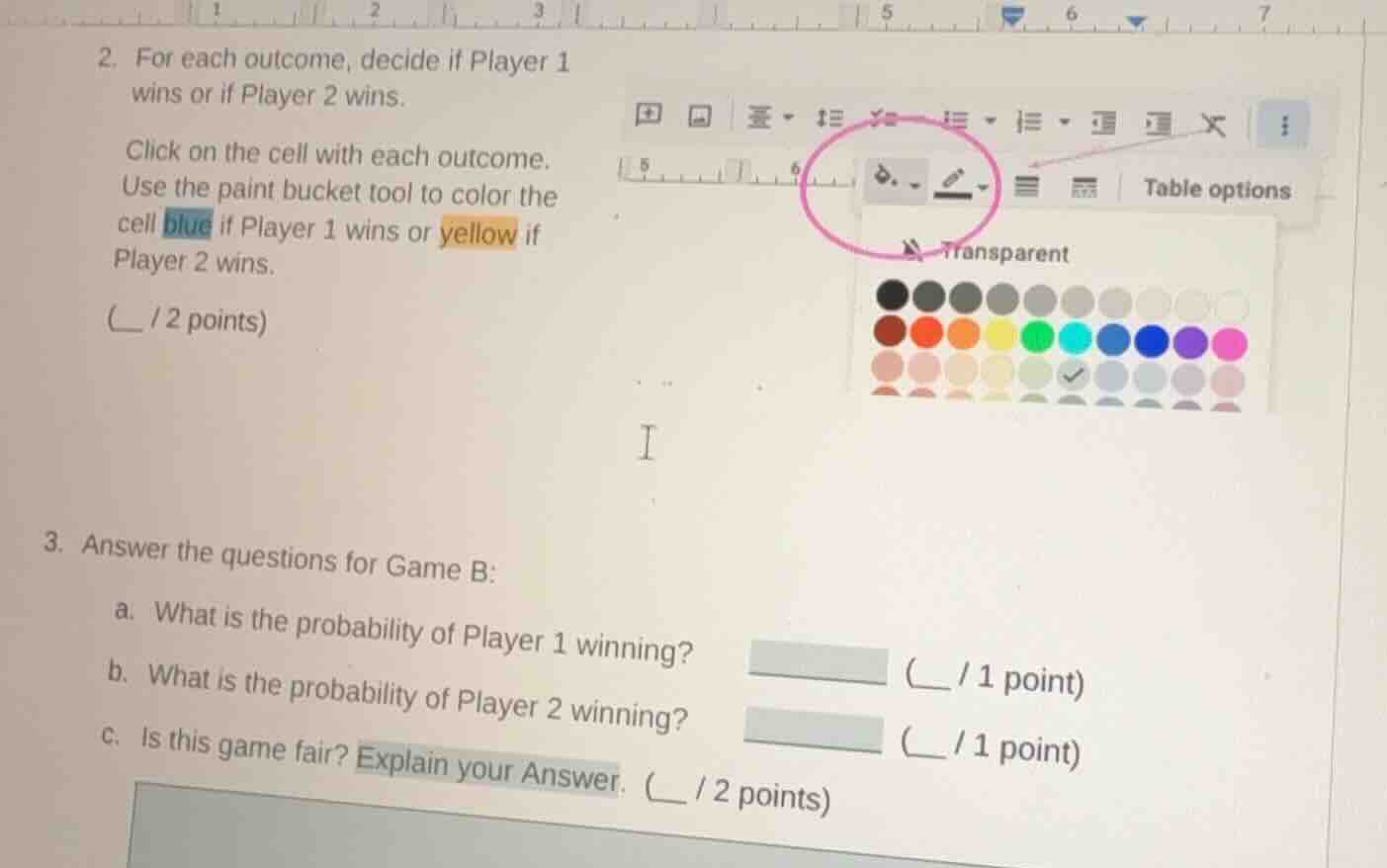
- for each outcome, decide if player 1
wins or if player 2 wins.
click on the cell with each outcome.
use the paint bucket tool to color the
cell blue if player 1 wins or yellow if
player 2 wins.
( / 2 points)
- answer the questions for game b:
a. what is the probability of player 1 winning?
b. what is the probability of player 2 winning?
c. is this game fair? explain your answer.
To solve this, we assume we first completed step 2 (coloring cells for wins) and now analyze Game B. Let's assume a typical game (e.g., a table with outcomes, say 4 outcomes: 2 blue (Player 1 wins) and 2 yellow (Player 2 wins), or other counts. But since the table isn't fully shown, we'll use a common example. Let's say after coloring, there are \( n \) total outcomes, \( w_1 \) for Player 1, \( w_2 \) for Player 2.
Part a: Probability Player 1 wins
Step 1: Define Probability Formula
Probability = \( \frac{\text{Number of Player 1 winning outcomes}}{\text{Total number of outcomes}} \)
Step 2: Assume Outcomes (Example: 4 total, 2 blue)
Suppose total outcomes \( = 4 \), Player 1 wins in \( 2 \) (blue cells). Then:
\( P(\text{Player 1}) = \frac{2}{4} = \frac{1}{2} \)
Part b: Probability Player 2 wins
Step 1: Use Complement or Direct Count
If total outcomes \( = 4 \), Player 2 wins in \( 2 \) (yellow cells). Then:
\( P(\text{Player 2}) = \frac{2}{4} = \frac{1}{2} \)
Part c: Is the game fair?
A game is fair if \( P(\text{Player 1}) = P(\text{Player 2}) \). From parts a and b, if both probabilities are \( \frac{1}{2} \), the game is fair because both players have an equal chance to win.

Snap & solve any problem in the app
Get step-by-step solutions on Sovi AI
Photo-based solutions with guided steps
Explore more problems and detailed explanations
s (Using Example Assumptions):
a. \( \boldsymbol{\frac{1}{2}} \)
b. \( \boldsymbol{\frac{1}{2}} \)
c. Yes, because the probability of Player 1 winning equals the probability of Player 2 winning (both \( \frac{1}{2} \)), so the game is fair.
(Note: Actual answers depend on the specific outcomes from step 2. If the table had, e.g., 3 blue and 1 yellow, probabilities would change. The above is a common fair game example.)