QUESTION IMAGE
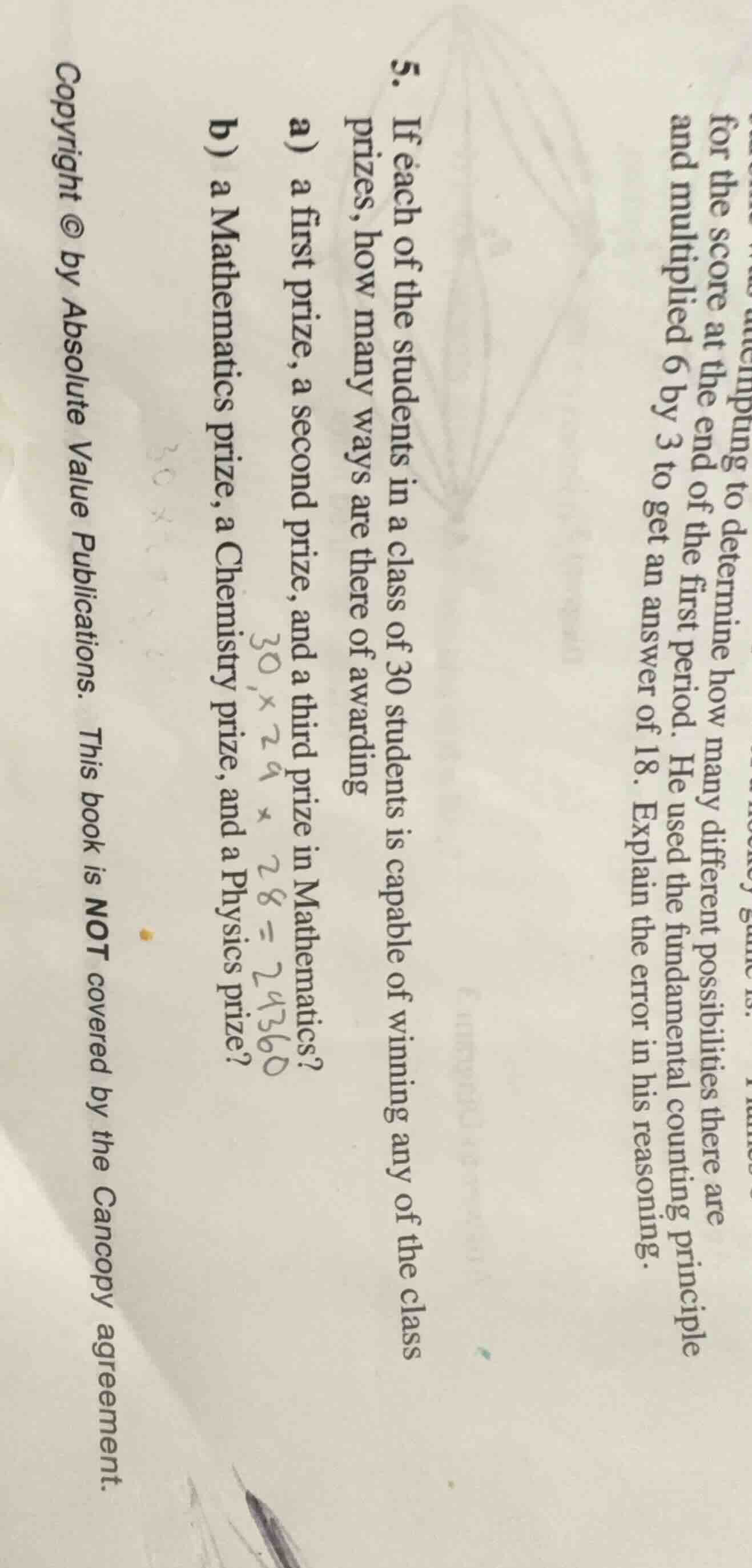
Question
- if each of the students in a class of 30 students is capable of winning any of the class prizes, how many ways are there of awarding
a) a first prize, a second prize, and a third prize in mathematics?
b) a mathematics prize, a chemistry prize, and a physics prize?
Part (a)
Step 1: Understand the problem
We need to find the number of ways to award a first, second, and third prize in Mathematics to 30 students. This is a permutation problem because the order of awarding (first, second, third) matters. The formula for permutations of \( n \) objects taken \( r \) at a time is \( P(n, r)=\frac{n!}{(n - r)!} \), where \( n = 30 \) (number of students) and \( r=3 \) (number of prizes).
Step 2: Calculate the permutation
Using the permutation formula \( P(30, 3)=\frac{30!}{(30 - 3)!}=\frac{30!}{27!} \)
Since \( n!=n\times(n - 1)\times\cdots\times1 \), we can simplify \( \frac{30!}{27!}=30\times29\times28 \)
\( 30\times29 = 870 \), then \( 870\times28=24360 \)
Step 1: Understand the problem
We need to find the number of ways to award a Mathematics prize, a Chemistry prize, and a Physics prize to 30 students. For each prize, we have 30 choices (since a student can win more than one prize, as the prizes are in different subjects). This is a problem of counting the number of ways to make independent choices, so we use the multiplication principle.
Step 2: Apply the multiplication principle
For the Mathematics prize, we have 30 choices. For the Chemistry prize, we also have 30 choices (because a student who won the Mathematics prize can still win the Chemistry prize). For the Physics prize, we have 30 choices. So the total number of ways is \( 30\times30\times30 \)
Step 3: Calculate the result
\( 30\times30 = 900 \), then \( 900\times30 = 27000 \)

Snap & solve any problem in the app
Get step-by-step solutions on Sovi AI
Photo-based solutions with guided steps
Explore more problems and detailed explanations
The number of ways is \( 24360 \)