QUESTION IMAGE
Question
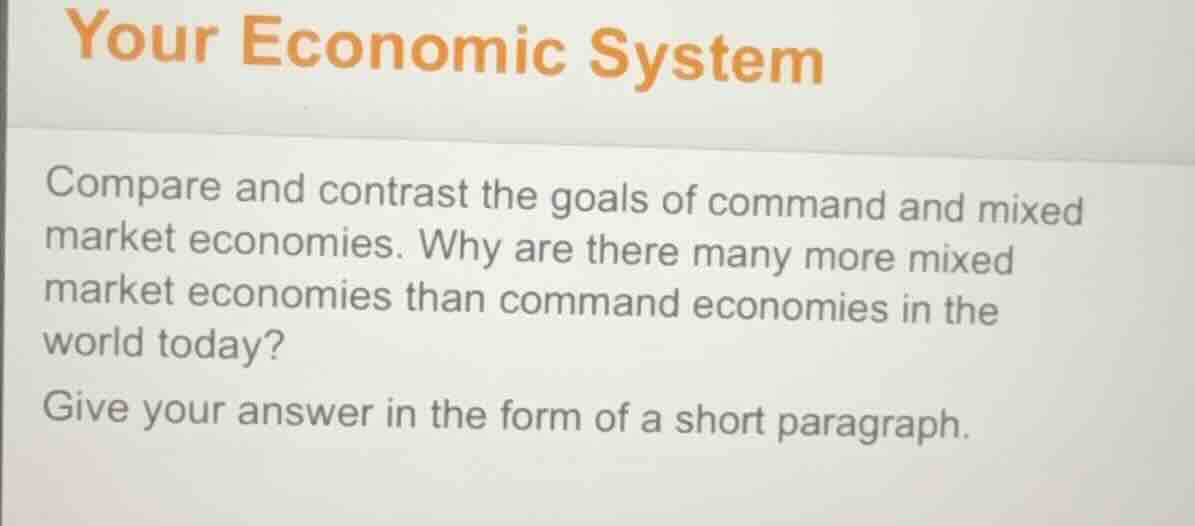
your economic system
compare and contrast the goals of command and mixed market economies. why are there many more mixed market economies than command economies in the world today?
give your answer in the form of a short paragraph.
Command economies aim for central planning - equal resource distribution, social welfare (e.g., healthcare, employment), and prioritizing collective (state - set) goals. Mixed market economies combine market freedom (private enterprise, profit - seeking) with government regulation to balance efficiency, equity (e.g., safety nets, antitrust), and stability. Most nations use mixed systems because pure command struggles with innovation, individual initiative, and resource misallocation (due to lack of market signals). Mixed economies leverage market efficiency (from supply - demand, competition) while addressing market failures (like monopolies, inequality) via government intervention, adapting better to global trade, technological change, and diverse societal needs.

Snap & solve any problem in the app
Get step-by-step solutions on Sovi AI
Photo-based solutions with guided steps
Explore more problems and detailed explanations
Command economies prioritize central planning to achieve equitable resource distribution, full employment, and collective goals (e.g., state - driven industrialization), with the government controlling production and allocation. Mixed market economies blend free - market mechanisms (private ownership, profit - motive) with government intervention to balance economic efficiency, social equity (e.g., public services, regulations), and stability. There are more mixed market economies today because pure command systems often lack innovation, individual incentive, and responsiveness to consumer needs (due to limited market signals), while mixed economies leverage market efficiency (from competition, supply - demand) and address market failures (e.g., inequality, monopolies) through regulation. Mixed systems also adapt better to global trade, technological change, and diverse societal priorities, avoiding the inefficiencies (e.g., resource misallocation) and rigidity of pure command economies.