QUESTION IMAGE
Question
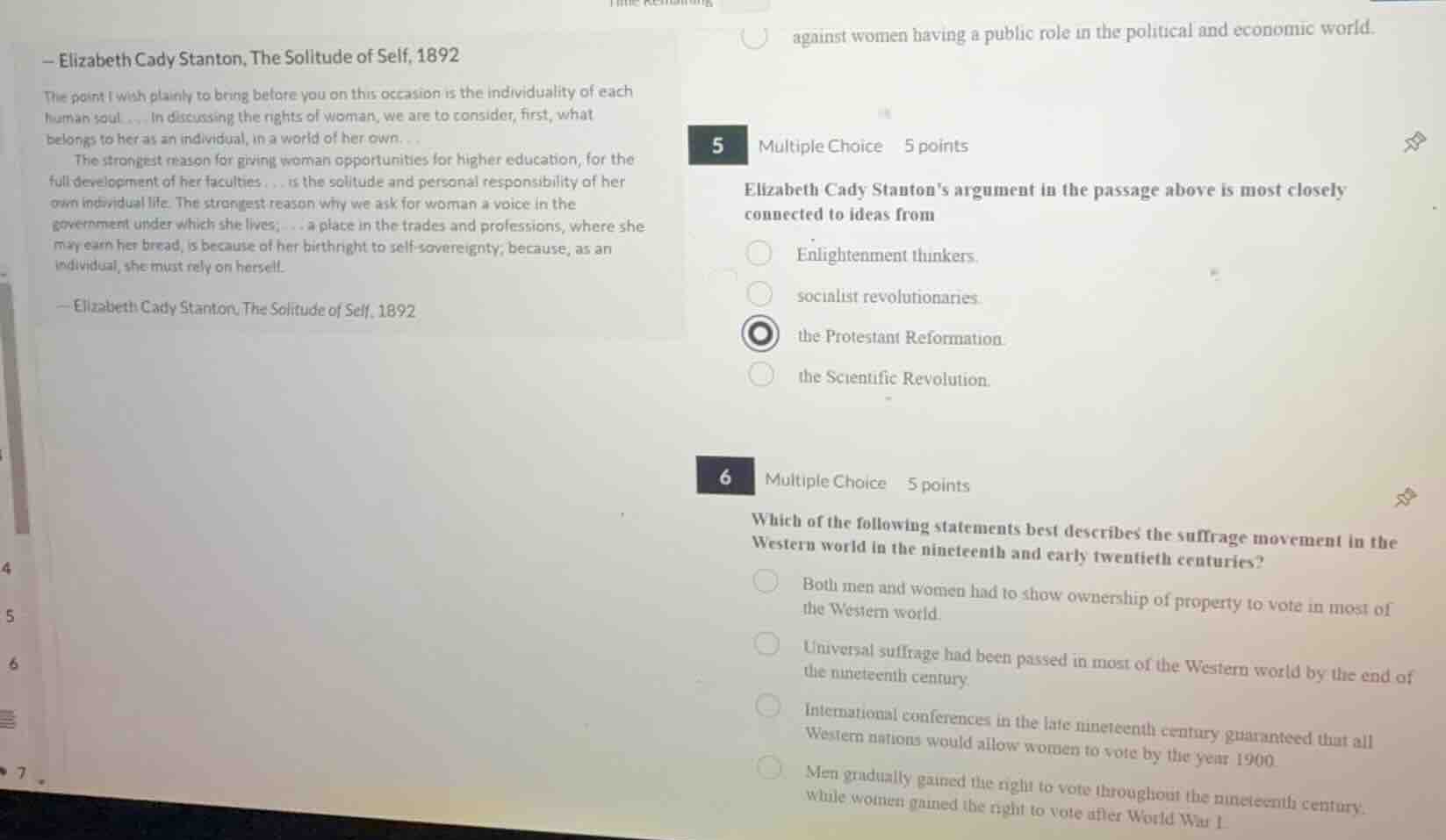
– elizabeth cady stanton, the solitude of self, 1892
the point i wish plainly to bring before you on this occasion is the individuality of each
human soul... in discussing the rights of woman, we are to consider, first, what
belongs to her as an individual, in a world of her own...
the strongest reason for giving woman opportunities for higher education, for the
full development of her faculties... is the solitude and personal responsibility of her
own individual life. the strongest reason why we ask for woman a voice in the
government under which she lives;... a place in the trades and professions, where she
may earn her bread, is because of her birthright to self - sovereignty, because, as an
individual, she must rely on herself.
– elizabeth cady stanton, the solitude of self, 1892
against women having a public role in the political and economic world.
5 multiple choice 5 points
elizabeth cady stanton’s argument in the passage above is most closely
connected to ideas from
enlightenment thinkers.
socialist revolutionaries.
the protestant reformation.
the scientific revolution.
6 multiple choice 5 points
which of the following statements best describes the suffrage movement in the
western world in the nineteenth and early twentieth centuries?
both men and women had to show ownership of property to vote in most of
the western world.
universal suffrage had been passed in most of the western world by the end of
the nineteenth century.
international conferences in the late nineteenth century guaranteed that all
western nations would allow women to vote by the year 1900.
men gradually gained the right to vote throughout the nineteenth century,
while women gained the right to vote after world war i.
Question 5
Elizabeth Cady Stanton's argument emphasizes individual rights and self - sovereignty for women. Enlightenment thinkers focused on individual rights, natural rights, and the idea of self - determination. Socialist revolutionaries are more concerned with class struggle and economic equality. The Protestant Reformation was about religious reform, not individual rights in the context of women's rights and self - sovereignty. The Scientific Revolution was about scientific methods and understanding of the natural world. So her argument is most connected to Enlightenment thinkers.
- Option 1: In the 19th and early 20th centuries, property requirements for voting (for both men and women in some cases) were common in the Western world as voting rights were gradually expanded and many places still had such restrictions.
- Option 2: Universal suffrage (including women's right to vote) was not passed in most of the Western world by the end of the 19th century. Women's suffrage was still a major struggle.
- Option 3: There were no international conferences that guaranteed women's right to vote by 1900. Women's suffrage was a long - fought - for right at the national level.
- Option 4: Men's right to vote was gradually gained in the 19th century (with the expansion of suffrage from property - owning men to more men), and women generally gained the right to vote after World War I (many Western countries granted women's suffrage in the 1920s). But the first option is more accurate as it reflects the property - based voting restrictions that were common for both genders during the 19th and early 20th centuries.

Snap & solve any problem in the app
Get step-by-step solutions on Sovi AI
Photo-based solutions with guided steps
Explore more problems and detailed explanations
A. Enlightenment thinkers