QUESTION IMAGE
Question
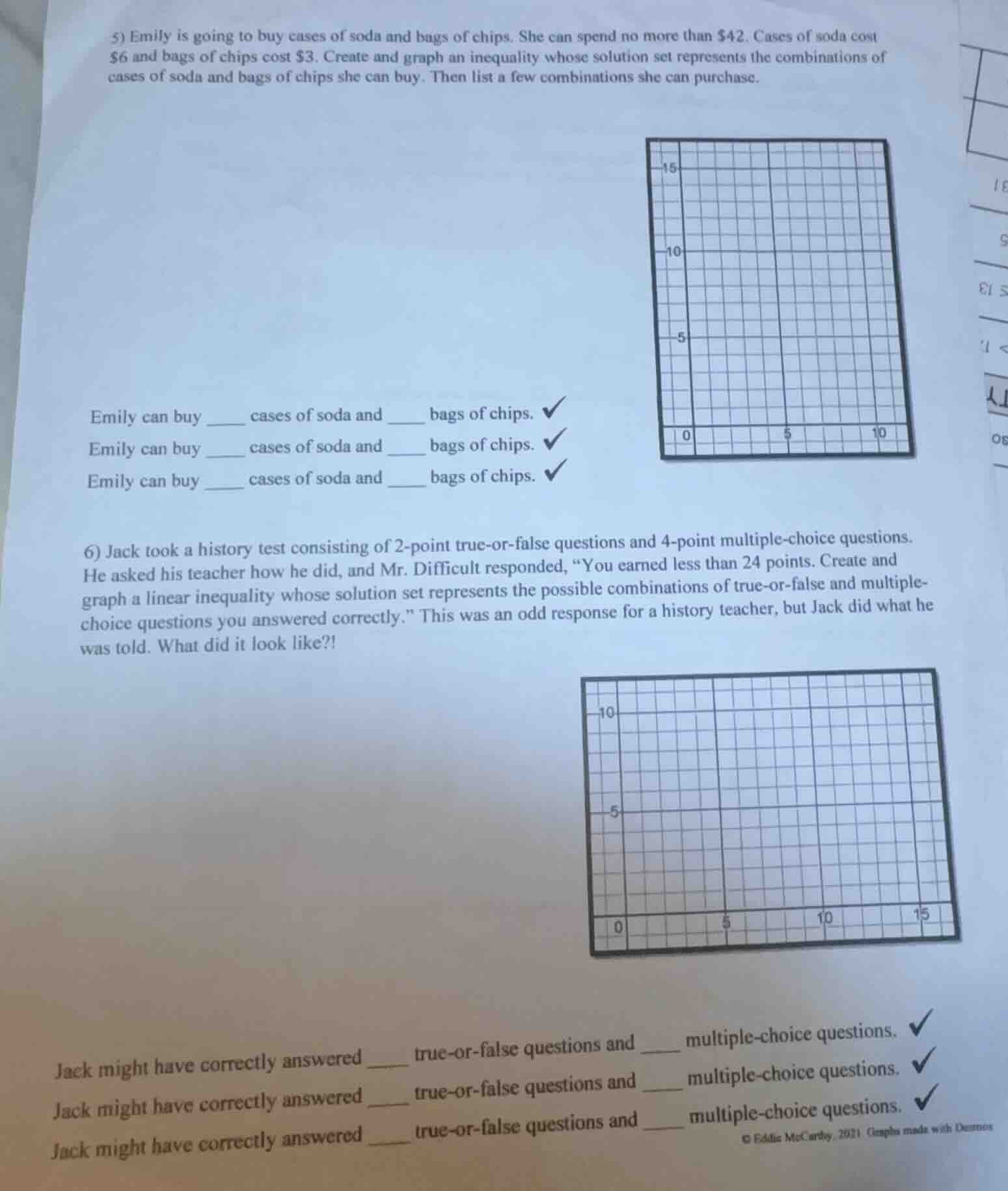
- emily is going to buy cases of soda and bags of chips. she can spend no more than $42. cases of soda cost $6 and bags of chips cost $3. create and graph an inequality whose solution set represents the combinations of cases of soda and bags of chips she can buy. then list a few combinations she can purchase.
emily can buy __ cases of soda and __ bags of chips.
emily can buy __ cases of soda and __ bags of chips.
emily can buy __ cases of soda and __ bags of chips.
- jack took a history test consisting of 2 - point true - or - false questions and 4 - point multiple - choice questions. he asked his teacher how he did, and mr. difficult responded, \you earned less than 24 points. create and graph a linear inequality whose solution set represents the possible combinations of true - or - false and multiple - choice questions you answered correctly.\ this was an odd response for a history teacher, but jack did what he was told. what did it look like?!
jack might have correctly answered __ true - or - false questions and __ multiple - choice questions.
jack might have correctly answered __ true - or - false questions and __ multiple - choice questions.
jack might have correctly answered __ true - or - false questions and __ multiple - choice questions.
Problem 5 (Emily's Soda and Chips Purchase)
Step1: Define variables
Let $x$ = number of soda cases, $y$ = number of chip bags.
Step2: Set up inequality
Total cost ≤ $42$, so $6x + 3y \leq 42$. Simplify: divide by 3: $2x + y \leq 14$.
Step3: Find intercepts for graph
- x-intercept (y=0): $2x=14 \implies x=7$
- y-intercept (x=0): $y=14$
Plot the line $2x+y=14$ as a solid line, shade below it (since ≤) with $x\geq0, y\geq0$ (non-negative quantities).
Step4: Find valid combinations
Test non-negative integer pairs satisfying $2x+y\leq14$:
- $x=0, y=14$: $6(0)+3(14)=42\leq42$
- $x=3, y=6$: $6(3)+3(6)=18+18=36\leq42$
- $x=7, y=0$: $6(7)+3(0)=42\leq42$
Step1: Define variables
Let $x$ = number of correct true-or-false questions, $y$ = number of correct multiple-choice questions.
Step2: Set up inequality
Total points < 24: $2x + 4y < 24$. Simplify: divide by 2: $x + 2y < 12$.
Step3: Find intercepts for graph
- x-intercept (y=0): $x=12$
- y-intercept (x=0): $2y=12 \implies y=6$
Plot the line $x+2y=12$ as a dashed line, shade below it (since <) with $x\geq0, y\geq0$ (non-negative quantities).
Step4: Find valid combinations
Test non-negative integer pairs satisfying $x+2y<12$:
- $x=0, y=5$: $2(0)+4(5)=20<24$
- $x=4, y=3$: $2(4)+4(3)=8+12=20<24$
- $x=10, y=0$: $2(10)+4(0)=20<24$

Snap & solve any problem in the app
Get step-by-step solutions on Sovi AI
Photo-based solutions with guided steps
Explore more problems and detailed explanations
Inequality: $6x + 3y \leq 42$ (or simplified $2x + y \leq 14$)
- Emily can buy 0 cases of soda and 14 bags of chips.
- Emily can buy 3 cases of soda and 6 bags of chips.
- Emily can buy 7 cases of soda and 0 bags of chips.
(Graph: Plot solid line through (7,0) and (0,14), shade the region below the line in the first quadrant.)
---