QUESTION IMAGE
Question
- emma is 12 miles from her home. she rides her bike 10 miles in 60 minutes at a constant speed toward her home. she stops at the library for 15 minutes. she rides her bike the rest of the way home in 25 minutes at a constant speed.
part a: suppose the given situation is represented by a function ( f ). sketch a graph of ( f ).
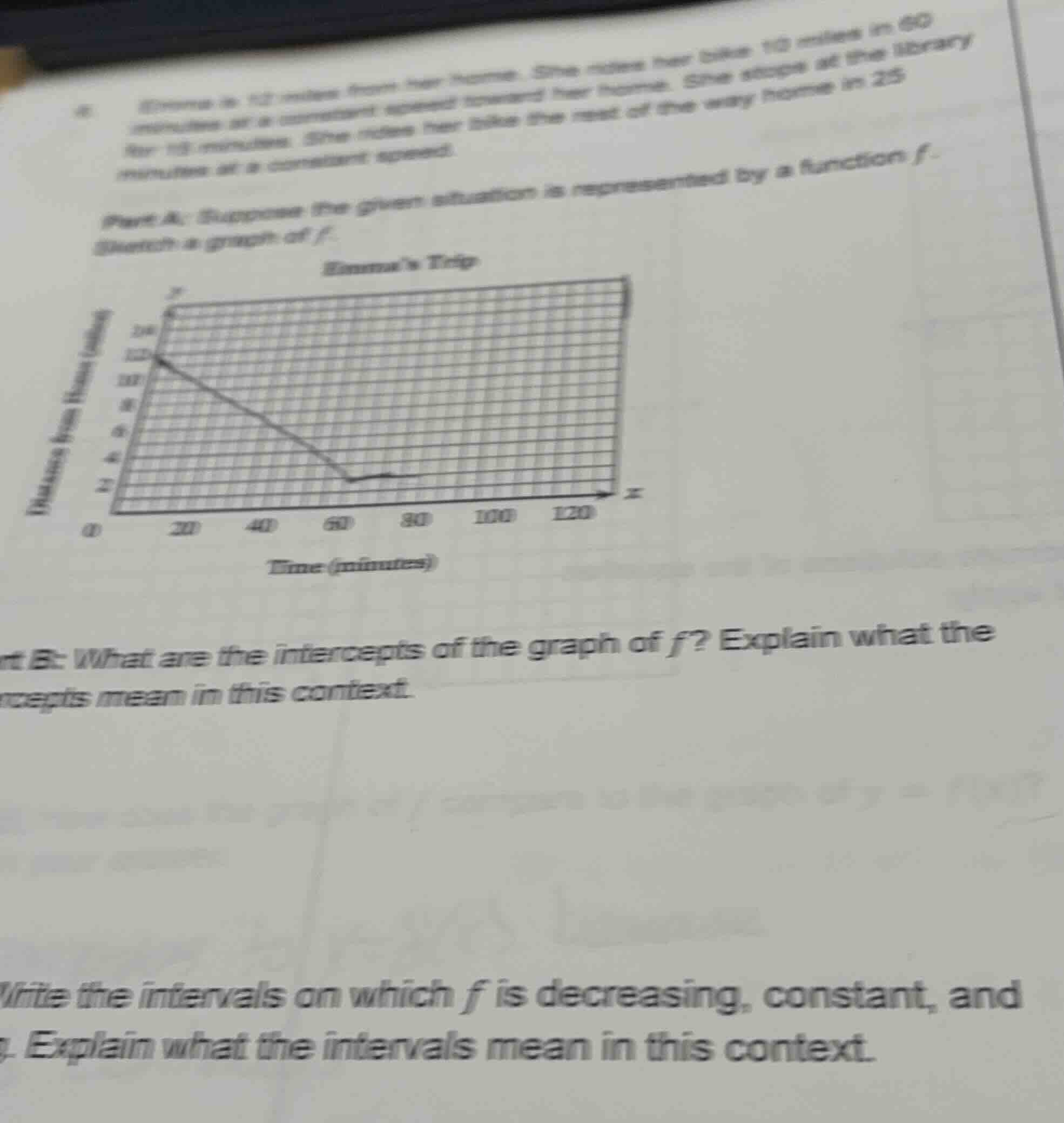
graph of emmas trip with x-axis: time (minutes) from 0 to 120, y-axis: distance from home (miles) from 0 to 14
part b: what are the intercepts of the graph of ( f )? explain what the intercepts mean in this context.
write the intervals on which ( f ) is decreasing, constant, and. explain what the intervals mean in this context.
Part B: Intercepts of the Graph of \( f \)
- Y - Intercept:
The \( y \)-intercept occurs where \( x = 0 \) (time = 0 minutes). From the graph and context, when \( x = 0 \), \( y = 12 \) miles. This means at the start of Emma’s trip (0 minutes), she is 12 miles from her home (since the library is 12 miles from her home, this is her initial distance from home).
- X - Intercept:
The \( x \)-intercept occurs where \( y = 0 \) (distance from home = 0 miles). To find this, we analyze her trip:
- First segment: Rides toward home for 60 minutes (covers 12 miles? Wait, no—wait, the first part: she rides 12 miles (library to home?) Wait, re-reading: “Emma is 12 miles from her home. She rides her bike 12 miles in 60 minutes at a constant speed toward her home.” Wait, no—wait, the library is 12 miles from her home. So initial distance from home is 12 miles (at \( x = 0 \), \( y = 12 \)). Then she rides toward home: distance decreases. Then she stops at the library? Wait, no—“She stops at the library for 15 minutes.” Wait, maybe the graph: the \( x \)-axis is time (minutes), \( y \)-axis is distance from home (miles).
Let’s re-express the trip:
- Time 0 to 60 minutes: Rides toward home (distance from home decreases) for 60 minutes, then stops at the library for 15 minutes (distance constant), then rides the rest home in 25 minutes? Wait, the graph shows:
- From \( x = 0 \) (time 0) to \( x = 60 \) (time 60 minutes): distance decreases from 12 to 2 miles? Wait, no, the graph’s \( y \)-axis: at \( x = 0 \), \( y = 12 \); at \( x = 60 \), \( y = 2 \); then from \( x = 60 \) to \( x = 75 \) (60 + 15 minutes), distance is constant (stops at library); then from \( x = 75 \) to \( x = 100 \) (75 + 25 minutes), distance decreases to 0.
So the \( x \)-intercept is when \( y = 0 \), which is at \( x = 100 \) minutes (since after the library stop, she rides 25 minutes to home: 75 + 25 = 100). This means at 100 minutes, she has arrived home (distance from home = 0).
- Decreasing Interval:
A function is decreasing when as \( x \) (time) increases, \( y \) (distance from home) decreases. From the graph:
- First segment: \( 0 \leq x \leq 60 \) minutes (riding toward home, distance decreases).
- Third segment: \( 75 \leq x \leq 100 \) minutes (riding from library to home, distance decreases to 0).
- Constant Interval:
A function is constant when as \( x \) (time) increases, \( y \) (distance) stays the same. This is when she stops at the library: \( 60 \leq x \leq 75 \) minutes (15 minutes of stopping, distance from home remains constant).
- Increasing Interval:
The function \( f \) does not increase in this context because she is only riding toward home or stopping (distance never increases; she starts at 12 miles from home and moves toward 0, with a stop in between).

Snap & solve any problem in the app
Get step-by-step solutions on Sovi AI
Photo-based solutions with guided steps
Explore more problems and detailed explanations
- Y - Intercept: \( (0, 12) \). This means at the start of her trip (0 minutes), Emma is 12 miles from her home (the library is 12 miles from her home).
- X - Intercept: \( (100, 0) \). This means after 100 minutes, Emma has arrived home (her distance from home is 0 miles).