QUESTION IMAGE
Question
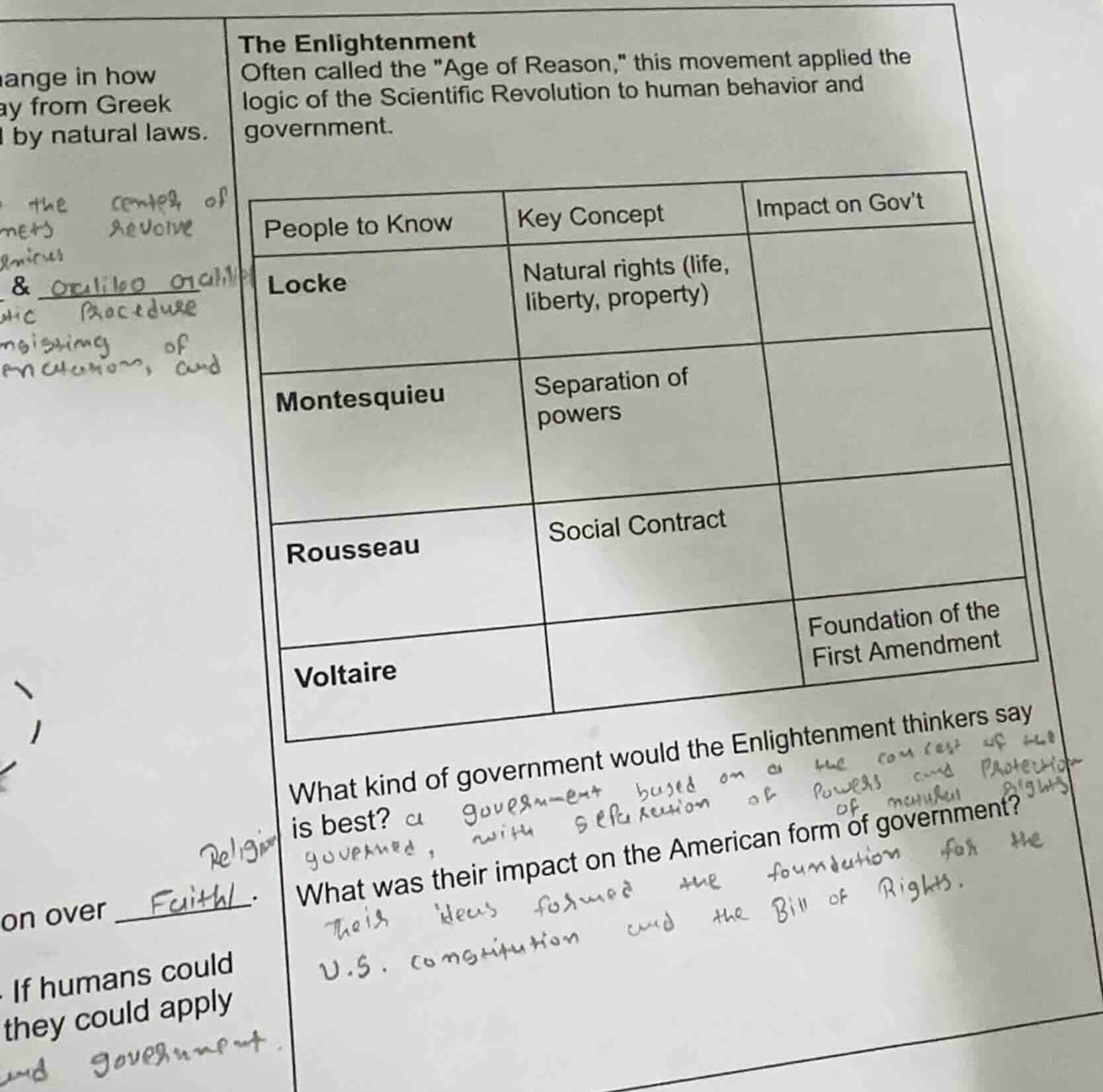
the enlightenment
often called the \age of reason,\ this movement applied the logic of the scientific revolution to human behavior and government.
| people to know | key concept | impact on govt |
|---|---|---|
| montesquieu | separation of powers | |
| rousseau | social contract | |
| voltaire | foundation of the first amendment |
what kind of government would the enlightenment thinkers say is best?
what was their impact on the american form of government?
To complete the table about Enlightenment thinkers, we analyze each thinker's key concept and its impact on government:
Locke
- Key Concept: Natural rights (life, liberty, property).
- Impact on Gov’t: Influenced the idea that government exists to protect these natural rights (e.g., foundational to the Declaration of Independence’s “life, liberty, and the pursuit of happiness”).
Montesquieu
- Key Concept: Separation of powers (executive, legislative, judicial).
- Impact on Gov’t: Led to the U.S. government’s three - branch system (to prevent tyranny by dividing power).
Rousseau
- Key Concept: Social Contract (people give up some freedoms to the government in exchange for protection, and the government’s authority comes from the people).
- Impact on Gov’t: Supported the idea of popular sovereignty (e.g., the U.S. system’s emphasis on government by the consent of the governed).
Voltaire
- Key Concept: Freedom of speech and religion (opposed religious persecution and advocated for civil liberties).
- Impact on Gov’t: Foundation of the First Amendment (freedom of speech, religion, press, etc.).
For the questions:
- What kind of government would Enlightenment thinkers say is best?
Enlightenment thinkers would support a government based on reason, natural rights, and the consent of the governed (e.g., a constitutional government with separation of powers, protection of individual rights, and popular sovereignty).
- What was their impact on the American form of government?
Their ideas formed the foundation of the U.S. Constitution (e.g., separation of powers, checks and balances) and the Bill of Rights (e.g., protection of natural rights like freedom of speech, religion).
Filled Table:
| People to Know | Key Concept | Impact on Gov’t |
|---|---|---|
| Montesquieu | Separation of powers | Led to the U.S. three - branch government (executive, legislative, judicial) |
| Rousseau | Social Contract | Supported popular sovereignty (government by consent of the governed) |
| Voltaire | Freedom of speech/religion | Foundation of the First Amendment |

Snap & solve any problem in the app
Get step-by-step solutions on Sovi AI
Photo-based solutions with guided steps
Explore more problems and detailed explanations
To complete the table about Enlightenment thinkers, we analyze each thinker's key concept and its impact on government:
Locke
- Key Concept: Natural rights (life, liberty, property).
- Impact on Gov’t: Influenced the idea that government exists to protect these natural rights (e.g., foundational to the Declaration of Independence’s “life, liberty, and the pursuit of happiness”).
Montesquieu
- Key Concept: Separation of powers (executive, legislative, judicial).
- Impact on Gov’t: Led to the U.S. government’s three - branch system (to prevent tyranny by dividing power).
Rousseau
- Key Concept: Social Contract (people give up some freedoms to the government in exchange for protection, and the government’s authority comes from the people).
- Impact on Gov’t: Supported the idea of popular sovereignty (e.g., the U.S. system’s emphasis on government by the consent of the governed).
Voltaire
- Key Concept: Freedom of speech and religion (opposed religious persecution and advocated for civil liberties).
- Impact on Gov’t: Foundation of the First Amendment (freedom of speech, religion, press, etc.).
For the questions:
- What kind of government would Enlightenment thinkers say is best?
Enlightenment thinkers would support a government based on reason, natural rights, and the consent of the governed (e.g., a constitutional government with separation of powers, protection of individual rights, and popular sovereignty).
- What was their impact on the American form of government?
Their ideas formed the foundation of the U.S. Constitution (e.g., separation of powers, checks and balances) and the Bill of Rights (e.g., protection of natural rights like freedom of speech, religion).
Filled Table:
| People to Know | Key Concept | Impact on Gov’t |
|---|---|---|
| Montesquieu | Separation of powers | Led to the U.S. three - branch government (executive, legislative, judicial) |
| Rousseau | Social Contract | Supported popular sovereignty (government by consent of the governed) |
| Voltaire | Freedom of speech/religion | Foundation of the First Amendment |