QUESTION IMAGE
Question
essay 10 points
(04.01 lc)
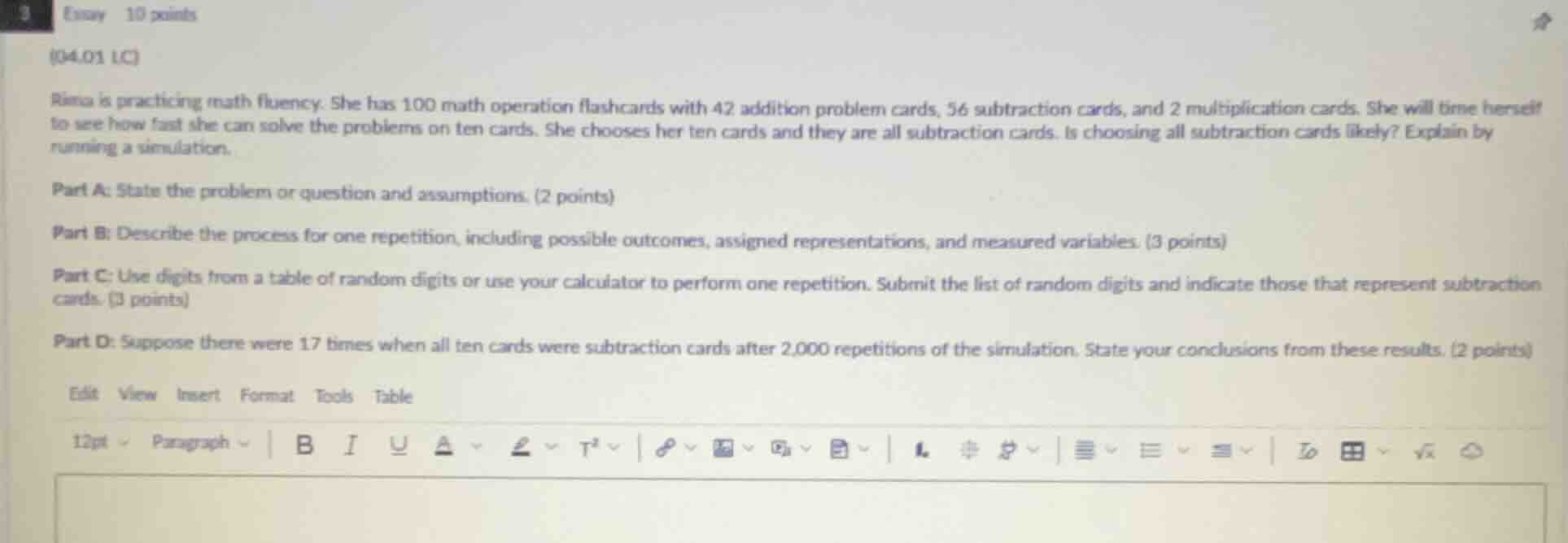
rima is practicing math fluency. she has 100 math operation flashcards with 42 addition problem cards, 36 subtraction cards, and 2 multiplication cards. she will time herself to see how fast she can solve the problems on ten cards. she chooses her ten cards and they are all subtraction cards. is choosing all subtraction cards likely? explain by running a simulation.
part a: state the problem or question and assumptions. (2 points)
part b: describe the process for one repetition, including possible outcomes, assigned representations, and measured variables. (3 points)
part c: use digits from a table of random digits or use your calculator to perform one repetition. submit the list of random digits and indicate those that represent subtraction cards. (3 points)
part d: suppose there were 17 times when all ten cards were subtraction cards after 2,000 repetitions of the simulation. state your conclusions from these results. (2 points)
Part A: State problem/assumptions
Step1: Define core question
Is selecting 10 subtraction cards likely?
Step2: List key assumptions
- Cards are randomly selected without replacement.
- Each card has equal selection chance.
- Card counts are fixed: 42 addition, 56 subtraction, 2 multiplication.
Part B: One repetition process
Step1: Assign digit representations
Assign 00-41 = addition, 42-97 = subtraction, 98-99 = multiplication.
Step2: Simulate 10 draws
Draw 10 unique 2-digit random numbers.
Step3: Count subtraction cards
Tally how many numbers fall in 42-97.
Part C: Perform one repetition
Step1: Generate random digits
Use random digit table: 12, 89, 45, 67, 32, 91, 50, 78, 22, 81
Step2: Classify each digit
- 12 (addition), 89 (subtraction), 45 (subtraction), 67 (subtraction), 32 (addition)
- 91 (subtraction), 50 (subtraction), 78 (subtraction), 22 (addition), 81 (subtraction)
Step3: Mark subtraction digits
Subtraction digits: 89, 45, 67, 91, 50, 78, 81
Part D: Analyze simulation results
Step1: Calculate relative frequency
$\text{Relative Frequency} = \frac{17}{2000} = 0.0085$
Step2: Interpret the value
This is a 0.85% chance of the event.

Snap & solve any problem in the app
Get step-by-step solutions on Sovi AI
Photo-based solutions with guided steps
Explore more problems and detailed explanations
Part A:
- Problem/Question: Is randomly selecting 10 cards that are all subtraction cards a likely event?
- Assumptions: Cards are selected randomly without replacement; each card has an equal probability of being chosen; the total count of each card type is fixed (42 addition, 56 subtraction, 2 multiplication).
Part B:
- Assign representations: Use 2-digit numbers: 00-41 = addition cards, 42-97 = subtraction cards, 98-99 = multiplication cards.
- One repetition process: Draw 10 unique 2-digit random numbers (to avoid reselecting the same card).
- Measured variable: Count how many of the 10 numbers fall in the 42-97 range (subtraction cards).
Part C:
- Random digits (2-digit): 12, 89, 45, 67, 32, 91, 50, 78, 22, 81
- Digits representing subtraction cards: 89, 45, 67, 91, 50, 78, 81
Part D:
The relative frequency of drawing all 10 subtraction cards is 0.85%, which is an extremely low probability. This means choosing all ten subtraction cards is not a likely event.