QUESTION IMAGE
Question
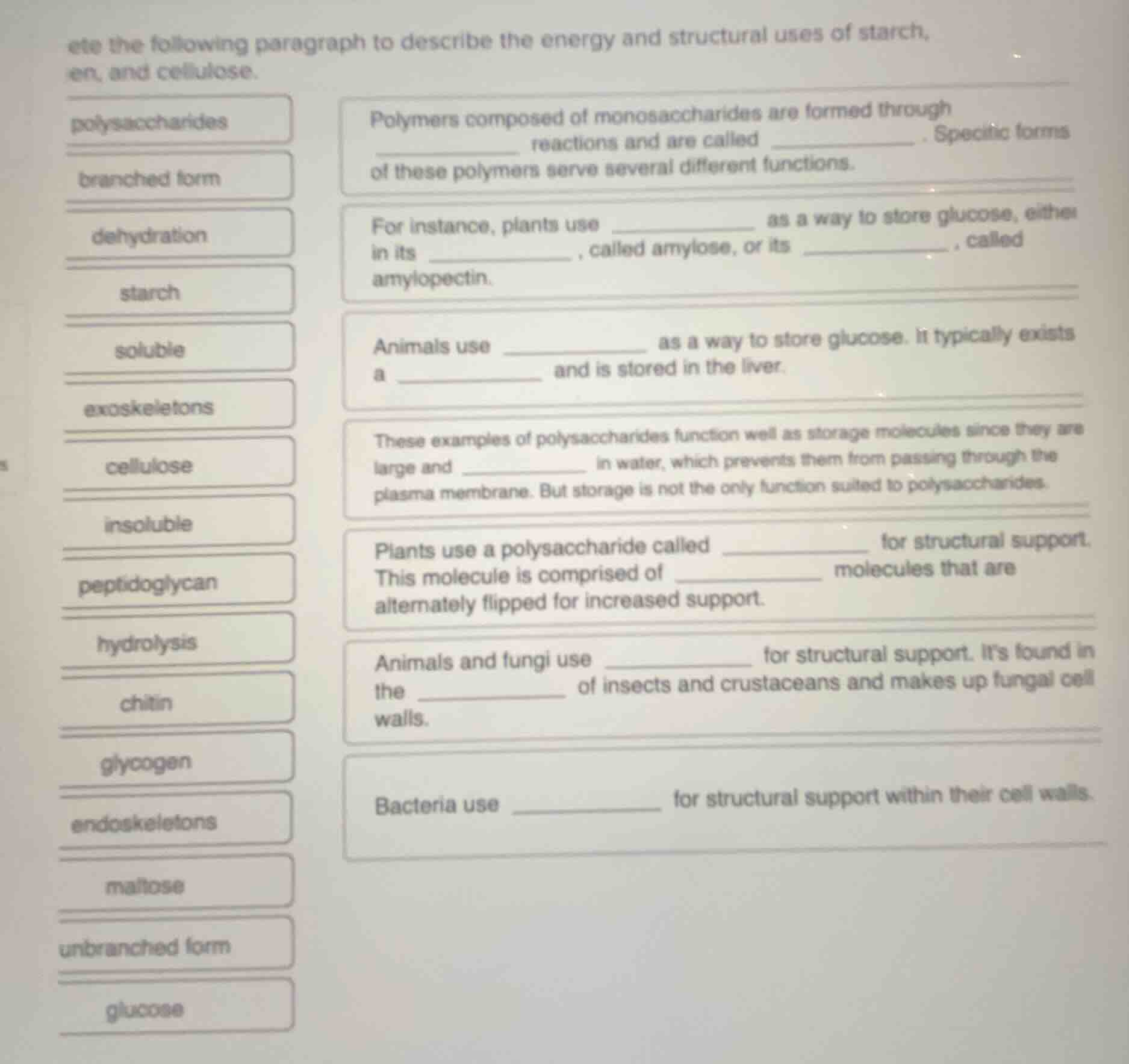
ete the following paragraph to describe the energy and structural uses of starch, en, and cellulose.
polysaccharides
branched form
dehydration
starch
soluble
exoskeletons
cellulose
insoluble
peptidoglycan
hydrolysis
chitin
glycogen
endoskeletons
maltose
glucose
polymers composed of monosaccharides are formed through ____ reactions and are called ____. specific forms of these polymers serve several different functions.
for instance, plants use ____ as a way to store glucose, either in its __, called amylose, or its ____, called amylopectin.
animals use ____ as a way to store glucose. it typically exists a ____ and is stored in the liver.
these examples of polysaccharides function well as storage molecules since they are large and ______ in water, which prevents them from passing through the plasma membrane. but storage is not the only function suited to polysaccharides.
plants use a polysaccharide called ____ for structural support. this molecule is comprised of ____ molecules that are alternately flipped for increased support.
animals and fungi use ____ for structural support. its found in the ____ of insects and crustaceans and makes up fungal cell walls.
bacteria use ______ for structural support within their cell walls.
- Polymers of monosaccharides form via dehydration reactions (removing water to link monomers) and are polysaccharides.
- Plants store glucose as starch, which has an unbranched form (amylose) and a branched form (amylopectin).
- Animals store glucose as glycogen, which is branched.
- Polysaccharides for storage are insoluble in water (so they don’t pass through membranes).
- Plants use cellulose (composed of glucose, flipped for structure) for support.
- Animals/fungi use chitin; in insects/crustaceans, it’s in exoskeletons.
- Bacteria use peptidoglycan in cell walls.

Snap & solve any problem in the app
Get step-by-step solutions on Sovi AI
Photo-based solutions with guided steps
Explore more problems and detailed explanations
- Polymers composed of monosaccharides are formed through $\boldsymbol{\text{dehydration}}$ reactions and are called $\boldsymbol{\text{polysaccharides}}$.
- For instance, plants use $\boldsymbol{\text{starch}}$ as a way to store glucose, either in its $\boldsymbol{\text{unbranched form}}$, called amylose, or its $\boldsymbol{\text{branched form}}$, called amylopectin.
- Animals use $\boldsymbol{\text{glycogen}}$ as a way to store glucose. It typically exists as a $\boldsymbol{\text{branched form}}$ and is stored in the liver.
- These examples of polysaccharides function well as storage molecules since they are large and $\boldsymbol{\text{insoluble}}$ in water, which prevents them from passing through the plasma membrane.
- Plants use a polysaccharide called $\boldsymbol{\text{cellulose}}$ for structural support. This molecule is comprised of $\boldsymbol{\text{glucose}}$ molecules that are alternately flipped for increased support.
- Animals and fungi use $\boldsymbol{\text{chitin}}$ for structural support. It’s found in the $\boldsymbol{\text{exoskeletons}}$ of insects and crustaceans and makes up fungal cell walls.
- Bacteria use $\boldsymbol{\text{peptidoglycan}}$ for structural support within their cell walls.