QUESTION IMAGE
Question
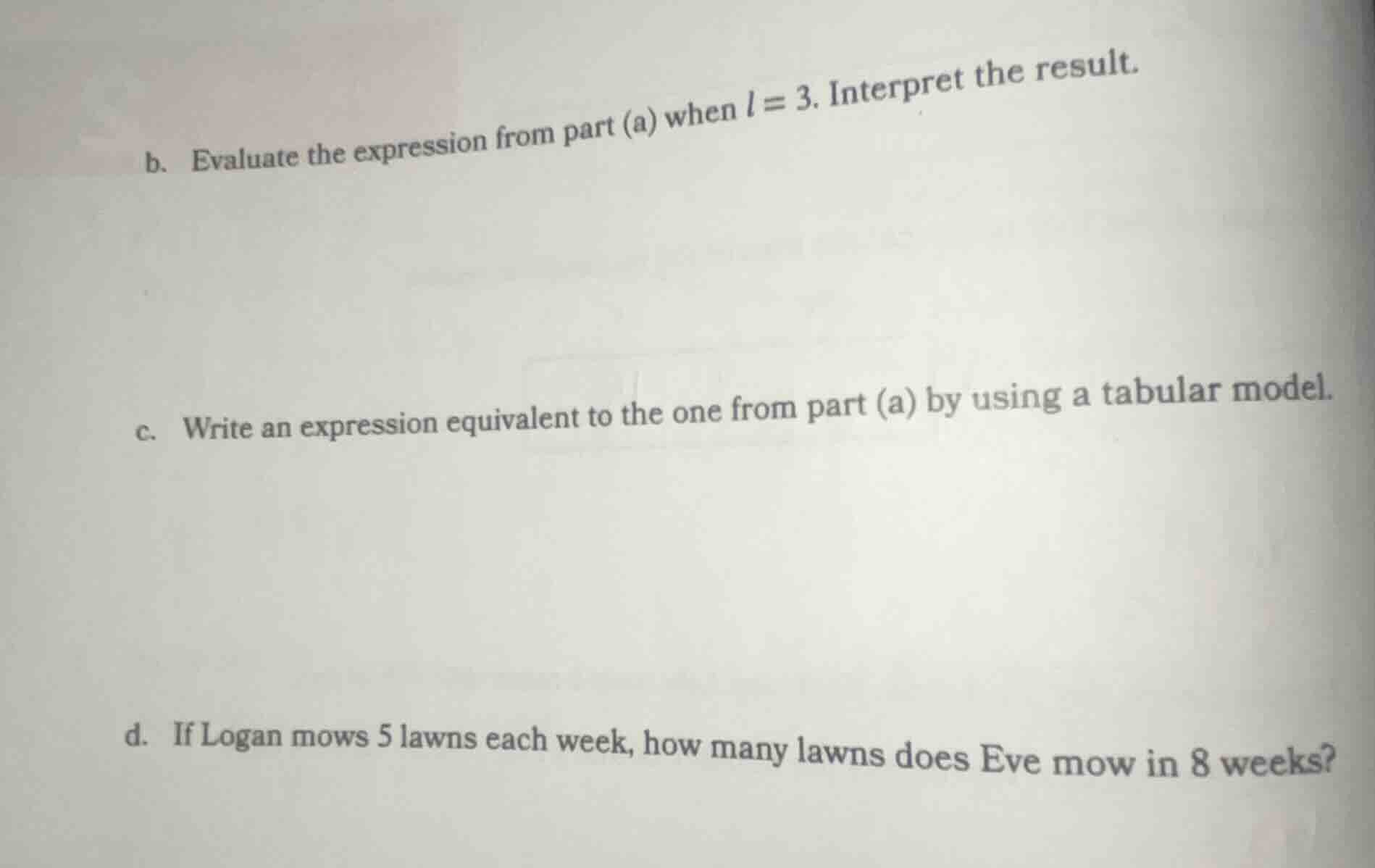
b. evaluate the expression from part (a) when $l = 3$. interpret the result.
c. write an expression equivalent to the one from part (a) by using a tabular model.
d. if logan mows 5 lawns each week, how many lawns does eve mow in 8 weeks?
To solve these sub - questions, we need to know the expression from part (a). Since it is not provided, we can't proceed with the solution. We assume that in part (a), there is an expression related to the number of lawns mowed by Eve, probably in terms of the number of lawns mowed by Logan (represented by \(l\)) and time (like weeks). For example, if Eve mows twice as many lawns as Logan per week and we are considering a certain number of weeks, the expression could be something like \(2\times l\times w\) (where \(w\) is the number of weeks). But without the exact expression from part (a), we can't give a definite solution.
If you can provide the expression from part (a), we will be able to solve sub - questions (b), (c), and (d) as follows:
For sub - question (b)
Once we have the expression from part (a), say the expression is \(E(l)=k\times l\) (where \(k\) is a constant related to the relationship between Eve's and Logan's lawn - mowing), we substitute \(l = 3\) into the expression. For example, if \(E(l)=2l\), then \(E(3)=2\times3 = 6\). The interpretation would be that when Logan mows 3 lawns (per the relevant time unit), Eve mows 6 lawns (per the same time unit).
For sub - question (c)
A tabular model can be used to represent the relationship between the number of lawns mowed by Logan and Eve. Let's assume the expression from part (a) is \(E = 2l\) (where \(E\) is the number of lawns mowed by Eve and \(l\) is the number of lawns mowed by Logan). We can create a table:
| Number of lawns mowed by Logan (\(l\)) | Number of lawns mowed by Eve (\(E\)) |
|---|---|
| 2 | \(2\times2 = 4\) |
| 3 | \(2\times3 = 6\) |
| ... | ... |
| \(l\) | \(2l\) |
The equivalent expression from the tabular model is still \(E = 2l\) (or whatever the original relationship was), but the tabular model helps to visualize the linear relationship between \(l\) and \(E\).
For sub - question (d)
If Logan mows 5 lawns each week (\(l = 5\)) and we consider 8 weeks (\(w = 8\)), and if the expression from part (a) is \(E=2lw\) (assuming Eve mows twice as many lawns as Logan per week), then we substitute \(l = 5\) and \(w = 8\) into the expression: \(E=2\times5\times8=80\). So Eve would mow 80 lawns in 8 weeks. But this is based on an assumed expression. We need the actual expression from part (a) to give a correct solution.

Snap & solve any problem in the app
Get step-by-step solutions on Sovi AI
Photo-based solutions with guided steps
Explore more problems and detailed explanations
To solve these sub - questions, we need to know the expression from part (a). Since it is not provided, we can't proceed with the solution. We assume that in part (a), there is an expression related to the number of lawns mowed by Eve, probably in terms of the number of lawns mowed by Logan (represented by \(l\)) and time (like weeks). For example, if Eve mows twice as many lawns as Logan per week and we are considering a certain number of weeks, the expression could be something like \(2\times l\times w\) (where \(w\) is the number of weeks). But without the exact expression from part (a), we can't give a definite solution.
If you can provide the expression from part (a), we will be able to solve sub - questions (b), (c), and (d) as follows:
For sub - question (b)
Once we have the expression from part (a), say the expression is \(E(l)=k\times l\) (where \(k\) is a constant related to the relationship between Eve's and Logan's lawn - mowing), we substitute \(l = 3\) into the expression. For example, if \(E(l)=2l\), then \(E(3)=2\times3 = 6\). The interpretation would be that when Logan mows 3 lawns (per the relevant time unit), Eve mows 6 lawns (per the same time unit).
For sub - question (c)
A tabular model can be used to represent the relationship between the number of lawns mowed by Logan and Eve. Let's assume the expression from part (a) is \(E = 2l\) (where \(E\) is the number of lawns mowed by Eve and \(l\) is the number of lawns mowed by Logan). We can create a table:
| Number of lawns mowed by Logan (\(l\)) | Number of lawns mowed by Eve (\(E\)) |
|---|---|
| 2 | \(2\times2 = 4\) |
| 3 | \(2\times3 = 6\) |
| ... | ... |
| \(l\) | \(2l\) |
The equivalent expression from the tabular model is still \(E = 2l\) (or whatever the original relationship was), but the tabular model helps to visualize the linear relationship between \(l\) and \(E\).
For sub - question (d)
If Logan mows 5 lawns each week (\(l = 5\)) and we consider 8 weeks (\(w = 8\)), and if the expression from part (a) is \(E=2lw\) (assuming Eve mows twice as many lawns as Logan per week), then we substitute \(l = 5\) and \(w = 8\) into the expression: \(E=2\times5\times8=80\). So Eve would mow 80 lawns in 8 weeks. But this is based on an assumed expression. We need the actual expression from part (a) to give a correct solution.