QUESTION IMAGE
Question
event: gilded age, 1877-1900
document: the gospel of wealth, andrew carnegie, 1889
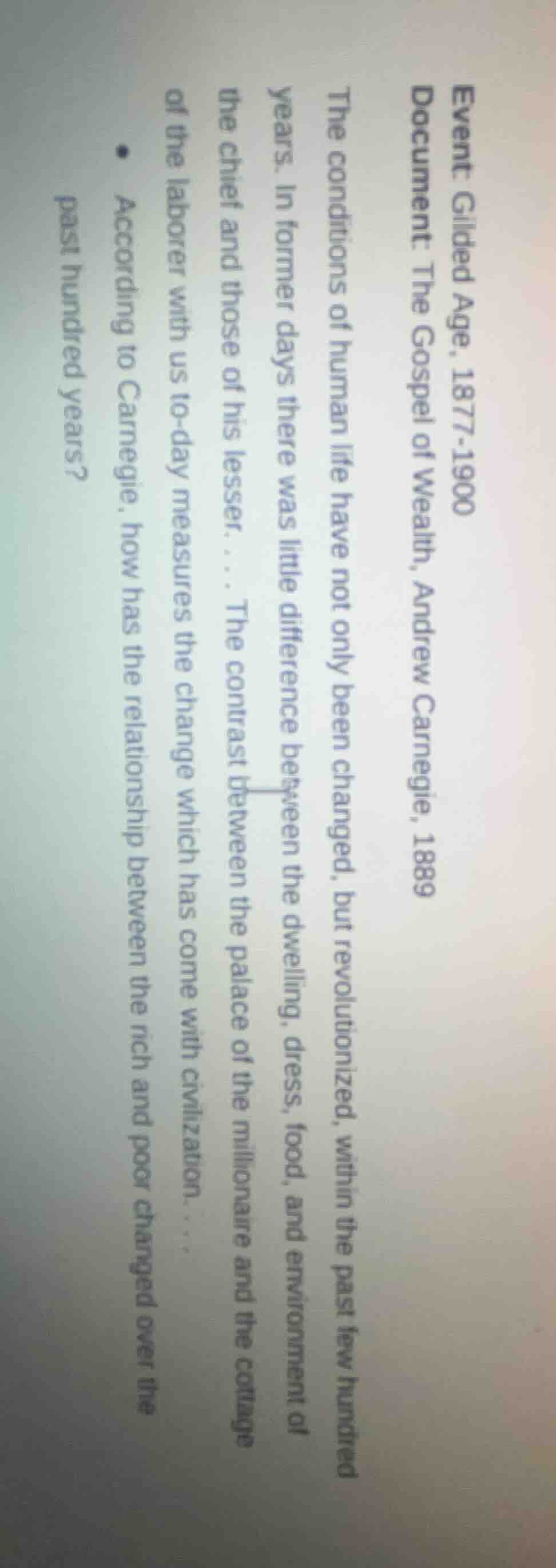
the conditions of human life have not only been changed, but revolutionized, within the past few hundred
years. in former days there was little difference between the dwelling, dress, food, and environment of
the chief and those of his lesser. ... the contrast between the palace of the millionaire and the cottage
of the laborer with us to - day measures the change which has come with civilization. ...
- according to carnegie, how has the relationship between the rich and poor changed over the
past hundred years?
To answer this, we analyze Andrew Carnegie's views in "The Gospel of Wealth". In the past (pre - industrial or early industrial), differences in living conditions (dwelling, dress, food, environment) between the rich (chief) and poor (lesser, laborer) were small. But with industrialization and civilization's progress (over the past hundred years), while the overall standard of living improved, the gap in material conditions (e.g., palace vs. cottage - like housing, luxury vs. basic goods) between the rich and poor became more pronounced. However, Carnegie also emphasized that the wealthy have a responsibility to use their wealth for the public good, which relates to the evolving economic and social relationship between classes.

Snap & solve any problem in the app
Get step-by-step solutions on Sovi AI
Photo-based solutions with guided steps
Explore more problems and detailed explanations
According to Carnegie, in former days, the difference in living conditions (dwelling, dress, food, environment) between the rich (chief) and poor (lesser, laborer) was small. Over the past hundred years, as civilization advanced, while the overall standard of living for all (including laborers) improved, the material gap between the rich (e.g., millionaires with palaces) and poor (e.g., laborers with cottages - like homes) became more distinct. Yet, he also framed the rich’s role in using wealth for the public good, shaping a new economic - social relationship where the wealthy are stewards of their wealth for societal benefit.