QUESTION IMAGE
Question
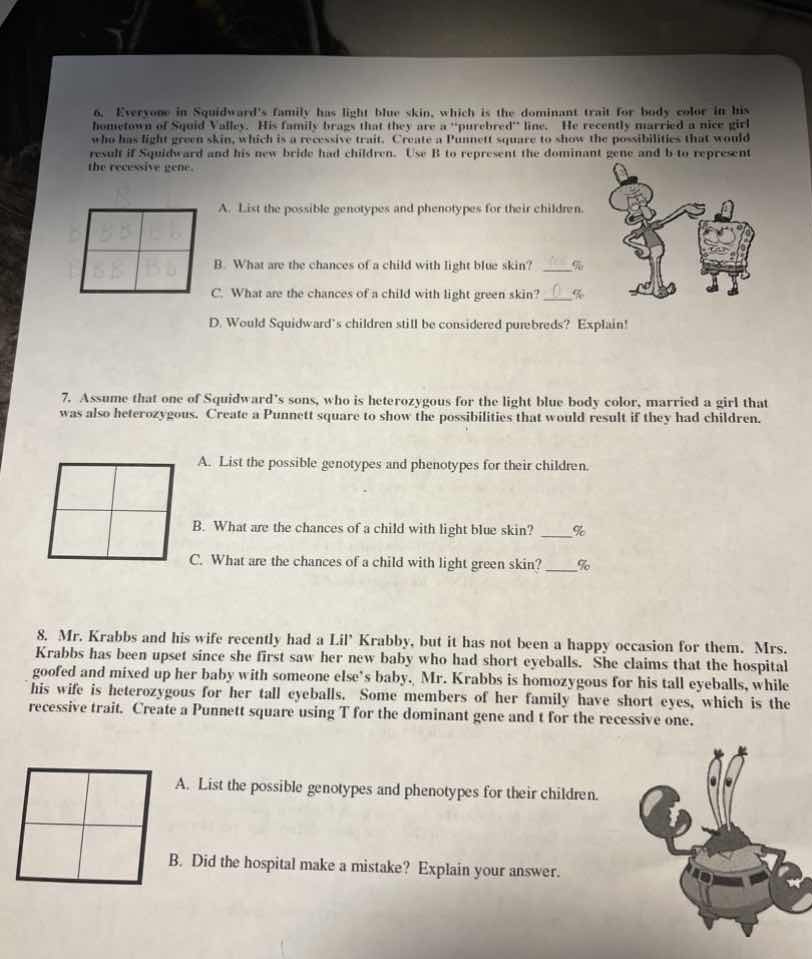
- everyone in squidwards family has light blue skin, which is the dominant trait for body color in his hometown of squid valley. his family brags that they are a \purebred\ line. he recently married a nice girl who has light green skin, which is a recessive trait. create a punnett square to show the possibilities that would result if squidward and his new bride had children. use b to represent the dominant gene and b to represent the recessive gene.
a. list the possible genotypes and phenotypes for their children.
b. what are the chances of a child with light blue skin? ____%
c. what are the chances of a child with light green skin? ____%
d. would squidwards children still be considered purebreds? explain!
- assume that one of squidwards sons, who is heterozygous for the light blue body color, married a girl that was also heterozygous. create a punnett square to show the possibilities that would result if they had children.
a. list the possible genotypes and phenotypes for their children.
b. what are the chances of a child with light blue skin? ____%
c. what are the chances of a child with light green skin? ____%
- mr. krabbs and his wife recently had a lil krabby, but it has not been a happy occasion for them. mrs. krabbs has been upset since she first saw her new baby who had short eyeballs. she claims that the hospital goofed and mixed up her baby with someone elses baby. mr. krabbs is homozygous for his tall eyeballs, while his wife is heterozygous for her tall eyeballs. some members of her family have short eyes, which is the recessive trait. create a punnett square using t for the dominant gene and t for the recessive one.
a. list the possible genotypes and phenotypes for their children.
b. did the hospital make a mistake? explain your answer.
Step1: Define parental genotypes
Squidward (purebred dominant): $BB$; Bride (recessive): $bb$
Step2: Set up Punnett Square
Step3: Solve Q6A
Identify genotypes/phenotypes from square.
Step4: Solve Q6B
Calculate light blue skin probability.
$\frac{4}{4} \times 100 = 100\%$
Step5: Solve Q6C
Calculate light green skin probability.
$\frac{0}{4} \times 100 = 0\%$
Step6: Solve Q6D
Purebred = homozygous; offspring are $Bb$.
Step7: Define parental genotypes (Q7)
Heterozygous son: $Bb$; Heterozygous wife: $Bb$
Step8: Set up Punnett Square (Q7)
Step9: Solve Q7A
Identify genotypes/phenotypes from square.
Step10: Solve Q7B
Calculate light blue skin probability.
$\frac{3}{4} \times 100 = 75\%$
Step11: Solve Q7C
Calculate light green skin probability.
$\frac{1}{4} \times 100 = 25\%$
Step12: Define parental genotypes (Q8)
Mr. Krabs (homozygous dominant): $TT$; Mrs. Krabs (heterozygous): $Tt$
Step13: Set up Punnett Square (Q8)
Step14: Solve Q8A
Identify genotypes/phenotypes from square.
Step15: Solve Q8B
Compare offspring traits to baby's trait.

Snap & solve any problem in the app
Get step-by-step solutions on Sovi AI
Photo-based solutions with guided steps
Explore more problems and detailed explanations
Question 6
A. Genotypes: $Bb$; Phenotypes: Light blue skin
B. 100
C. 0
D. No, they would not be purebred. All children are heterozygous ($Bb$), meaning they carry one recessive allele and are not homozygous for the dominant trait.
Question 7
A. Genotypes: $BB$, $Bb$, $bb$; Phenotypes: $BB$ and $Bb$ = light blue skin, $bb$ = light green skin
B. 75
C. 25
Question 8
A. Genotypes: $TT$, $Tt$; Phenotypes: Tall eyeballs
B. Yes, the hospital made a mistake. All possible offspring will have at least one dominant $T$ allele, so they can only have tall eyeballs. A baby with short eyeballs ($tt$) cannot be their biological child.