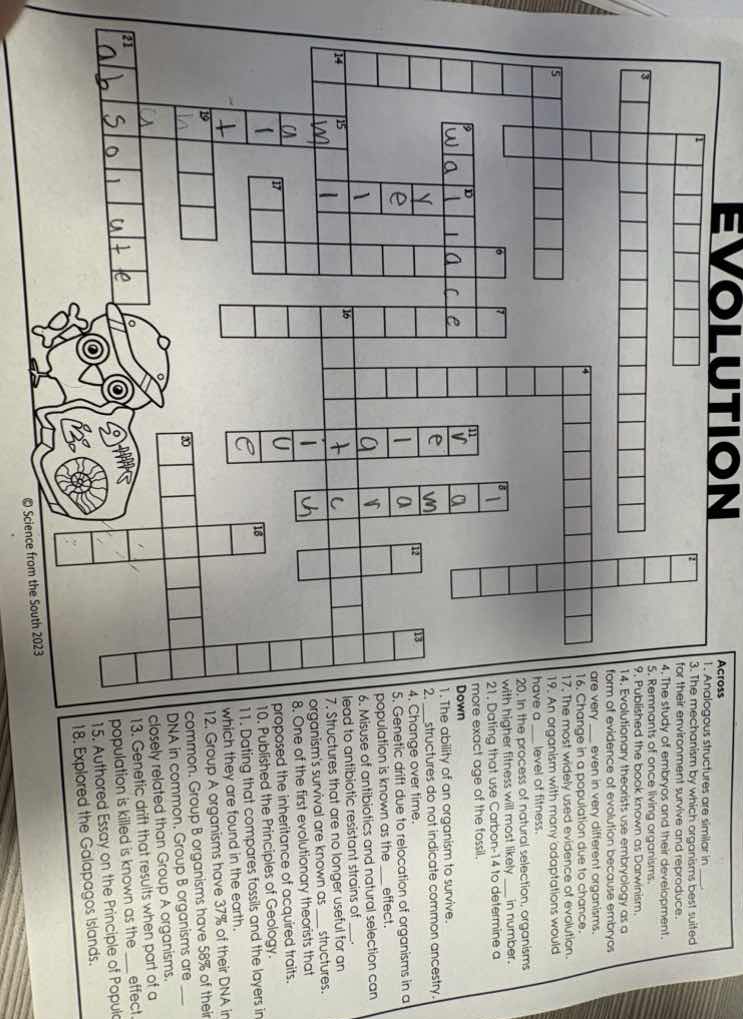
QUESTION IMAGE
Question
evolution
across
- analogous structures are similar in ______, but not in origin or ancestry.
- the method by which organisms with best suited ______ of environment survive and reproduce.
- for the study of embryos and their development.
- remnants of once useful organs or structures.
- published the book, on the origin of species.
- evolutionary theory, also known as darwinism.
- change in a population due to chance.
- the movement of individuals to a new area, which may introduce different alleles to a population or remove alleles from a population.
- as organisms with most useful adaptations would have a ______ level of fitness.
- in the process of natural selection, organisms with higher fitness will ______ in number.
- using exact age of the fossil, as to determine a more exact time of the fossil.
down
- the ability of an organism to survive.
- ______ structures over time indicate common ancestry, a change of an organism.
- genetic drift due to the relocation of organisms in a ______.
- mutation is unknown as the ______ effect.
- use of antibiotics on the population of bacteria can lead to antibiotic resistant strains of ______.
- structures that are no longer useful to an organisms survival are known as ______ structures.
- one of the five evidences of evolution, the study of the distribution of acquired traits.
- published the principles of geology.
- dating that compares fossils and the layers in which they are found in the earth, to their dna.
- group a organisms have 37% of their dna in common. group b organisms have 95% of their dna in common. group b organisms are ______ related than group a organisms.
- genetic drift that results when part of a population is killed or ____, is known as the ____ effect.
- a (n) ______ essay on the principle of population, killed darwins theory of evolution.
- explored the galapagos islands.
Response
To solve this evolution - themed crossword puzzle, we analyze each clue and find the appropriate answer based on evolutionary concepts:
Across Clues
- The ability of an organism to survive. The term related to an organism's ability to survive in its environment is "FITNESS".
- Change over time. In the context of evolution, the change in species over time is called "EVOLUTION".
- Genetic drift due to the relocation of organisms in a population is known as the "FOUNDER" effect (when a small group starts a new population).
- The study of embryos and their development. The field that studies embryos and their development is "EMBRYOLOGY".
- Remnants of once useful structures. These are called "VESTIGIAL" structures (like the human appendix).
- Mutation or unknown or random selection can lead to antibiotic - resistant strains of bacteria. The process by which organisms with favorable traits survive and reproduce is "NATURAL" selection.
- Structures that are known as "HOMOLOGOUS" structures (structures with a common evolutionary origin but different functions, like the forelimbs of humans, bats, and whales).
- One of the first evolutionists, proposed the idea of acquired traits. This was "LAMARCK".
- Published the principles of geology, which influenced Darwin. This was "LYELL".
- Dating that compares the fossils and the layers in which they are found in the earth. This is "RELATIVE" dating.
- When dating, the amount of a radioactive isotope in a fossil or rock is measured. This is "ABSOLUTE" dating.
- Group A organisms have 37% of their DNA in common. Group B organisms are "MORE" closely related (if they have a higher percentage of common DNA).
- Genetic drift that results when part of a population is killed is known as the "BOTTLENECK" effect (a sharp reduction in population size).
- Evolutionary theory was proposed by Darwin and Wallace. The theory of evolution by natural selection was put forward by "DARWIN" (and Wallace).
- A (unclear clue context, but based on evolution and a common term, maybe "DARWIN" related, but more likely "NATURAL" selection - related, but re - evaluating, for the "Authorized Essay on the Principle..." clue, the author was Darwin, and the essay was on natural selection, but the answer here could be "DARWIN".
- Change in a population due to chance. This is "GENETIC" drift.
- The most widely accepted theory of evolution. This is "NATURAL" selection (the theory that organisms with favorable traits are more likely to survive and reproduce).
- Explored the Galapagos Islands. This was "DARWIN".
Down Clues (assuming some, but the main focus here is to provide the answers for the across clues as per the visible part)

Snap & solve any problem in the app
Get step-by-step solutions on Sovi AI
Photo-based solutions with guided steps
Explore more problems and detailed explanations
s (for the visible across clues)
- FITNESS
- EVOLUTION
- FOUNDER
- EMBRYOLOGY
- VESTIGIAL
- NATURAL
- HOMOLOGOUS
- LAMARCK
- LYELL
- RELATIVE
- ABSOLUTE
- MORE
- BOTTLENECK
- DARWIN
- DARWIN (or related term, but likely DARWIN for the essay clue)
- GENETIC
- NATURAL
- DARWIN
If we take the first across clue "The ability of an organism to survive", the answer is \(\boldsymbol{FITNESS}\)