QUESTION IMAGE
Question
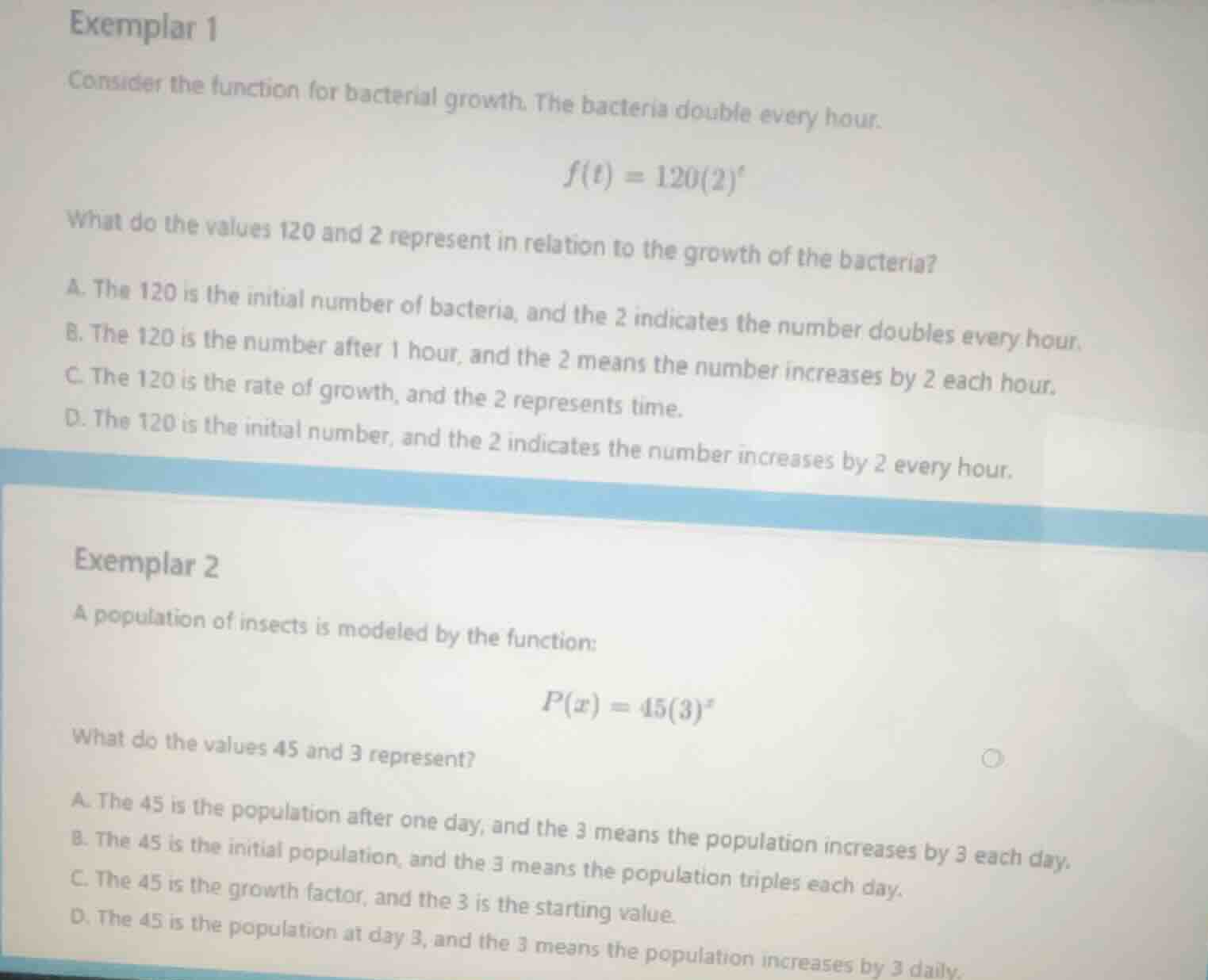
exemplar 1
consider the function for bacterial growth. the bacteria double every hour.
$f(t) = 120(2)^t$
what do the values 120 and 2 represent in relation to the growth of the bacteria?
a. the 120 is the initial number of bacteria, and the 2 indicates the number doubles every hour.
b. the 120 is the number after 1 hour, and the 2 means the number increases by 2 each hour.
c. the 120 is the rate of growth, and the 2 represents time.
d. the 120 is the initial number, and the 2 indicates the number increases by 2 every hour.
exemplar 2
a population of insects is modeled by the function:
$p(x) = 45(3)^x$
what do the values 45 and 3 represent?
a. the 45 is the population after one day, and the 3 means the population increases by 3 each day.
b. the 45 is the initial population, and the 3 means the population triples each day.
c. the 45 is the growth factor, and the 3 is the starting value.
d. the 45 is the population at day 3, and the 3 means the population increases by 3 daily.
Exemplar 1
For the exponential growth function \( f(t)=120(2)^t \), in an exponential growth model of the form \( f(t)=a(b)^t \), \( a \) is the initial amount and \( b \) is the growth factor (indicating how the quantity changes over time). Here, when \( t = 0 \) (initial time), \( f(0)=120(2)^0=120 \), so 120 is the initial number of bacteria. The base 2 means the number of bacteria doubles every hour (since it's multiplied by 2 each hour).
- Option A: Matches the explanation (120 is initial, 2 means doubling).
- Option B: 120 is not the number after 1 hour (after 1 hour, \( f(1)=120\times2 = 240 \)), so B is wrong.
- Option C: 120 is not the growth rate (growth rate is related to the multiplier, and 2 is not time), so C is wrong.
- Option D: 2 does not mean increasing by 2 (it means doubling), so D is wrong.
For the exponential function \( P(x)=45(3)^x \), using the exponential growth model \( P(x)=a(b)^x \), \( a \) is the initial population and \( b \) is the growth factor (shows how the population changes per unit time). When \( x = 0 \), \( P(0)=45(3)^0 = 45 \), so 45 is the initial population. The base 3 means the population triples each day (multiplied by 3 each day).
- Option A: 45 is not population after 1 day (after 1 day, \( P(1)=45\times3=135 \)), and 3 does not mean increasing by 3, so A is wrong.
- Option B: 3 does not mean increasing by 3 (it means tripling), so B is wrong.
- Option C: 45 is the initial population (not growth factor), but the description of 3 (tripling each day) is correct? Wait, no—wait, in the model, \( a = 45 \) (initial), \( b = 3 \) (growth factor, tripling). Wait, the option says "The 45 is the initial population, and the 3 means the population triples each day"—yes, that's correct. Wait, let's re - check:
- Option C: Wait, no, the option says "The 45 is the growth factor, and the 3 is the starting value"—no, that's wrong. Wait, I made a mistake. Let's re - evaluate:
Wait, the function is \( P(x)=45(3)^x \). So \( a = 45 \) (initial population, when \( x = 0 \)), \( b = 3 \) (growth factor, so the population triples each day). So:
- Option B: Says "The 45 is the initial population, and the 3 means the population triples each day"—yes, that's correct. Wait, the option B is "The 45 is the initial population, and the 3 means the population triples each day". Let's check other options:
- Option A: 45 is not after 1 day, 3 is not increasing by 3.
- Option C: 45 is not growth factor (growth factor is 3), 3 is not starting value.
- Option D: 45 is not population at day 3 (at day 3, \( P(3)=45\times3^3=45\times27 = 1215 \)), and 3 is not increasing by 3. So the correct option is B? Wait, no—wait the option B says "The 45 is the initial population, and the 3 means the population triples each day"—yes, that's correct. Wait, I think I mis - labeled earlier. Let's re - do:
In \( P(x)=a(b)^x \), \( a = 45 \) (initial population, when \( x = 0 \)), \( b = 3 \) (so the population is multiplied by 3 each day, i.e., triples). So:
- Option B: "The 45 is the initial population, and the 3 means the population triples each day"—this is correct.
- Option A: Wrong, as 45 is initial, not after 1 day, and 3 is tripling, not +3.
- Option C: Wrong, 45 is initial (not growth factor), 3 is growth factor (not starting value).
- Option D: Wrong, 45 is initial, not at day 3, and 3 is tripling, not +3.
Wait, I think I made a mistake in the first analysis. So the correct option is B? Wait, no, the option B is "The 45 is the initial population, and the 3 means the population triples each day"—yes, that's correct.
Wait, let's check the options again:
Option B: "The 45 is the initial population, and the 3 means the population triples each day."—this matches the model. So the correct option is B.

Snap & solve any problem in the app
Get step-by-step solutions on Sovi AI
Photo-based solutions with guided steps
Explore more problems and detailed explanations
A. The 120 is the initial number of bacteria, and the 2 indicates the number doubles every hour.