QUESTION IMAGE
Question
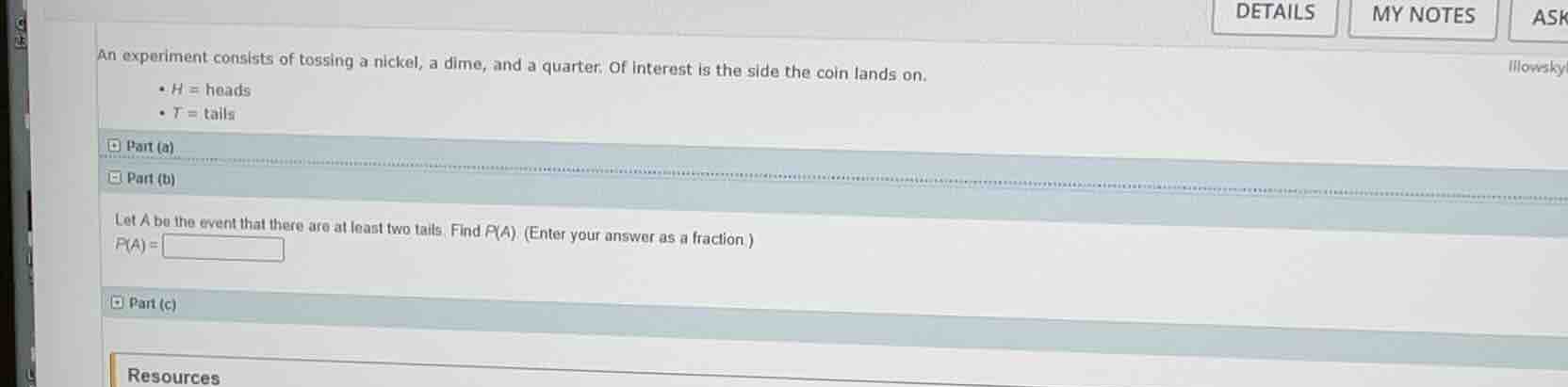
an experiment consists of tossing a nickel, a dime, and a quarter. of interest is the side the coin lands on.
- ( h = ) heads
- ( t = ) tails
part (a)
part (b)
let ( a ) be the event that there are at least two tails. find ( p(a) ). (enter your answer as a fraction.)
( p(a) = )
part (c)
Step1: Determine total number of outcomes
When tossing a nickel, a dime, and a quarter (3 coins), each coin has 2 outcomes (H or T). So total number of outcomes is \(2\times2\times2 = 2^3=8\).
Step2: Identify favorable outcomes for event A
Event A is at least two tails, which means 2 tails or 3 tails.
- For 2 tails: The number of ways to choose 2 coins out of 3 to be tails is given by combination formula \(C(n,k)=\frac{n!}{k!(n - k)!}\), here \(n = 3,k=2\), so \(C(3,2)=\frac{3!}{2!(3 - 2)!}=\frac{3\times2!}{2!\times1!}=3\). The outcomes are (TTH, THT, HTT).
- For 3 tails: There is 1 way (TTT).
So total favorable outcomes \(=3 + 1=4\).
Step3: Calculate probability
Probability \(P(A)=\frac{\text{Number of favorable outcomes}}{\text{Total number of outcomes}}=\frac{4}{8}=\frac{1}{2}\)? Wait, no, wait. Wait, 3 (for two tails) + 1 (for three tails) is 4? Wait, no: Wait, when we have 3 coins, the number of ways to get two tails: Let's list all possible outcomes:
All possible outcomes when tossing 3 coins:
- HHH
- HHT
- HTH
- HTT
- THH
- THT
- TTH
- TTT
Now, event A: at least two tails. So outcomes with two tails: HTT, THT, TTH (3 outcomes) and three tails: TTT (1 outcome). So total favorable outcomes: \(3 + 1=4\)? Wait, no, 3 + 1 is 4? Wait, HTT, THT, TTH are three outcomes with two tails, and TTT is one with three tails. So total 4? Wait, but \(3+1 = 4\), total outcomes 8. So \(P(A)=\frac{4}{8}=\frac{1}{2}\)? Wait, no, wait: Wait, 3 (two tails) + 1 (three tails) = 4. So \(\frac{4}{8}=\frac{1}{2}\)? Wait, but let's check again. Wait, the number of ways to get two tails: C(3,2)=3, number of ways to get three tails: C(3,3)=1. So total favorable is 3 + 1 = 4. Total outcomes 8. So \(P(A)=\frac{4}{8}=\frac{1}{2}\)? Wait, no, wait, 4 divided by 8 is 1/2? Wait, but let's list the outcomes:
Outcomes with at least two tails: HTT, THT, TTH, TTT. That's 4 outcomes. Total 8. So 4/8 = 1/2? Wait, but wait, maybe I made a mistake. Wait, no: Wait, "at least two tails" means two or more tails. So two tails (3 cases) and three tails (1 case), total 4 cases. So probability is 4/8 = 1/2. Wait, but let's recalculate:
Wait, the number of ways to get two tails: C(3,2) = 3, number of ways to get three tails: C(3,3)=1. So total favorable is 3 + 1 = 4. Total outcomes 8. So \(P(A)=\frac{4}{8}=\frac{1}{2}\)? Wait, no, wait, 4/8 reduces to 1/2? Wait, but wait, 4 divided by 8 is 0.5, but let's check the list again. Wait, the outcomes with at least two tails: HTT, THT, TTH, TTT. That's 4 outcomes. So 4 out of 8, which is 1/2. Wait, but let's check the count again. Wait, when we have three coins, the number of outcomes with k tails is C(3,k). So for k = 2: C(3,2)=3, k=3: C(3,3)=1. So total is 3 + 1 = 4. So \(P(A)=\frac{4}{8}=\frac{1}{2}\)? Wait, no, 4/8 is 1/2? Wait, but let's check the list of all 8 outcomes:
- HHH - 0 tails
- HHT - 1 tail
- HTH - 1 tail
- HTT - 2 tails
- THH - 1 tail
- THT - 2 tails
- TTH - 2 tails
- TTT - 3 tails
So the outcomes with at least two tails (2 or 3 tails) are HTT, THT, TTH, TTT. That's 4 outcomes. So 4/8 = 1/2. Wait, but I think I made a mistake earlier. Wait, 3 (two tails) + 1 (three tails) is 4, total 8, so 4/8 = 1/2. Wait, but let's confirm:
Wait, the formula for probability is number of favorable over total. So yes, 4/8 simplifies to 1/2? Wait, no, wait 4 divided by 8 is 0.5, which is 1/2. But wait, let's check again. Wait, maybe I miscounted the favorable outcomes. Let's list all outcomes for event A (at least two tails):
- Two tails: HTT, THT, TTH (3 outcomes)
- Three tails: TTT (1 ou…

Snap & solve any problem in the app
Get step-by-step solutions on Sovi AI
Photo-based solutions with guided steps
Explore more problems and detailed explanations
\(\frac{1}{2}\)