QUESTION IMAGE
Question
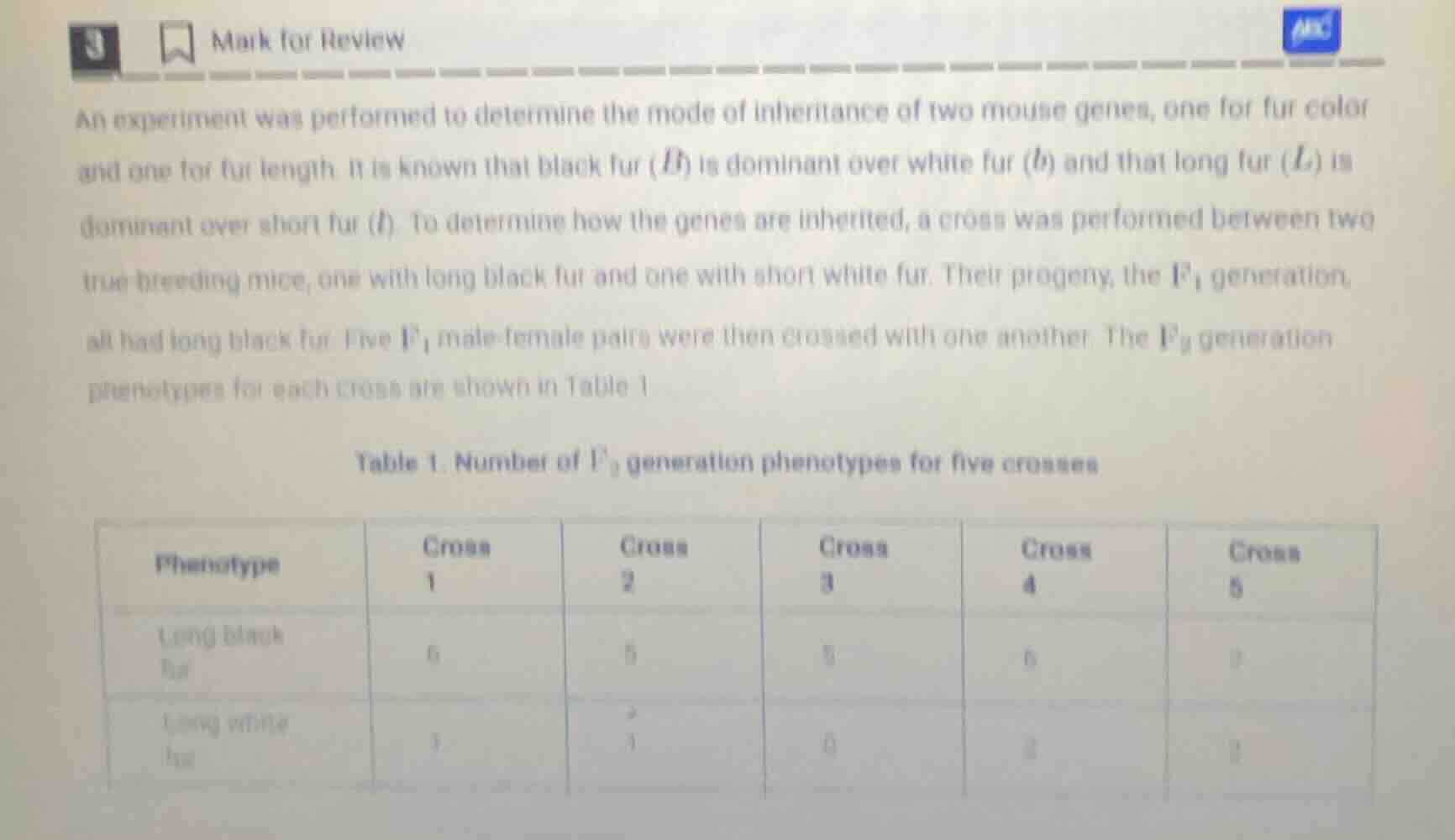
an experiment was performed to determine the mode of inheritance of two mouse genes, one for fur color and one for fur length. it is known that black fur (b) is dominant over white fur (b) and that long fur (l) is dominant over short fur (l). to determine how the genes are inherited, a cross was performed between two true - breeding mice, one with long black fur and one with short white fur. their progeny, the f₁ generation, all had long black fur. five f₁ male - female pairs were then crossed with one another. the f₂ generation phenotypes for each cross are shown in table 1. table 1. number of f₂ generation phenotypes for five crosses. (the table has columns for phenotype, cross 1, cross 2, cross 3, cross 4, cross 5 and rows for long black fur, long white fur (and probably other phenotypes not fully shown here))
Since the table seems incomplete (missing other phenotypes like short black and short white fur, and the numbers for some columns are unclear or cut off), we can't fully analyze the data. However, if we assume the standard dihybrid cross (independent assortment) for two genes, the expected phenotypic ratio in F₂ for a dihybrid cross (when parents are heterozygous for both traits, i.e., F₁ is LlBb) should be 9:3:3:1 for long black : long white : short black : short white (but the table here only shows long black and long white, maybe a typo or incomplete table).
If we consider the given data for long black (LB) and long white (LW) in the crosses:
For a dihybrid cross with independent assortment, the ratio of LB : LW : short black (SB) : short white (SW) should be 9:3:3:1. But since we only have LB and LW here, maybe the question was about something else (like linkage, but data is incomplete).
Alternatively, if we look at the F₁ generation: true - breeding long black (LLBB) crossed with true - breeding short white (llbb) gives F₁ as LlBb (all long black). Then F₁ x F₁ (LlBb x LlBb) should give F₂ with the 9:3:3:1 ratio.
But with the given table (incomplete), we can't proceed further. If we assume that the question was[SSE onError error]

Snap & solve any problem in the app
Get step-by-step solutions on Sovi AI
Photo-based solutions with guided steps
Explore more problems and detailed explanations
Since the table seems incomplete (missing other phenotypes like short black and short white fur, and the numbers for some columns are unclear or cut off), we can't fully analyze the data. However, if we assume the standard dihybrid cross (independent assortment) for two genes, the expected phenotypic ratio in F₂ for a dihybrid cross (when parents are heterozygous for both traits, i.e., F₁ is LlBb) should be 9:3:3:1 for long black : long white : short black : short white (but the table here only shows long black and long white, maybe a typo or incomplete table).
If we consider the given data for long black (LB) and long white (LW) in the crosses:
For a dihybrid cross with independent assortment, the ratio of LB : LW : short black (SB) : short white (SW) should be 9:3:3:1. But since we only have LB and LW here, maybe the question was about something else (like linkage, but data is incomplete).
Alternatively, if we look at the F₁ generation: true - breeding long black (LLBB) crossed with true - breeding short white (llbb) gives F₁ as LlBb (all long black). Then F₁ x F₁ (LlBb x LlBb) should give F₂ with the 9:3:3:1 ratio.
But with the given table (incomplete), we can't proceed further. If we assume that the question was[SSE onError error]