QUESTION IMAGE
Question
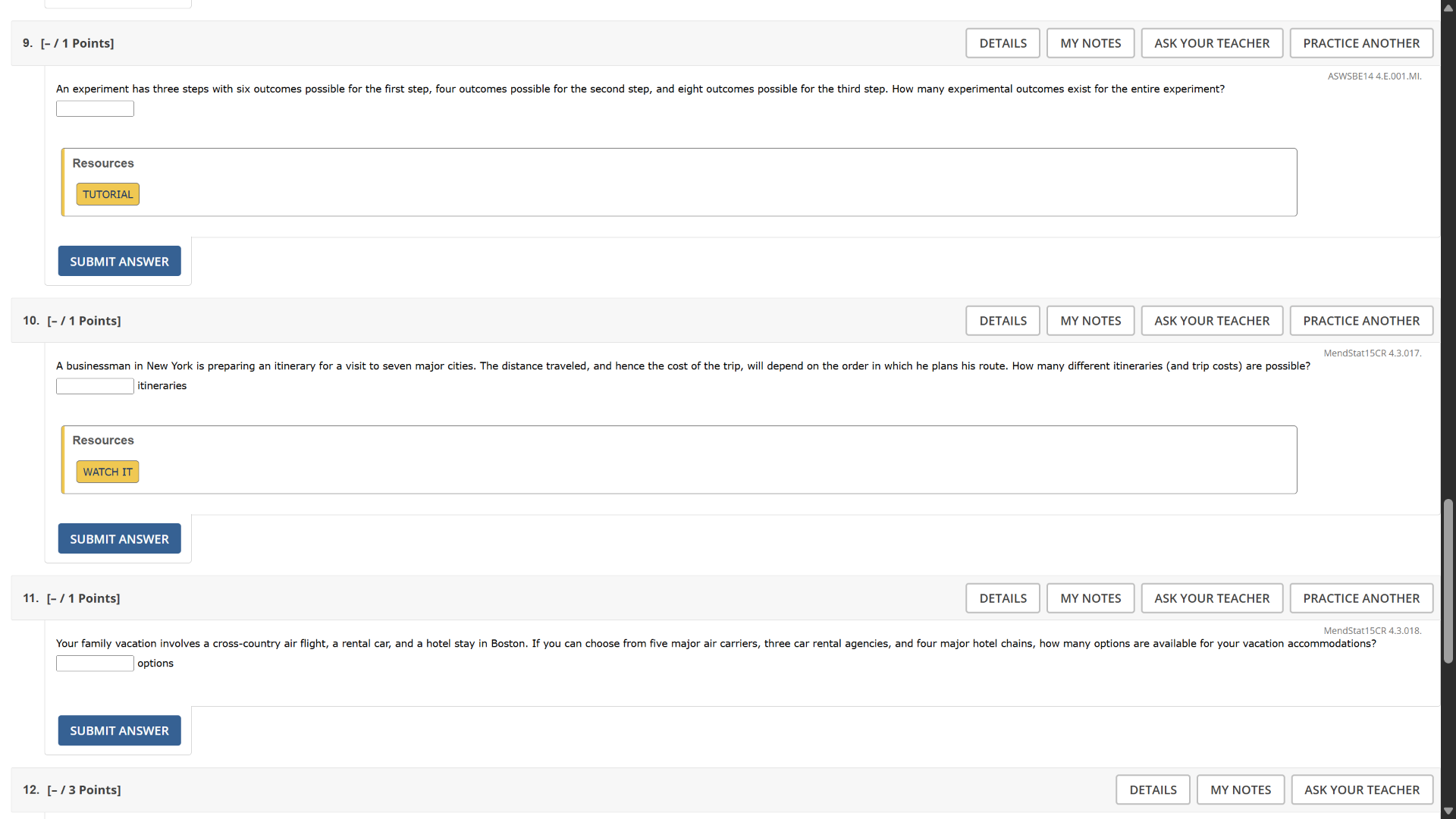
- an experiment has three steps with six outcomes possible for the first step, four outcomes possible for the second step, and eight outcomes possible for the third step. how many experimental outcomes exist for the entire experiment?
- a businessman in new york is preparing an itinerary for a visit to seven major cities. the distance traveled, and hence the cost of the trip, will depend on the order in which he plans his route. how many different itineraries (and trip costs) are possible?
- your family vacation involves a cross - country air flight, a rental car, and a hotel stay in boston. if you can choose from five major air carriers, three car rental agencies, and four major hotel chains, how many options are available for your vacation accommodations?
Question 9
Step1: Identify the multiplication principle
For a multi - step experiment, if the first step has \(n_1\) outcomes, the second step has \(n_2\) outcomes, and the third step has \(n_3\) outcomes, the total number of experimental outcomes is the product of the number of outcomes at each step. So we use the formula \(N=n_1\times n_2\times n_3\).
Here, \(n_1 = 6\), \(n_2=4\), and \(n_3 = 8\).
Step2: Calculate the total number of outcomes
Substitute the values into the formula: \(N=6\times4\times8\)
First, calculate \(6\times4 = 24\). Then, calculate \(24\times8=192\).
Step1: Identify the permutation concept
The number of different itineraries is the number of permutations of \(n\) distinct objects taken \(n\) at a time. The formula for permutations of \(n\) objects is \(n!\) (n factorial), where \(n!=n\times(n - 1)\times(n - 2)\times\cdots\times1\). Here, \(n = 7\) (since there are 7 cities).
Step2: Calculate \(7!\)
\(7!=7\times6\times5\times4\times3\times2\times1\)
\(7\times6 = 42\), \(42\times5=210\), \(210\times4 = 840\), \(840\times3=2520\), \(2520\times2 = 5040\), \(5040\times1=5040\)
Step1: Apply the multiplication principle
For the vacation, we have three choices: air carriers, car rental agencies, and hotel chains. Let the number of air carriers be \(n_1 = 5\), car rental agencies be \(n_2=3\), and hotel chains be \(n_3 = 4\). The total number of options is the product of the number of choices in each category, using the formula \(N=n_1\times n_2\times n_3\).
Step2: Calculate the total number of options
Substitute the values: \(N = 5\times3\times4\)
First, \(5\times3=15\), then \(15\times4 = 60\)

Snap & solve any problem in the app
Get step-by-step solutions on Sovi AI
Photo-based solutions with guided steps
Explore more problems and detailed explanations
\(192\)