QUESTION IMAGE
Question
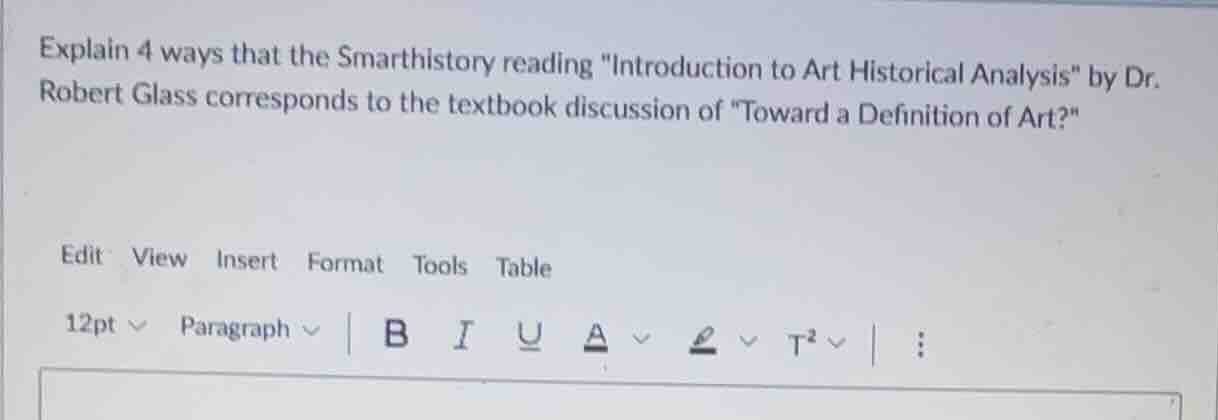
explain 4 ways that the smarthistory reading \introduction to art historical analysis\ by dr. robert glass corresponds to the textbook discussion of \toward a definition of art?\
Brief Explanations
- Focus on Definitional Flexibility: Both texts reject rigid, universal definitions of art. Smarthistory's analysis emphasizes that art meaning is shaped by context, audience, and cultural frameworks, matching the textbook's exploration of why fixed art definitions fail across time and cultures.
- Emphasis on Contextual Analysis: The Smarthistory reading centers on examining art through its historical, social, and cultural contexts to interpret its purpose and meaning. This aligns with the textbook's discussion that art's definition is tied to the contexts in which it is created and received.
- Inclusion of Non-Western/Non-Canonical Art: Both works expand beyond traditional Western fine art to consider global, folk, and functional objects as valid subjects of art analysis. The Smarthistory guide advocates for inclusive analysis, mirroring the textbook's challenge of narrow, Eurocentric art definitions.
- Role of the Viewer/Interpreter: The Smarthistory reading highlights that a viewer's background and perspective influence art interpretation. This corresponds to the textbook's argument that art's definition is partially constructed by the audience, not just the creator or object itself.

Snap & solve any problem in the app
Get step-by-step solutions on Sovi AI
Photo-based solutions with guided steps
Explore more problems and detailed explanations
- Both reject rigid universal art definitions, prioritizing contextual meaning.
- Both center contextual analysis (historical, cultural, social) for interpreting art.
- Both include non-Western/non-canonical objects in art discussions.
- Both recognize the viewer's role in shaping art's meaning and definition.