QUESTION IMAGE
Question
exponential decay functions
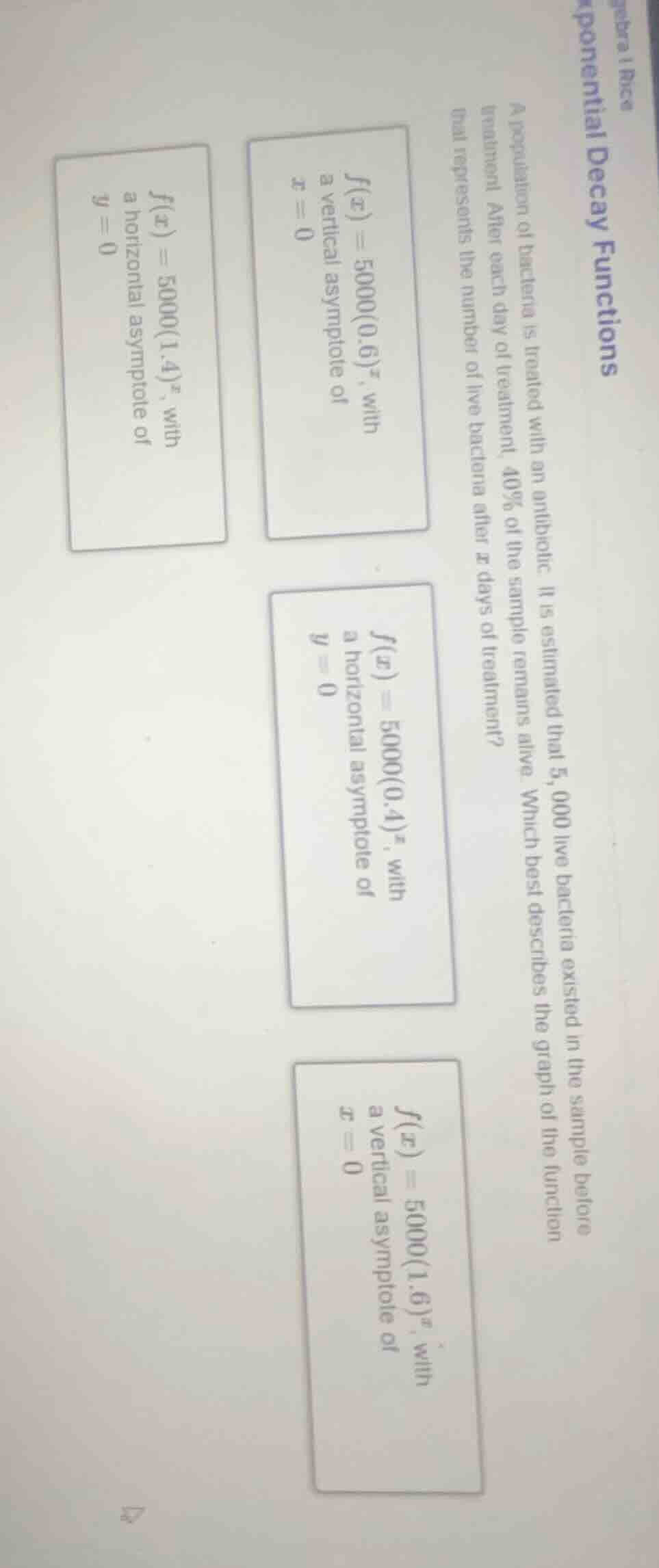
a population of bacteria is treated with an antibiotic. it is estimated that 5,000 live bacteria existed in the sample before
treatment. after each day of treatment, 40% of the sample remains alive. which best describes the graph of the function
that represents the number of live bacteria after x days of treatment?
$f(x) = 5000(0.6)^x$, with
a vertical asymptote of
$x = 0$
$f(x) = 5000(0.4)^x$, with
a horizontal asymptote of
$y = 0$
$f(x) = 5000(1.4)^x$, with
a horizontal asymptote of
$y = 0$
$f(x) = 5000(1.6)^x$, with
a vertical asymptote of
$x = 0$
Step 1: Identify the type of function
This is an exponential decay problem. The general form of an exponential decay function is \( f(x) = a(b)^x \), where \( 0 < b < 1 \), \( a \) is the initial amount, and \( x \) is the time.
Step 2: Determine the base \( b \)
We know that 40% of the bacteria remain alive each day. So the decay factor \( b \) is 0.4 (since 40% = 0.4). The initial amount \( a \) is 5000 (the initial number of live bacteria). So the function should be \( f(x)=5000(0.4)^x \).
Step 3: Analyze the asymptote
For an exponential function of the form \( f(x) = a(b)^x \) (where \( a>0 \) and \( 0 < b < 1 \) for decay), the horizontal asymptote is \( y = 0 \). This is because as \( x \to \infty \), \( (0.4)^x \to 0 \), so \( f(x) \to 0 \). Vertical asymptotes are not typical for exponential functions of this form (they have horizontal asymptotes, not vertical ones in the context of population decay). Also, functions with \( b>1 \) are growth functions, so \( f(x)=5000(1.4)^x \) and \( f(x)=5000(1.6)^x \) are growth functions, not decay, so they can be eliminated. The function with \( b = 0.6 \) would mean 60% remain, not 40%, so that's incorrect.

Snap & solve any problem in the app
Get step-by-step solutions on Sovi AI
Photo-based solutions with guided steps
Explore more problems and detailed explanations
\( f(x) = 5000(0.4)^x \), with a horizontal asymptote of \( y = 0 \)