QUESTION IMAGE
Question
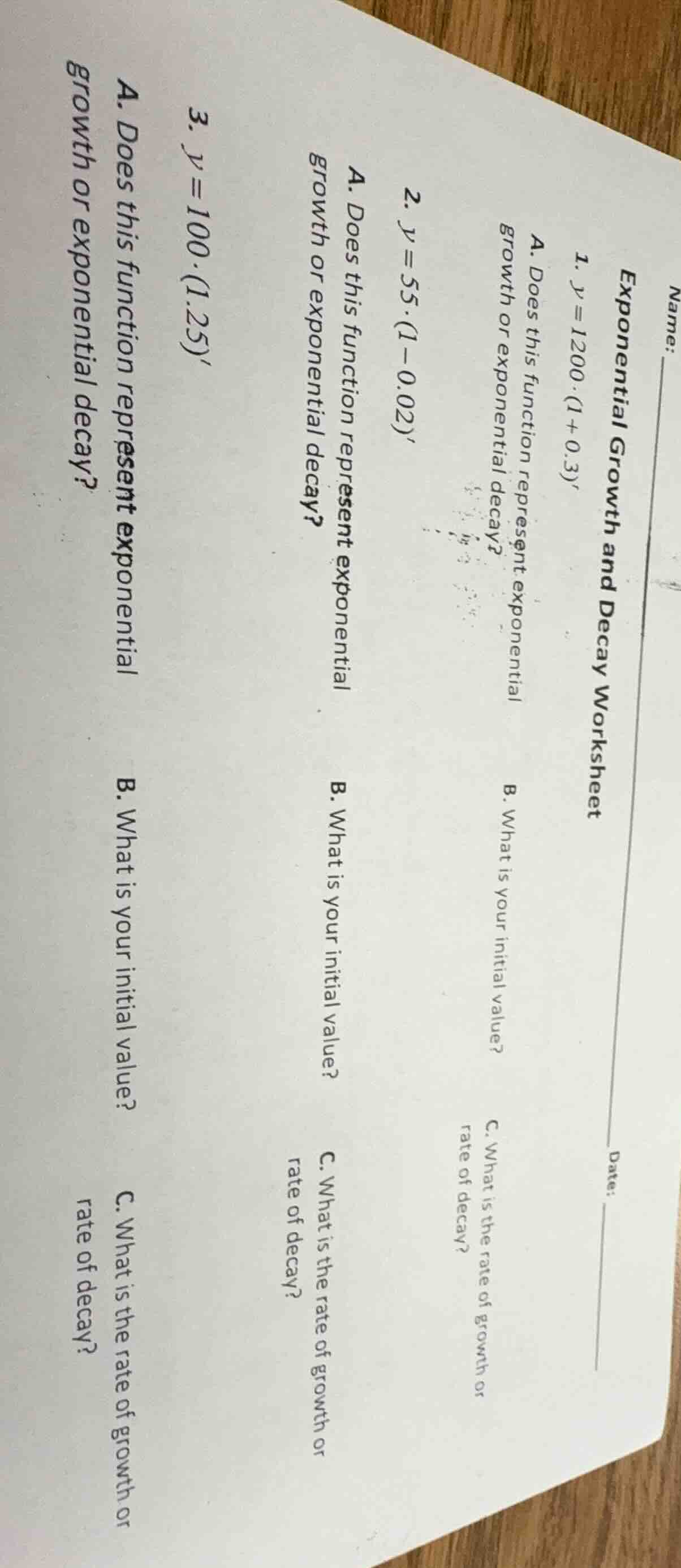
exponential growth and decay worksheet
- $y = 1200 \cdot (1 + 0.3)^t$
a. does this function represent exponential growth or exponential decay?
b. what is your initial value?
c. what is the rate of growth or rate of decay?
- $y = 55 \cdot (1 - 0.02)^t$
a. does this function represent exponential growth or exponential decay?
b. what is your initial value?
c. what is the rate of growth or rate of decay?
- $y = 100 \cdot (1.25)^t$
a. does this function represent exponential growth or exponential decay?
b. what is your initial value?
c. what is the rate of growth or rate of decay?
Problem 1: \( y = 1200 \cdot (1 + 0.3)^t \)
A. Growth or Decay?
Step 1: Analyze the base
The general form of an exponential function is \( y = a \cdot (1 + r)^t \) for growth (where \( r>0 \)) and \( y = a \cdot (1 - r)^t \) for decay (where \( r>0 \)). Here, the base is \( 1 + 0.3=1.3 \), which is greater than 1.
Step 2: Determine growth/decay
Since the base \( 1.3>1 \), this represents exponential growth.
Step 1: Recall initial value definition
The initial value of an exponential function \( y = a \cdot b^t \) is the value when \( t = 0 \). When \( t = 0 \), \( b^0=1 \), so \( y=a \).
Step 2: Identify \( a \)
In \( y = 1200 \cdot (1 + 0.3)^t \), \( a = 1200 \).
Step 1: Recall growth rate formula
For \( y = a \cdot (1 + r)^t \), \( r \) is the growth rate (in decimal). Here, \( 1 + r=1.3 \).
Step 2: Solve for \( r \)
Subtract 1 from both sides: \( r=1.3 - 1 = 0.3 \), or \( 30\% \) when converted to a percentage.

Snap & solve any problem in the app
Get step-by-step solutions on Sovi AI
Photo-based solutions with guided steps
Explore more problems and detailed explanations
Exponential Growth