QUESTION IMAGE
Question
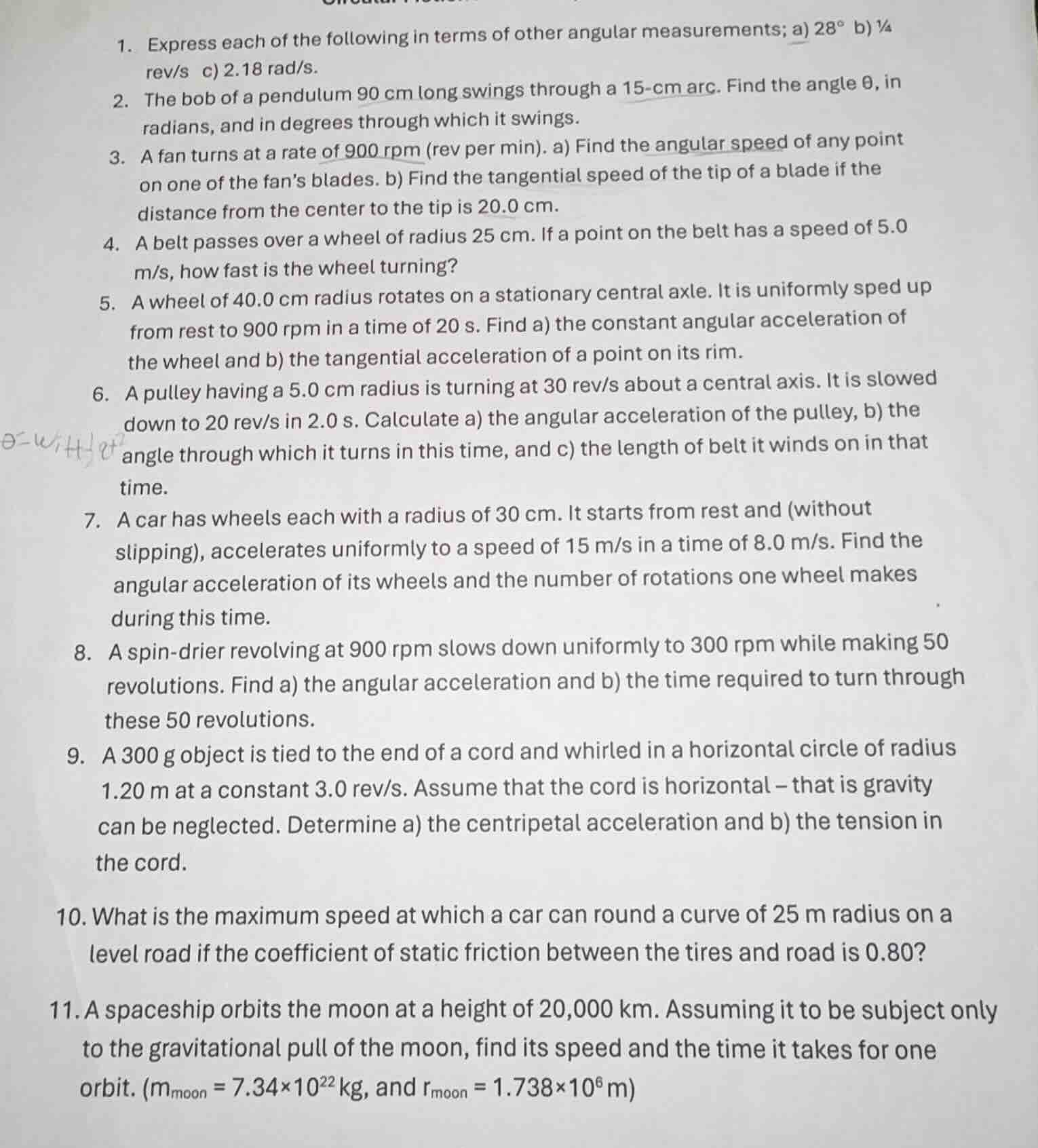
- express each of the following in terms of other angular measurements; a) 28° b) ¼ rev/s c) 2.18 rad/s.
- the bob of a pendulum 90 cm long swings through a 15 - cm arc. find the angle θ, in radians, and in degrees through which it swings.
- a fan turns at a rate of 900 rpm (rev per min). a) find the angular speed of any point on one of the fan’s blades. b) find the tangential speed of the tip of a blade if the distance from the center to the tip is 20.0 cm.
- a belt passes over a wheel of radius 25 cm. if a point on the belt has a speed of 5.0 m/s, how fast is the wheel turning?
- a wheel of 40.0 cm radius rotates on a stationary central axle. it is uniformly sped up from rest to 900 rpm in a time of 20 s. find a) the constant angular acceleration of the wheel and b) the tangential acceleration of a point on its rim.
- a pulley having a 5.0 cm radius is turning at 30 rev/s about a central axis. it is slowed down to 20 rev/s in 2.0 s. calculate a) the angular acceleration of the pulley, b) the angle through which it turns in this time, and c) the length of belt it winds on in that time.
- a car has wheels each with a radius of 30 cm. it starts from rest and (without slipping), accelerates uniformly to a speed of 15 m/s in a time of 8.0 s. find the angular acceleration of its wheels and the number of rotations one wheel makes during this time.
- a spin - drier revolving at 900 rpm slows down uniformly to 300 rpm while making 50 revolutions. find a) the angular acceleration and b) the time required to turn through these 50 revolutions.
- a 300 g object is tied to the end of a cord and whirled in a horizontal circle of radius 1.20 m at a constant 3.0 rev/s. assume that the cord is horizontal – that is gravity can be neglected. determine a) the centripetal acceleration and b) the tension in the cord.
- what is the maximum speed at which a car can round a curve of 25 m radius on a level road if the coefficient of static friction between the tires and road is 0.80?
- a spaceship orbits the moon at a height of 20,000 km. assuming it to be subject only to the gravitational pull of the moon, find its speed and the time it takes for one orbit. ($m_{moon}=7.34×10^{22}kg$, and $r_{moon}=1.738×10^{6}m$)
To solve these problems, we'll use concepts from Physics (specifically, rotational motion and circular motion). Let's tackle a few problems step-by-step.
Problem 2: Pendulum Angle
The bob of a pendulum 90 cm long swings through a 15-cm arc. Find the angle \( \theta \) in radians and degrees.
Step 1: Recall the arc length formula
The arc length \( s \) is related to the radius \( r \) and angle \( \theta \) (in radians) by \( s = r\theta \).
Step 2: Solve for \( \theta \) (radians)
Given \( s = 15 \, \text{cm} \), \( r = 90 \, \text{cm} \):
\[
\theta = \frac{s}{r} = \frac{15}{90} = \frac{1}{6} \approx 0.1667 \, \text{radians}
\]
Step 3: Convert radians to degrees
Use \( 1 \, \text{radian} = \frac{180^\circ}{\pi} \):
\[
\theta_{\text{degrees}} = \theta \times \frac{180^\circ}{\pi} = \frac{1}{6} \times \frac{180^\circ}{\pi} \approx 9.55^\circ
\]
Problem 3: Fan Angular Speed
A fan turns at 900 rpm.
Part (a): Angular speed \( \omega \)
Angular speed in radians per second:
- \( 1 \, \text{rev} = 2\pi \, \text{radians} \)
- \( 1 \, \text{min} = 60 \, \text{s} \)
\[
\omega = 900 \, \frac{\text{rev}}{\text{min}} \times \frac{2\pi \, \text{rad}}{\text{rev}} \times \frac{1 \, \text{min}}{60 \, \text{s}} = 30\pi \approx 94.25 \, \text{rad/s}
\]
Part (b): Tangential speed \( v \)
Tangential speed \( v = r\omega \), where \( r = 20.0 \, \text{cm} = 0.20 \, \text{m} \):
\[
v = 0.20 \, \text{m} \times 30\pi \, \text{rad/s} \approx 18.85 \, \text{m/s}
\]
Problem 10: Maximum Speed on a Curve
A car rounds a 25-m radius curve. The coefficient of static friction \( \mu_s = 0.80 \). Find the maximum speed.
Step 1: Centripetal force from friction
The maximum centripetal force is provided by static friction: \( F_c = f_s = \mu_s N \). For a level road, \( N = mg \) (normal force equals weight). Thus:
\[
\frac{mv^2}{r} = \mu_s mg
\]
Step 2: Solve for \( v \)
Cancel \( m \) from both sides:
\[
\frac{v^2}{r} = \mu_s g \implies v = \sqrt{\mu_s g r}
\]
Step 3: Substitute values
\( g = 9.8 \, \text{m/s}^2 \), \( r = 25 \, \text{m} \), \( \mu_s = 0.80 \):
\[
v = \sqrt{0.80 \times 9.8 \times 25} = \sqrt{196} = 14 \, \text{m/s}
\]
Final Answers (Selected Problems)
- Problem 2: \( \theta \approx \boldsymbol{0.167 \, \text{rad}} \) or \( \boldsymbol{9.55^\circ} \)
- Problem 3a: Angular speed \( \boldsymbol{\approx 94.3 \, \text{rad/s}} \)
- Problem 3b: Tangential speed \( \boldsymbol{\approx 18.9 \, \text{m/s}} \)
- Problem 10: Maximum speed \( \boldsymbol{14 \, \text{m/s}} \)
For other problems, follow similar steps using rotational/circular motion formulas (e.g., \( \omega = \frac{\Delta \theta}{\Delta t} \), \( \alpha = \frac{\Delta \omega}{\Delta t} \), \( v = r\omega \), \( a_t = r\alpha \), \( a_c = \frac{v^2}{r} \), etc.).

Snap & solve any problem in the app
Get step-by-step solutions on Sovi AI
Photo-based solutions with guided steps
Explore more problems and detailed explanations
To solve these problems, we'll use concepts from Physics (specifically, rotational motion and circular motion). Let's tackle a few problems step-by-step.
Problem 2: Pendulum Angle
The bob of a pendulum 90 cm long swings through a 15-cm arc. Find the angle \( \theta \) in radians and degrees.
Step 1: Recall the arc length formula
The arc length \( s \) is related to the radius \( r \) and angle \( \theta \) (in radians) by \( s = r\theta \).
Step 2: Solve for \( \theta \) (radians)
Given \( s = 15 \, \text{cm} \), \( r = 90 \, \text{cm} \):
\[
\theta = \frac{s}{r} = \frac{15}{90} = \frac{1}{6} \approx 0.1667 \, \text{radians}
\]
Step 3: Convert radians to degrees
Use \( 1 \, \text{radian} = \frac{180^\circ}{\pi} \):
\[
\theta_{\text{degrees}} = \theta \times \frac{180^\circ}{\pi} = \frac{1}{6} \times \frac{180^\circ}{\pi} \approx 9.55^\circ
\]
Problem 3: Fan Angular Speed
A fan turns at 900 rpm.
Part (a): Angular speed \( \omega \)
Angular speed in radians per second:
- \( 1 \, \text{rev} = 2\pi \, \text{radians} \)
- \( 1 \, \text{min} = 60 \, \text{s} \)
\[
\omega = 900 \, \frac{\text{rev}}{\text{min}} \times \frac{2\pi \, \text{rad}}{\text{rev}} \times \frac{1 \, \text{min}}{60 \, \text{s}} = 30\pi \approx 94.25 \, \text{rad/s}
\]
Part (b): Tangential speed \( v \)
Tangential speed \( v = r\omega \), where \( r = 20.0 \, \text{cm} = 0.20 \, \text{m} \):
\[
v = 0.20 \, \text{m} \times 30\pi \, \text{rad/s} \approx 18.85 \, \text{m/s}
\]
Problem 10: Maximum Speed on a Curve
A car rounds a 25-m radius curve. The coefficient of static friction \( \mu_s = 0.80 \). Find the maximum speed.
Step 1: Centripetal force from friction
The maximum centripetal force is provided by static friction: \( F_c = f_s = \mu_s N \). For a level road, \( N = mg \) (normal force equals weight). Thus:
\[
\frac{mv^2}{r} = \mu_s mg
\]
Step 2: Solve for \( v \)
Cancel \( m \) from both sides:
\[
\frac{v^2}{r} = \mu_s g \implies v = \sqrt{\mu_s g r}
\]
Step 3: Substitute values
\( g = 9.8 \, \text{m/s}^2 \), \( r = 25 \, \text{m} \), \( \mu_s = 0.80 \):
\[
v = \sqrt{0.80 \times 9.8 \times 25} = \sqrt{196} = 14 \, \text{m/s}
\]
Final Answers (Selected Problems)
- Problem 2: \( \theta \approx \boldsymbol{0.167 \, \text{rad}} \) or \( \boldsymbol{9.55^\circ} \)
- Problem 3a: Angular speed \( \boldsymbol{\approx 94.3 \, \text{rad/s}} \)
- Problem 3b: Tangential speed \( \boldsymbol{\approx 18.9 \, \text{m/s}} \)
- Problem 10: Maximum speed \( \boldsymbol{14 \, \text{m/s}} \)
For other problems, follow similar steps using rotational/circular motion formulas (e.g., \( \omega = \frac{\Delta \theta}{\Delta t} \), \( \alpha = \frac{\Delta \omega}{\Delta t} \), \( v = r\omega \), \( a_t = r\alpha \), \( a_c = \frac{v^2}{r} \), etc.).