QUESTION IMAGE
Question
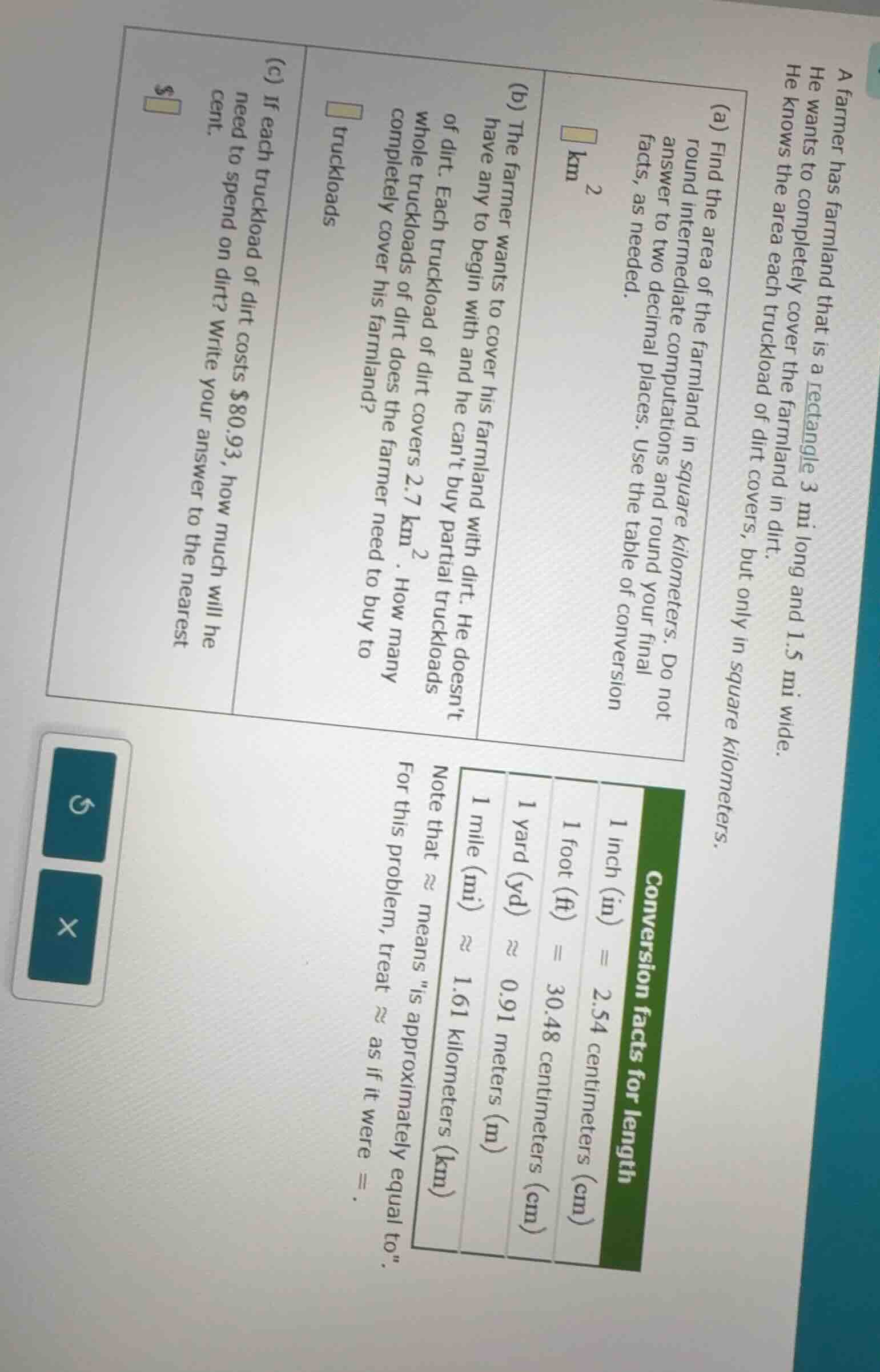
a farmer has farmland that is a rectangle 3 mi long and 1.5 mi wide. he wants to completely cover the farmland in dirt. he knows the area each truckload of dirt covers, but only in square kilometers.
(a) find the area of the farmland in square kilometers. do not round intermediate computations and round your final answer to two decimal places. use the table of conversion facts, as needed.
(b) the farmer wants to cover his farmland with dirt. he doesnt have any to begin with and he cant buy partial truckloads of dirt. each truckload of dirt covers 2.7 km². how many whole truckloads of dirt does the farmer need to buy to completely cover his farmland?
(c) if each truckload of dirt costs $80.93, how much will he need to spend on dirt? write your answer to the nearest cent.
conversion facts for length
1 inch (in) = 2.54 centimeters (cm)
1 foot (ft) = 30.48 centimeters (cm)
1 yard (yd) ≈ 0.91 meters (m)
1 mile (mi) ≈ 1.61 kilometers (km)
note that ≈ means \is approximately equal to\. for this problem, treat ≈ as if it were =.
Part (a)
Step1: Find area in square miles
The farmland is a rectangle with length \( l = 3\) mi and width \( w = 1.5\) mi. The area of a rectangle is \( A = l\times w\). So, \( A_{\text{mi}^2}=3\times1.5 = 4.5\) square miles.
Step2: Convert square miles to square kilometers
We know that \( 1\) mi \( \approx 1.61\) km, so \( 1\) square mile \( \approx(1.61)^2\) square kilometers. Then, \( A_{\text{km}^2}=4.5\times(1.61)^2\). First, calculate \( (1.61)^2=2.5921\). Then, \( 4.5\times2.5921 = 11.66445\approx11.66\) square kilometers.
Step1: Divide total area by truckload area
We have the total area \( A = 11.66\) \( \text{km}^2\) (from part a) and each truckload covers \( 2.7\) \( \text{km}^2\). So, the number of truckloads \( n=\frac{11.66}{2.7}\approx4.32\). But since we can't buy partial truckloads, we need to round up to the next whole number. So, \( n = 5\) (because \( 4\) truckloads would cover \( 4\times2.7 = 10.8\) \( \text{km}^2\), which is less than \( 11.66\) \( \text{km}^2\), and \( 5\) truckloads cover \( 5\times2.7 = 13.5\) \( \text{km}^2\) which is enough).
Step1: Calculate total cost
Each truckload costs \( \$80.93\) and we need \( 5\) truckloads (from part b). So, the total cost \( C = 5\times80.93=\$404.65\).

Snap & solve any problem in the app
Get step-by-step solutions on Sovi AI
Photo-based solutions with guided steps
Explore more problems and detailed explanations
\( 11.66\)