QUESTION IMAGE
Question
fermentation
when yeast cells run low on oxygen
- ____ and __ are made during fermentation in ____ cells
- bread rises when yeast inside the bread produces ______.
word bank:
carbon dioxide
glycolysis
oxygen
cytoplasm
yeast
ethanol
chemical structure of pyruvate
arrow to a chemical structure, then to a box
arrow to a chemical structure, then to a box
why cells need fermentation when oxygen is low?
- ____ can be performed without ____
- fermentation takes place in the ______
image of a hockey player
when human cells (like muscles) run low on oxygen
- ____ is made during fermentation in human ____ cells.
- lactic acid can build up in muscles and cause ______.
- lactic acid is transported by the ____ to the __ and can be converted into ____.
word bank:
muscle
lactic acid
bloodstream
soreness
glucose
liver
chemical structure of pyruvate
arrow to a chemical structure, then to a box
name:
© bethany lau
Part 1: Yeast Fermentation (Top - Left and Middle)
When yeast cells run low on oxygen:
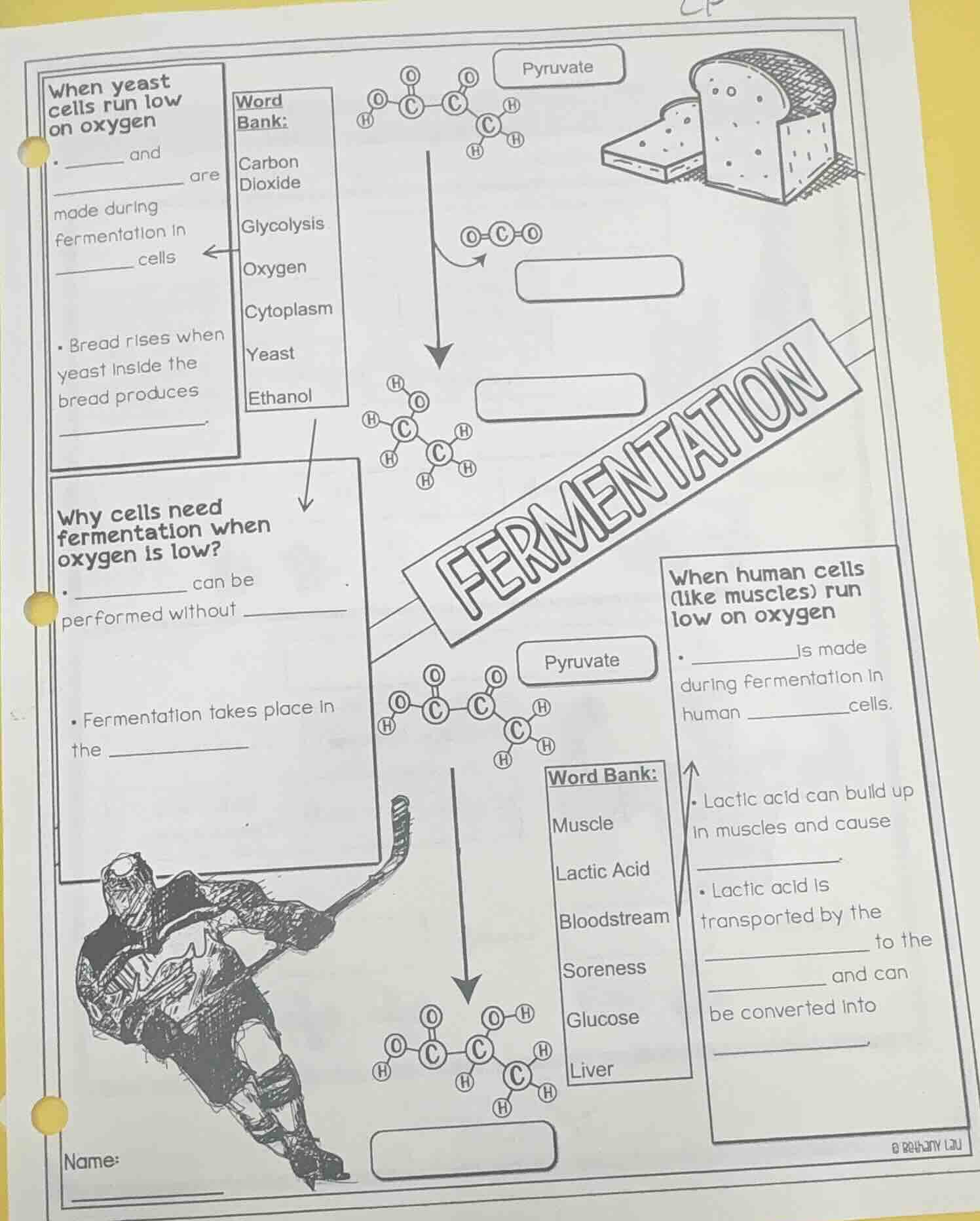
- The products of yeast fermentation are Ethanol and Carbon Dioxide, and this occurs in Yeast cells. Bread rises because yeast produces Carbon Dioxide (the gas creates bubbles in the dough).
Why cells need fermentation when oxygen is low:
- Glycolysis (the first part of cellular respiration) can be performed without Oxygen, and fermentation takes place in the Cytoplasm of the cell.
Chemical Reactions (Middle - Top):
- The first product from pyruvate (the 3 - carbon molecule) is Carbon Dioxide (the \( \text{O}=\text{C}=\text{O} \) structure), and the second product is Ethanol (the 2 - carbon alcohol structure).
Part 2: Human (Muscle) Fermentation (Bottom - Right and Middle)
When human cells (like muscles) run low on oxygen:
- Lactic Acid is made during fermentation in human Muscle cells. Lactic acid build - up in muscles causes Soreness. Lactic acid is transported by the Bloodstream to the Liver, where it can be converted into Glucose.
Chemical Reaction (Middle - Bottom):
- The product of pyruvate in human muscle fermentation is Lactic Acid (the structure with an additional \( -\text{OH} \) group compared to pyruvate).
Filling the Blanks (Summarized):
- Yeast Fermentation Section:
- When yeast cells run low on oxygen: \(\boldsymbol{\text{Ethanol}}\) and \(\boldsymbol{\text{Carbon Dioxide}}\) are made during fermentation in \(\boldsymbol{\text{Yeast}}\) cells. Bread rises when yeast inside the bread produces \(\boldsymbol{\text{Carbon Dioxide}}\).
- Why cells need fermentation when oxygen is low: \(\boldsymbol{\text{Glycolysis}}\) can be performed without \(\boldsymbol{\text{Oxygen}}\). Fermentation takes place in the \(\boldsymbol{\text{Cytoplasm}}\).
- Chemical products from pyruvate: First blank (gas): \(\boldsymbol{\text{Carbon Dioxide}}\); Second blank (alcohol): \(\boldsymbol{\text{Ethanol}}\).
- Human Fermentation Section:
- When human cells (like muscles) run low on oxygen: \(\boldsymbol{\text{Lactic Acid}}\) is made during fermentation in human \(\boldsymbol{\text{Muscle}}\) cells. Lactic acid can build up in muscles and cause \(\boldsymbol{\text{Soreness}}\). Lactic acid is transported by the \(\boldsymbol{\text{Bloodstream}}\) to the \(\boldsymbol{\text{Liver}}\) and can be converted into \(\boldsymbol{\text{Glucose}}\).
- Chemical product from pyruvate: \(\boldsymbol{\text{Lactic Acid}}\).
Final Answers (Filling the Blanks in Order as per the Worksheet):
- When yeast cells run low on oxygen: \(\boldsymbol{\text{Ethanol}}\); \(\boldsymbol{\text{Carbon Dioxide}}\); \(\boldsymbol{\text{Yeast}}\); \(\boldsymbol{\text{Carbon Dioxide}}\)
- Why cells need fermentation when oxygen is low: \(\boldsymbol{\text{Glycolysis}}\); \(\boldsymbol{\text{Oxygen}}\); \(\boldsymbol{\text{Cytoplasm}}\)
- Yeast fermentation chemical products: \(\boldsymbol{\text{Carbon Dioxide}}\); \(\boldsymbol{\text{Ethanol}}\)
- Human fermentation: \(\boldsymbol{\text{Lactic Acid}}\); \(\boldsymbol{\text{Muscle}}\); \(\boldsymbol{\text{Soreness}}\); \(\boldsymbol{\text{Bloodstream}}\); \(\boldsymbol{\text{Liver}}\); \(\boldsymbol{\text{Glucose}}\)
- Human fermentation chemical product: \(\boldsymbol{\text{Lactic Acid}}\)
(Note: The order of filling may vary slightly depending on the exact blank positions in the original worksheet, but the above answers cover all the key concepts and structures related to yeast and human muscle fermentation.)

Snap & solve any problem in the app
Get step-by-step solutions on Sovi AI
Photo-based solutions with guided steps
Explore more problems and detailed explanations
Part 1: Yeast Fermentation (Top - Left and Middle)
When yeast cells run low on oxygen:
- The products of yeast fermentation are Ethanol and Carbon Dioxide, and this occurs in Yeast cells. Bread rises because yeast produces Carbon Dioxide (the gas creates bubbles in the dough).
Why cells need fermentation when oxygen is low:
- Glycolysis (the first part of cellular respiration) can be performed without Oxygen, and fermentation takes place in the Cytoplasm of the cell.
Chemical Reactions (Middle - Top):
- The first product from pyruvate (the 3 - carbon molecule) is Carbon Dioxide (the \( \text{O}=\text{C}=\text{O} \) structure), and the second product is Ethanol (the 2 - carbon alcohol structure).
Part 2: Human (Muscle) Fermentation (Bottom - Right and Middle)
When human cells (like muscles) run low on oxygen:
- Lactic Acid is made during fermentation in human Muscle cells. Lactic acid build - up in muscles causes Soreness. Lactic acid is transported by the Bloodstream to the Liver, where it can be converted into Glucose.
Chemical Reaction (Middle - Bottom):
- The product of pyruvate in human muscle fermentation is Lactic Acid (the structure with an additional \( -\text{OH} \) group compared to pyruvate).
Filling the Blanks (Summarized):
- Yeast Fermentation Section:
- When yeast cells run low on oxygen: \(\boldsymbol{\text{Ethanol}}\) and \(\boldsymbol{\text{Carbon Dioxide}}\) are made during fermentation in \(\boldsymbol{\text{Yeast}}\) cells. Bread rises when yeast inside the bread produces \(\boldsymbol{\text{Carbon Dioxide}}\).
- Why cells need fermentation when oxygen is low: \(\boldsymbol{\text{Glycolysis}}\) can be performed without \(\boldsymbol{\text{Oxygen}}\). Fermentation takes place in the \(\boldsymbol{\text{Cytoplasm}}\).
- Chemical products from pyruvate: First blank (gas): \(\boldsymbol{\text{Carbon Dioxide}}\); Second blank (alcohol): \(\boldsymbol{\text{Ethanol}}\).
- Human Fermentation Section:
- When human cells (like muscles) run low on oxygen: \(\boldsymbol{\text{Lactic Acid}}\) is made during fermentation in human \(\boldsymbol{\text{Muscle}}\) cells. Lactic acid can build up in muscles and cause \(\boldsymbol{\text{Soreness}}\). Lactic acid is transported by the \(\boldsymbol{\text{Bloodstream}}\) to the \(\boldsymbol{\text{Liver}}\) and can be converted into \(\boldsymbol{\text{Glucose}}\).
- Chemical product from pyruvate: \(\boldsymbol{\text{Lactic Acid}}\).
Final Answers (Filling the Blanks in Order as per the Worksheet):
- When yeast cells run low on oxygen: \(\boldsymbol{\text{Ethanol}}\); \(\boldsymbol{\text{Carbon Dioxide}}\); \(\boldsymbol{\text{Yeast}}\); \(\boldsymbol{\text{Carbon Dioxide}}\)
- Why cells need fermentation when oxygen is low: \(\boldsymbol{\text{Glycolysis}}\); \(\boldsymbol{\text{Oxygen}}\); \(\boldsymbol{\text{Cytoplasm}}\)
- Yeast fermentation chemical products: \(\boldsymbol{\text{Carbon Dioxide}}\); \(\boldsymbol{\text{Ethanol}}\)
- Human fermentation: \(\boldsymbol{\text{Lactic Acid}}\); \(\boldsymbol{\text{Muscle}}\); \(\boldsymbol{\text{Soreness}}\); \(\boldsymbol{\text{Bloodstream}}\); \(\boldsymbol{\text{Liver}}\); \(\boldsymbol{\text{Glucose}}\)
- Human fermentation chemical product: \(\boldsymbol{\text{Lactic Acid}}\)
(Note: The order of filling may vary slightly depending on the exact blank positions in the original worksheet, but the above answers cover all the key concepts and structures related to yeast and human muscle fermentation.)