QUESTION IMAGE
Question
final question:
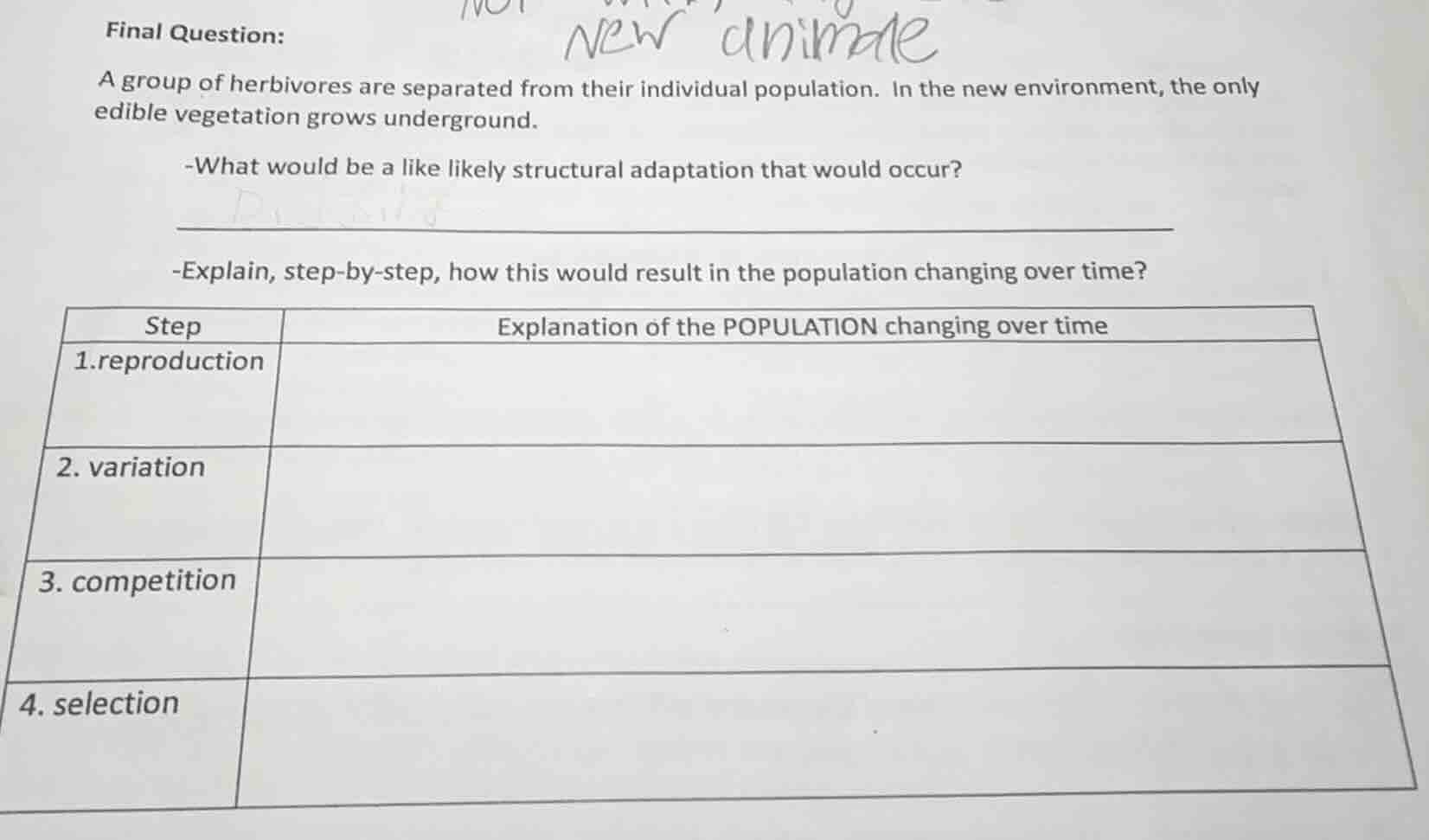
a group of herbivores are separated from their individual population. in the new environment, the only edible vegetation grows underground.
-what would be a like likely structural adaptation that would occur?
-explain, step-by-step, how this would result in the population changing over time?
| step | explanation of the population changing over time |
|---|---|
| 2. variation | |
| 3. competition | |
| 4. selection |
Brief Explanations
For the structural adaptation: The herbivores would likely evolve longer, stronger digging appendages (such as elongated claws, snouts, or tusks) to access the underground vegetation.
For the population change steps:
- Reproduction: The herbivores produce offspring, passing on their genetic traits.
- Variation: Among the offspring, there is natural genetic variation in the size/strength of digging structures. Some individuals have better digging adaptations than others.
- Competition: All individuals compete for the underground vegetation. Those with more effective digging structures can access more food.
- Selection: Individuals with superior digging traits are more likely to survive, stay healthy, and reproduce, passing these beneficial traits to their offspring. Over generations, the proportion of the population with these digging adaptations increases.

Snap & solve any problem in the app
Get step-by-step solutions on Sovi AI
Photo-based solutions with guided steps
Explore more problems and detailed explanations
- Likely structural adaptation: Longer, stronger digging structures (e.g., elongated claws, snouts, or tusks) to access underground vegetation.
- Population change over time:
- Reproduction: Herbivores produce offspring, passing on genes.
- Variation: Offspring have varied digging structure traits.
- Competition: Individuals compete for underground food.
- Selection: Better diggers survive/reproduce more, shifting the population to have more effective digging adaptations over generations.