QUESTION IMAGE
Question
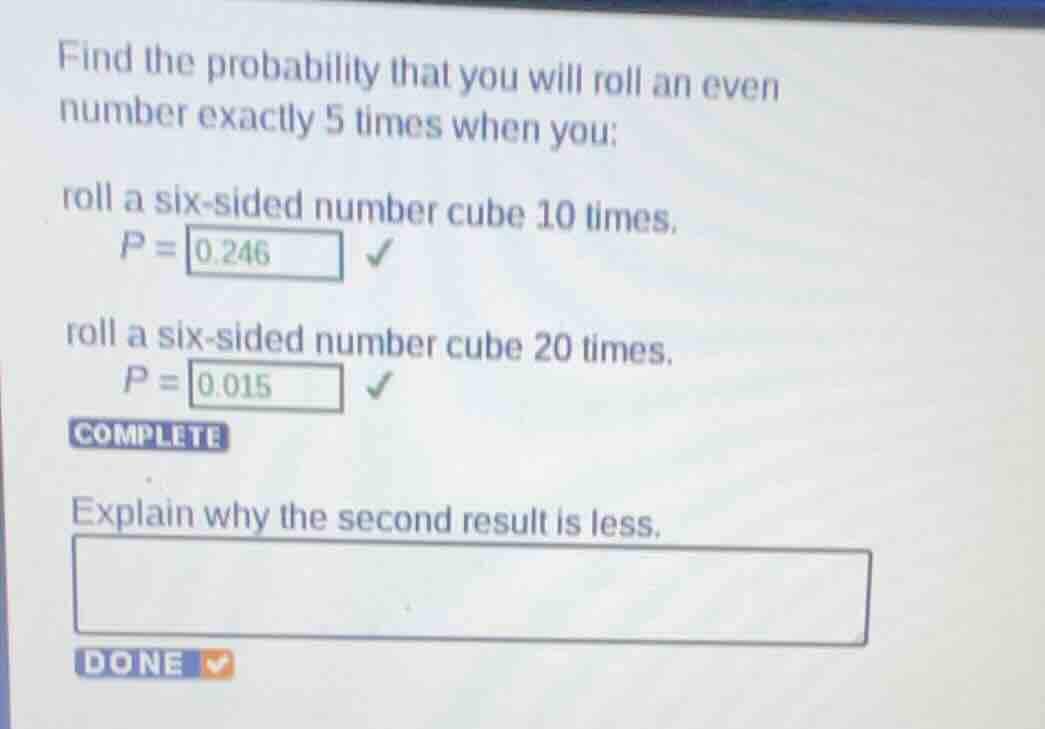
find the probability that you will roll an even number exactly 5 times when you: roll a six - sided number cube 10 times, p = 0.246 roll a six - sided number cube 20 times, p = 0.015 complete explain why the second result is less.
When rolling a fair six-sided die, the probability of rolling an even number on a single roll is $\frac{1}{2}$. For a binomial distribution (fixed independent trials with two outcomes), the mean number of even rolls for $n$ trials is $\mu = n \times \frac{1}{2}$. For 10 rolls, the mean is 5 even numbers; for 20 rolls, the mean is 10 even numbers. The probability of getting exactly 5 even rolls is highest near the mean of the 10-trial distribution, but 5 is far below the mean of the 20-trial distribution. Probabilities in a binomial distribution are concentrated near the mean, so outcomes far from the mean have lower probabilities.

Snap & solve any problem in the app
Get step-by-step solutions on Sovi AI
Photo-based solutions with guided steps
Explore more problems and detailed explanations
When rolling 20 times, the expected (average) number of even rolls is 10. Getting exactly 5 even rolls is far below this expected value, while for 10 rolls, 5 even rolls is exactly the expected value. Probabilities in this scenario are highest near the expected number of successes, so the probability of 5 even rolls is much lower when rolling 20 times compared to 10 times.