QUESTION IMAGE
Question
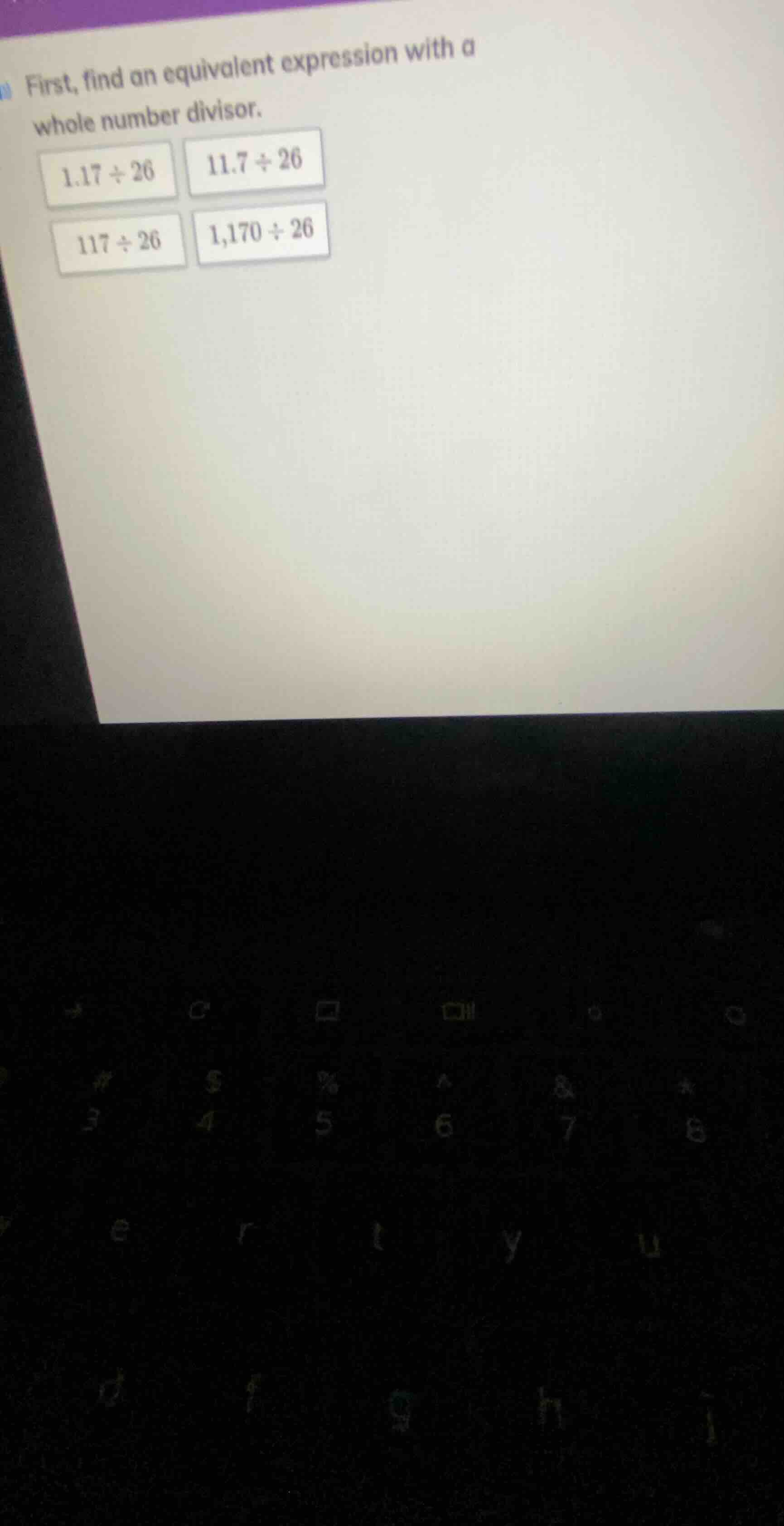
first, find an equivalent expression with a whole number divisor. 1.17 ÷ 26 11.7 ÷ 26 117 ÷ 26 1,170 ÷ 26
To find an equivalent expression with a whole number divisor, we need to make the dividend a whole number while keeping the division equivalent. This is done by multiplying both the dividend and the divisor by the same power of 10 to eliminate the decimal in the dividend.
Step 1: Analyze the original expression (assuming we start from a decimal dividend, e.g., if we consider a base expression like \(1.17\div26\), but let's check each option)
- For \(1.17\div26\): The dividend is a decimal. To make it a whole number, we multiply numerator and denominator by 100: \(\frac{1.17\times100}{26\times100}=\frac{117}{2600}\) (not one of the options, so maybe the base is different). Wait, maybe the intended original expression is, say, \(1.17\div2.6\) but no, the divisor here is 26 (whole number). Wait, the question is to find an equivalent expression with a whole number divisor (but 26 is already a whole number). Wait, maybe the original problem was a division with a decimal divisor, but here divisor is 26 (whole number). Wait, maybe the task is to find an equivalent expression where the dividend is a whole number (since divisor is already whole number). So we need to multiply dividend and divisor by a power of 10 to make dividend whole.
Looking at the options:
- \(1.17\div26\): dividend is 1.17 (decimal)
- \(11.7\div26\): dividend is 11.7 (decimal)
- \(117\div26\): dividend is 117 (whole number), divisor 26 (whole number)
- \(1170\div26\): dividend is 1170 (whole number), divisor 26 (whole number)
To find which is equivalent to a division where maybe the original dividend was a decimal. Let's take an example: suppose the original expression is \(1.17\div2.6\) (but no, divisor here is 26). Wait, maybe the problem is to find an equivalent expression to, say, \(1.17\div26\) with a whole number dividend. So multiply numerator and denominator by 100: \(\frac{1.17\times100}{26\times100}=\frac{117}{2600}\) – no. Wait, maybe the divisor was originally a decimal, but in the options, divisor is 26 (whole number). Wait, the question says "find an equivalent expression with a whole number divisor" – but 26 is already a whole number. So maybe it's to find an equivalent expression where the dividend is a whole number (since divisor is whole). So we need to multiply dividend and divisor by a power of 10 to eliminate decimals in dividend.
Looking at \(1.17\div26\): multiply numerator and denominator by 100: \(117\div2600\) (not an option). Wait, maybe the original expression was \(11.7\div2.6\) (divisor decimal). Let's check: \(\frac{11.7}{2.6}=\frac{11.7\times10}{2.6\times10}=\frac{117}{26}\) (which is one of the options: \(117\div26\)). Ah! So maybe the original division was \(11.7\div2.6\) (divisor 2.6, decimal), and we need to make divisor whole number by multiplying numerator and denominator by 10: \(\frac{11.7\times10}{2.6\times10}=\frac{117}{26}\), which is \(117\div26\). So among the options, \(117\div26\) is the equivalent expression with a whole number divisor (26 is whole, and dividend 117 is whole).
Step 2: Verify the equivalence
Using the property of division: \(\frac{a}{b}=\frac{a\times k}{b\times k}\) for \(k
eq0\). If we have \(11.7\div2.6\) (original, divisor decimal), multiply numerator and denominator by 10: \(\frac{11.7\times10}{2.6\times10}=\frac{117}{26}=117\div26\). So \(117\div26\) is equivalent to \(11.7\div2.6\) with a whole number divisor (26) and whole number dividend (117).

Snap & solve any problem in the app
Get step-by-step solutions on Sovi AI
Photo-based solutions with guided steps
Explore more problems and detailed explanations
\(117\div26\) (assuming the original expression was a division with a decimal divisor, and this is the equivalent with whole number divisor and dividend)