QUESTION IMAGE
Question
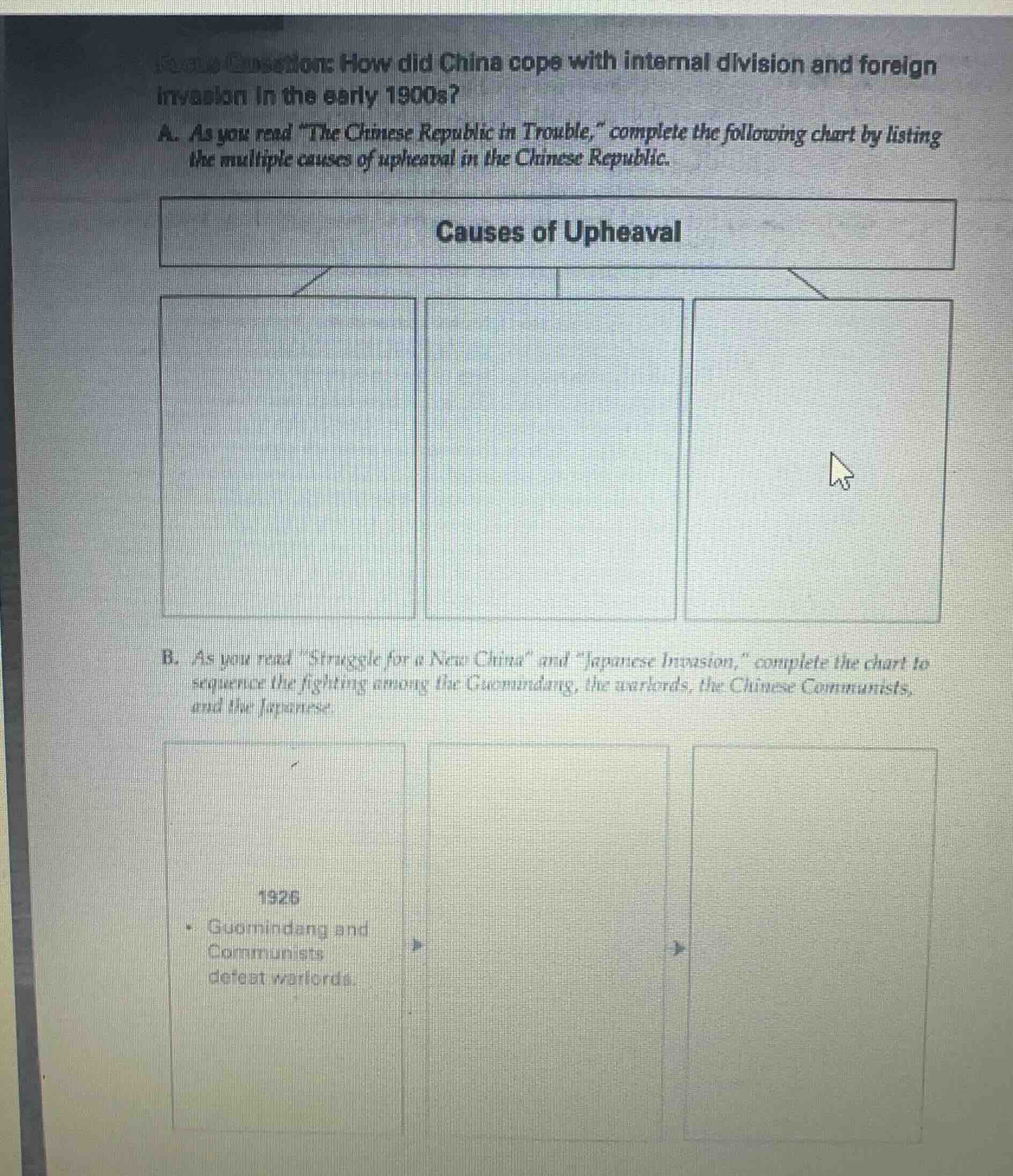
focus question: how did china cope with internal division and foreign invasion in the early 1900s? a. as you read \the chinese republic in trouble,\ complete the following chart by listing the multiple causes of upheaval in the chinese republic. causes of upheaval b. as you read \struggle for a new china\ and \japanese invasion,\ complete the chart to sequence the fighting among the guomindang, the warlords, the chinese communists, and the japanese. 1926 - guomindang and communists defeat warlords.
Part A: Causes of Upheaval in the Chinese Republic
To complete the chart for part A, we analyze the historical context of the early 1900s in China:
- Political Fragmentation: After the fall of the Qing Dynasty, warlords seized regional power, leading to internal division (e.g., warlordism, weak central government under the Republic).
- Foreign Imperialism: Continued foreign interference (e.g., Japanese aggression, unequal treaties with Western powers) undermined sovereignty and economic stability.
- Social and Economic Turmoil: Peasant unrest due to land inequality, inflation, and poverty; urban discontent from industrial exploitation and foreign economic dominance.
- Ideological Conflicts: Struggles between nationalists (Guomindang), communists, and traditional/conservative factions over China’s future.
Part B: Sequencing the Fighting (1926 Onward)
Using historical timelines of the Chinese Civil War and Japanese invasion:
- 1926: Guomindang (KMT) and Communists (CCP) form the First United Front to defeat warlords (Northern Expedition).
- Late 1920s–1930s: KMT turns on CCP (White Terror, Long March), while Japan invades Manchuria (1931) and expands (1937 Full-Scale War).
- 1937–1945: KMT and CCP temporarily unite against Japanese invasion (Second United Front), though tensions persist.
- 1945–1949: Civil War resumes; CCP defeats KMT, leading to the founding of the PRC (1949).

Snap & solve any problem in the app
Get step-by-step solutions on Sovi AI
Photo-based solutions with guided steps
Explore more problems and detailed explanations
s (Filled Charts)
Part A: Causes of Upheaval
| Category | Causes |
|---|---|
| Foreign | Japanese invasion (Manchuria, 1931), Western imperialist influence. |
| Social/Economic | Peasant poverty/land inequality, urban unrest, inflation. |
| Ideological | Conflicts between KMT, CCP, and traditional ideologies. |
Part B: Fighting Sequence (1926 Onward)
| Year/Period | Event |
|---|---|
| 1927–1936 | KMT-CCP civil war (CCP retreats in Long March); Japan invades Manchuria (1931). |
| 1937–1945 | KMT-CCP unite against Japan (Second United Front); WWII/Chinese resistance. |
| 1945–1949 | Civil war resumes; CCP wins, KMT flees to Taiwan. |
These answers align with historical events of China’s early 20th-century struggles against internal division and foreign invasion.