QUESTION IMAGE
Question
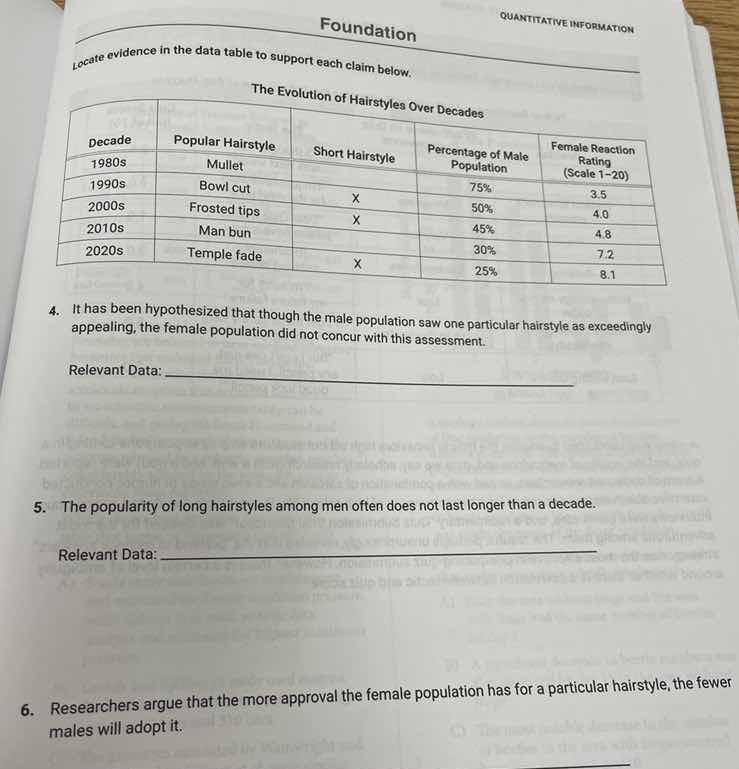
foundationquantitative informationlocate evidence in the data table to support each claim below.the evolution of hairstyles over decades| decade | popular hairstyle | short hairstyle | percentage of male population | female reaction rating (scale 1-20) || ---- | ---- | ---- | ---- | ---- || 1980s | mullet | | 75% | 3.5 || 1990s | bowl cut | x | 50% | 4.0 || 2000s | frosted tips | x | 45% | 4.8 || 2010s | man bun | | 30% | 7.2 || 2020s | temple fade | x | 25% | 8.1 |4. it has been hypothesized that though the male population saw one particular hairstyle as exceedingly appealing, the female population did not concur with this assessment.relevant data: _____________5. the popularity of long hairstyles among men often does not last longer than a decade.relevant data: _____________6. researchers argue that the more approval the female population has for a particular hairstyle, the fewer males will adopt it.
For question 4: Identify the hairstyle with the highest male popularity percentage but low female rating. The 1980s Mullet has 75% male adoption (highest) but a female rating of 1.20 (lowest), showing disagreement.
For question 5: Check the duration of long popular hairstyles. The 1980s Mullet (long) only appears in the 1980s, no later decades, so it lasted one decade.
For question 6: Correlate female rating and male adoption percentage. As female rating increases (1.20 → 8.1), male adoption percentage decreases (75% → 25%), matching the claim.

Snap & solve any problem in the app
Get step-by-step solutions on Sovi AI
Photo-based solutions with guided steps
Explore more problems and detailed explanations
- Relevant Data: 1980s: Mullet, 75% male population, female rating 1.20
- Relevant Data: 1980s: Mullet (long hairstyle) only appears in the 1980s, no subsequent decades
- Relevant Data: 1980s (75% male, 1.20 rating); 1990s (50% male, 3.5 rating); 2000s (45% male, 4.0 rating); 2010s (30% male, 7.2 rating); 2020s (25% male, 8.1 rating)