QUESTION IMAGE
Question
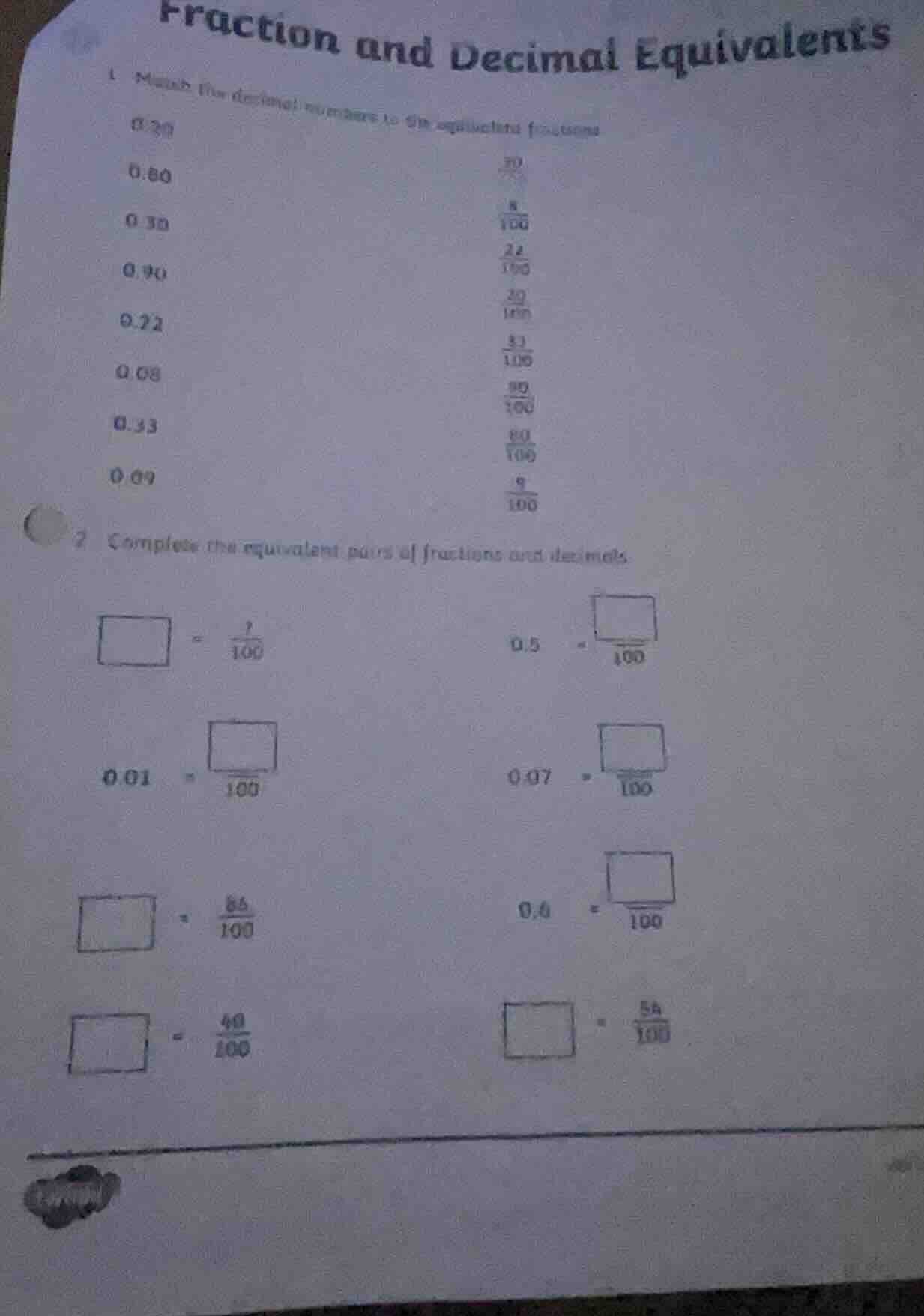
fraction and decimal equivalents
1 match the decimal numbers to the equivalent fractions
0.30
0.80
0.30
0.90
0.22
0.08
0.33
0.09
$\frac{30}{100}$
$\frac{8}{100}$
$\frac{22}{100}$
$\frac{30}{100}$
$\frac{33}{100}$
$\frac{80}{100}$
$\frac{90}{100}$
$\frac{9}{100}$
2 complete the equivalent pairs of fractions and decimals.
$\square = \frac{7}{100}$
$0.5 = \frac{\square}{100}$
$0.01 = \frac{\square}{100}$
$0.97 = \frac{\square}{100}$
$\square = \frac{86}{100}$
$0.6 = \frac{\square}{100}$
$\square = \frac{40}{100}$
$\square = \frac{54}{100}$
Problem 2 Solutions (Completing Equivalent Pairs)
To solve these, we use the rule: A decimal \( 0.a \) (where \( a \) is a number) is equivalent to \( \frac{a}{100} \) when considering hundredths place, and a fraction \( \frac{b}{100} \) is equivalent to the decimal \( 0.b \) (where \( b \) is the numerator, treated as a two - digit number, with leading zero if needed for place - value).
1. \( \square=\frac{7}{100} \)
Step1: Recall decimal - fraction conversion
A fraction with denominator 100 can be written as a decimal by dividing the numerator by 100. For \( \frac{7}{100} \), we do \( 7\div100 \).
Step2: Perform the division
\( 7\div100 = 0.07 \)
So the decimal equivalent of \( \frac{7}{100} \) is \( 0.07 \).
2. \( 0.5=\frac{\square}{100} \)
Step1: Recall fraction - decimal conversion
A decimal \( 0.5 \) (which is in the tenths place) can be converted to a fraction with denominator 100 by multiplying both the numerator and denominator of the fraction equivalent of the tenths place by 10. The fraction equivalent of \( 0.5 \) is \( \frac{5}{10} \). To get a denominator of 100, we multiply numerator and denominator by 10: \( \frac{5\times10}{10\times10}=\frac{50}{100} \). Or, since \( 0.5=\frac{5}{10} \), and to make the denominator 100, we know that \( 0.5=\frac{x}{100} \), so \( x = 0.5\times100 \).
Step2: Calculate \( x \)
\( 0.5\times100=50 \)
So \( 0.5=\frac{50}{100} \).
3. \( 0.01=\frac{\square}{100} \)
Step1: Recall decimal - fraction conversion
The decimal \( 0.01 \) is already in the hundredths place. By the rule that \( 0.01=\frac{1}{100} \) (because \( 1\div100 = 0.01 \)).
So the numerator is 1.
4. \( 0.97=\frac{\square}{100} \)
Step1: Recall decimal - fraction conversion
A decimal \( 0.97 \) (in the hundredths place) can be written as a fraction with denominator 100 as \( \frac{97}{100} \) (since \( 97\div100 = 0.97 \)).
So the numerator is 97.
5. \( \square=\frac{86}{100} \)
Step1: Recall decimal - fraction conversion
To convert \( \frac{86}{100} \) to a decimal, we divide 86 by 100.
Step2: Perform the division
\( 86\div100 = 0.86 \)
So the decimal equivalent is \( 0.86 \).
6. \( 0.6=\frac{\square}{100} \)
Step1: Recall fraction - decimal conversion
The decimal \( 0.6=\frac{6}{10} \). To convert it to a fraction with denominator 100, we multiply both the numerator and denominator by 10. So \( \frac{6\times10}{10\times10}=\frac{60}{100} \). Alternatively, using the formula \( 0.6=\frac{x}{100} \), we solve for \( x \) by \( x = 0.6\times100 \).
Step2: Calculate \( x \)
\( 0.6\times100 = 60 \)
So \( 0.6=\frac{60}{100} \).
7. \( \square=\frac{40}{100} \)
Step1: Recall decimal - fraction conversion
To convert \( \frac{40}{100} \) to a decimal, we divide 40 by 100.
Step2: Perform the division
\( 40\div100=0.40 \) (or simply \( 0.4 \), but since the fraction has denominator 100, we can write it as \( 0.40 \))
8. \( \square=\frac{54}{100} \)
Step1: Recall decimal - fraction conversion
To convert \( \frac{54}{100} \) to a decimal, we divide 54 by 100.
Step2: Perform the division
\( 54\div100 = 0.54 \)
Final Answers for Problem 2:
- \( 0.07=\frac{7}{100} \)
- \( 0.5=\frac{50}{100} \)
- \( 0.01=\frac{1}{100} \)
- \( 0.97=\frac{97}{100} \)
- \( 0.86=\frac{86}{100} \)
- \( 0.6=\frac{60}{100} \)
- \( 0.40=\frac{40}{100} \) (or \( 0.4=\frac{40}{100} \))
- \( 0.54=\frac{54}{100} \)

Snap & solve any problem in the app
Get step-by-step solutions on Sovi AI
Photo-based solutions with guided steps
Explore more problems and detailed explanations
Problem 2 Solutions (Completing Equivalent Pairs)
To solve these, we use the rule: A decimal \( 0.a \) (where \( a \) is a number) is equivalent to \( \frac{a}{100} \) when considering hundredths place, and a fraction \( \frac{b}{100} \) is equivalent to the decimal \( 0.b \) (where \( b \) is the numerator, treated as a two - digit number, with leading zero if needed for place - value).
1. \( \square=\frac{7}{100} \)
Step1: Recall decimal - fraction conversion
A fraction with denominator 100 can be written as a decimal by dividing the numerator by 100. For \( \frac{7}{100} \), we do \( 7\div100 \).
Step2: Perform the division
\( 7\div100 = 0.07 \)
So the decimal equivalent of \( \frac{7}{100} \) is \( 0.07 \).
2. \( 0.5=\frac{\square}{100} \)
Step1: Recall fraction - decimal conversion
A decimal \( 0.5 \) (which is in the tenths place) can be converted to a fraction with denominator 100 by multiplying both the numerator and denominator of the fraction equivalent of the tenths place by 10. The fraction equivalent of \( 0.5 \) is \( \frac{5}{10} \). To get a denominator of 100, we multiply numerator and denominator by 10: \( \frac{5\times10}{10\times10}=\frac{50}{100} \). Or, since \( 0.5=\frac{5}{10} \), and to make the denominator 100, we know that \( 0.5=\frac{x}{100} \), so \( x = 0.5\times100 \).
Step2: Calculate \( x \)
\( 0.5\times100=50 \)
So \( 0.5=\frac{50}{100} \).
3. \( 0.01=\frac{\square}{100} \)
Step1: Recall decimal - fraction conversion
The decimal \( 0.01 \) is already in the hundredths place. By the rule that \( 0.01=\frac{1}{100} \) (because \( 1\div100 = 0.01 \)).
So the numerator is 1.
4. \( 0.97=\frac{\square}{100} \)
Step1: Recall decimal - fraction conversion
A decimal \( 0.97 \) (in the hundredths place) can be written as a fraction with denominator 100 as \( \frac{97}{100} \) (since \( 97\div100 = 0.97 \)).
So the numerator is 97.
5. \( \square=\frac{86}{100} \)
Step1: Recall decimal - fraction conversion
To convert \( \frac{86}{100} \) to a decimal, we divide 86 by 100.
Step2: Perform the division
\( 86\div100 = 0.86 \)
So the decimal equivalent is \( 0.86 \).
6. \( 0.6=\frac{\square}{100} \)
Step1: Recall fraction - decimal conversion
The decimal \( 0.6=\frac{6}{10} \). To convert it to a fraction with denominator 100, we multiply both the numerator and denominator by 10. So \( \frac{6\times10}{10\times10}=\frac{60}{100} \). Alternatively, using the formula \( 0.6=\frac{x}{100} \), we solve for \( x \) by \( x = 0.6\times100 \).
Step2: Calculate \( x \)
\( 0.6\times100 = 60 \)
So \( 0.6=\frac{60}{100} \).
7. \( \square=\frac{40}{100} \)
Step1: Recall decimal - fraction conversion
To convert \( \frac{40}{100} \) to a decimal, we divide 40 by 100.
Step2: Perform the division
\( 40\div100=0.40 \) (or simply \( 0.4 \), but since the fraction has denominator 100, we can write it as \( 0.40 \))
8. \( \square=\frac{54}{100} \)
Step1: Recall decimal - fraction conversion
To convert \( \frac{54}{100} \) to a decimal, we divide 54 by 100.
Step2: Perform the division
\( 54\div100 = 0.54 \)
Final Answers for Problem 2:
- \( 0.07=\frac{7}{100} \)
- \( 0.5=\frac{50}{100} \)
- \( 0.01=\frac{1}{100} \)
- \( 0.97=\frac{97}{100} \)
- \( 0.86=\frac{86}{100} \)
- \( 0.6=\frac{60}{100} \)
- \( 0.40=\frac{40}{100} \) (or \( 0.4=\frac{40}{100} \))
- \( 0.54=\frac{54}{100} \)