QUESTION IMAGE
Question
the french revolution
causes of the french revolution
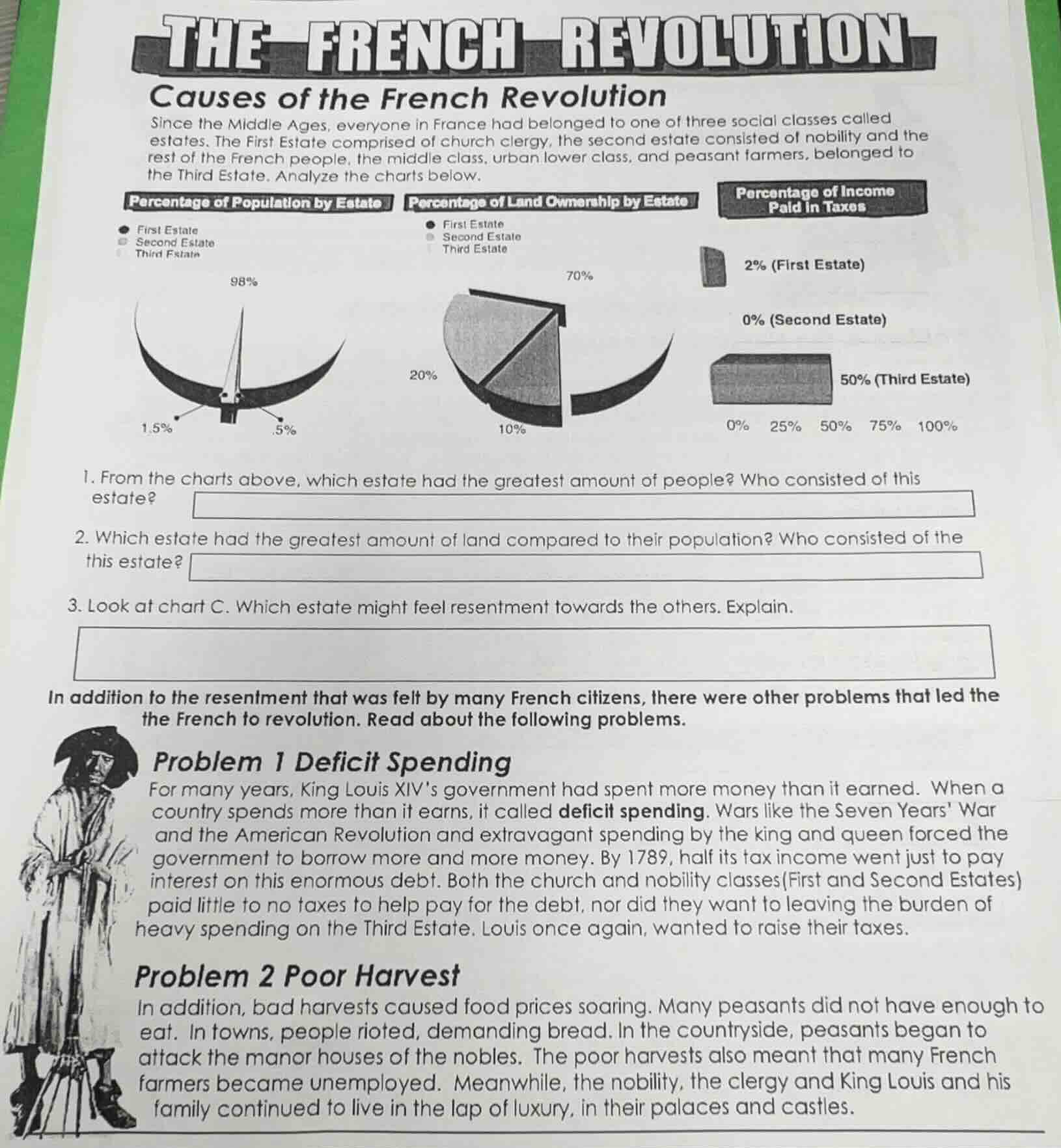
since the middle ages, everyone in france had belonged to one of three social classes called estates. the first estate comprised of church clergy, the second estate consisted of nobility and the rest of the french people, the middle class, urban lower class, and peasant farmers, belonged to the third estate. analyze the charts below.
percentage of population by estate percentage of land ownership by estate percentage of income paid in taxes
first estate
second estate
third estate
first estate
second estate
third estate
2% (first estate)
0% (second estate)
50% (third estate)
0% 25% 50% 75% 100%
- from the charts above, which estate had the greatest amount of people? who consisted of this estate?
- which estate had the greatest amount of land compared to their population? who consisted of the this estate?
- look at chart c. which estate might feel resentment towards the others. explain.
in addition to the resentment that was felt by many french citizens, there were other problems that led the the french to revolution. read about the following problems.
problem 1 deficit spending
for many years, king louis xivs government had spent more money than it earned. when a country spends more than it earns, it called deficit spending. wars like the seven years war and the american revolution and extravagant spending by the king and queen forced the government to borrow more and more money. by 1789, half its tax income went just to pay interest on this enormous debt. both the church and nobility classes(first and second estates) paid little to no taxes to help pay for the debt, nor did they want to leaving the burden of heavy spending on the third estate. louis once again, wanted to raise their taxes.
problem 2 poor harvest
in addition, bad harvests caused food prices soaring. many peasants did not have enough to eat. in towns, people rioted, demanding bread. in the countryside, peasants began to attack the manor houses of the nobles. the poor harvests also meant that many french farmers became unemployed. meanwhile, the nobility, the clergy and king louis and his family continued to live in the lap of luxury, in their palaces and castles.
Question 1
To determine which estate had the greatest population, we analyze the "Percentage of Population by Estate" chart. The Third Estate is shown to be 98% of the population. From the text, the Third Estate consisted of the middle class, urban lower class, and peasant farmers.
We compare the population percentage and land ownership percentage of each estate. The Second Estate has a population of 0.5% but owns 20% of the land. The First Estate has 1.5% population and 10% land. The Third Estate has 98% population and 70% land. Calculating the land - population ratio (land percentage / population percentage): For First Estate, \( \frac{10}{1.5}\approx6.67 \); for Second Estate, \( \frac{20}{0.5} = 40 \); for Third Estate, \( \frac{70}{98}\approx0.71 \). The Second Estate has the highest ratio. The Second Estate consisted of the nobility.
Looking at the "Percentage of Income Paid in Taxes" chart, the Third Estate paid 50% of their income in taxes, while the First Estate paid 2% and the Second Estate paid 0%. Also, from the text, the Third Estate had to bear the burden of deficit spending as the First and Second Estates paid little to no taxes. This unequal tax burden and the fact that they were the largest group but had the least favorable economic and social conditions would lead to resentment.

Snap & solve any problem in the app
Get step-by-step solutions on Sovi AI
Photo-based solutions with guided steps
Explore more problems and detailed explanations
The Third Estate had the greatest amount of people. It consisted of the middle class, urban lower class, and peasant farmers.