QUESTION IMAGE
Question
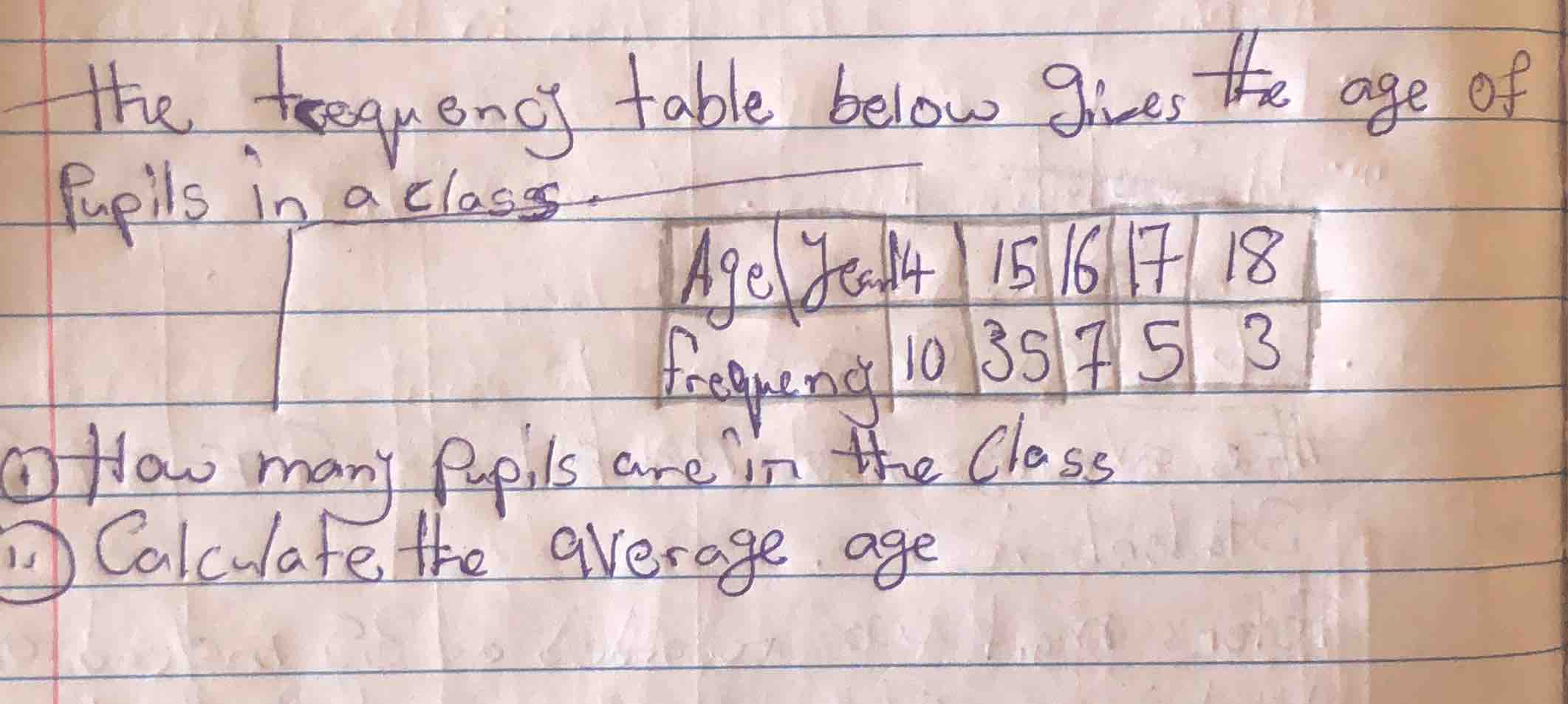
the frequency table below gives the age of pupils in a class.
age (years) | 14 | 15 | 16 | 17 | 18
frequency | 10 | 35 | 7 | 5 | 3
(i) how many pupils are in the class
(ii) calculate the average age
Sub - Question 1: How many pupils are in the class?
Step1: Sum the frequencies
To find the total number of pupils, we add up all the frequency values. The frequencies are 10 (for age 14), 35 (for age 15), 7 (for age 16), 5 (for age 17), and 3 (for age 18). So we calculate \(10 + 35+7 + 5+3\).
Step2: Calculate the sum
First, \(10+35 = 45\). Then, \(45 + 7=52\). Next, \(52+5 = 57\). Finally, \(57 + 3=60\).
Step1: Recall the formula for the mean (average)
The formula for the mean of a frequency - distribution is \(\bar{x}=\frac{\sum_{i = 1}^{n}x_{i}f_{i}}{\sum_{i = 1}^{n}f_{i}}\), where \(x_{i}\) is the value of the variable (age in this case) and \(f_{i}\) is the corresponding frequency, and \(n\) is the number of classes.
Step2: Calculate \(\sum_{i = 1}^{n}x_{i}f_{i}\)
- For \(x = 14\) and \(f = 10\): \(14\times10=140\)
- For \(x = 15\) and \(f = 35\): \(15\times35 = 525\)
- For \(x = 16\) and \(f = 7\): \(16\times7=112\)
- For \(x = 17\) and \(f = 5\): \(17\times5 = 85\)
- For \(x = 18\) and \(f = 3\): \(18\times3=54\)
Now, sum these products: \(140+525 + 112+85+54\).
First, \(140+525=665\). Then, \(665 + 112 = 777\). Next, \(777+85 = 862\). Finally, \(862+54 = 916\).
Step3: Recall the total frequency from Sub - Question 1
We know from Sub - Question 1 that \(\sum_{i = 1}^{n}f_{i}=60\).
Step4: Calculate the average
Using the formula \(\bar{x}=\frac{\sum x_{i}f_{i}}{\sum f_{i}}\), we substitute \(\sum x_{i}f_{i}=916\) and \(\sum f_{i}=60\). So \(\bar{x}=\frac{916}{60}\approx15.27\) (rounded to two decimal places) or as a fraction \(\frac{229}{15}\approx15.27\).

Snap & solve any problem in the app
Get step-by-step solutions on Sovi AI
Photo-based solutions with guided steps
Explore more problems and detailed explanations
60