QUESTION IMAGE
Question
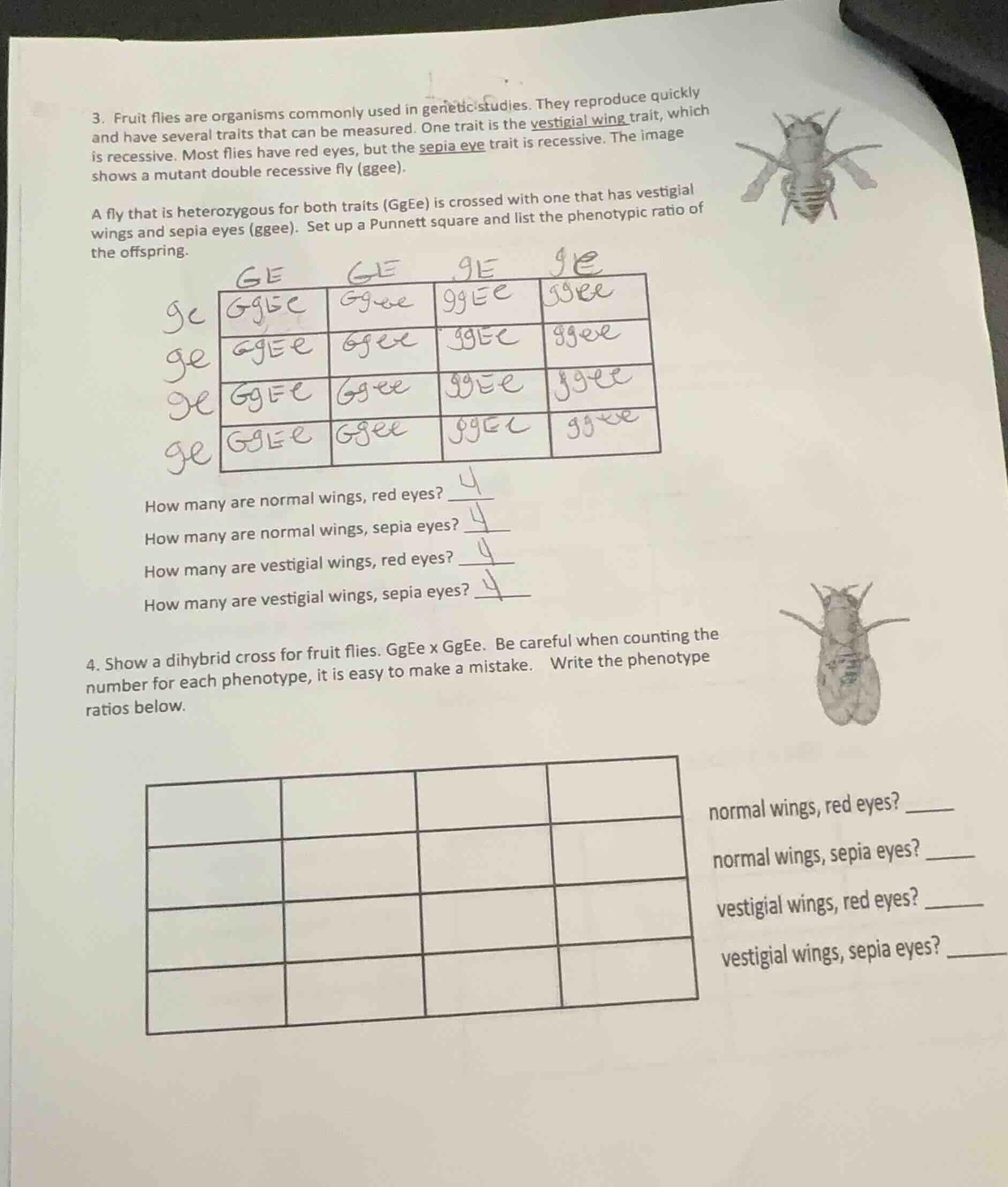
- fruit flies are organisms commonly used in genetic studies. they reproduce quickly and have several traits that can be measured. one trait is the vestigial wing trait, which is recessive. most flies have red eyes, but the sepia eye trait is recessive. the image shows a mutant double recessive fly (ggee).
a fly that is heterozygous for both traits (ggee) is crossed with one that has vestigial wings and sepia eyes (ggee). set up a punnett square and list the phenotypic ratio of the offspring.
how many are normal wings, red eyes?
how many are normal wings, sepia eyes?
how many are vestigial wings, red eyes?
how many are vestigial wings, sepia eyes?
- show a dihybrid cross for fruit flies. ggee x ggee. be careful when counting the number for each phenotype, it is easy to make a mistake. write the phenotype ratios below.
normal wings, red eyes?
normal wings, sepia eyes?
vestigial wings, red eyes?
vestigial wings, sepia eyes?
Problem 3 (Cross: GgEe × ggee)
Step1: Determine Gametes
- For GgEe: Gametes are GE, Ge, gE, ge (since it's heterozygous for both, it produces 4 types of gametes).
- For ggee: Gametes are all ge (homozygous recessive for both, so only one type of gamete).
Step2: Set Up Punnett Square
The Punnett square has 4 columns (GE, Ge, gE, ge) and 4 rows (all ge). Filling it:
- GE × ge: GgEe (normal wings, red eyes)
- Ge × ge: Ggee (normal wings, sepia eyes)
- gE × ge: ggEe (vestigial wings, red eyes)
- ge × ge: ggee (vestigial wings, sepia eyes)
Each of these combinations occurs 4 times (since 4 rows and 4 columns, but actually, since ggee only produces ge, each of the 4 gametes from GgEe pairs with ge 4 times? Wait, no, the Punnett square for GgEe (4 gametes) × ggee (1 gamete) is 4×4? Wait, no, ggee has only one type of gamete (ge), so the Punnett square is 4 rows (ge) and 4 columns (GE, Ge, gE, ge). So each cell is:
- GE & ge: GgEe
- Ge & ge: Ggee
- gE & ge: ggEe
- ge & ge: ggee
And since there are 4 rows (each ge) and 4 columns, each combination is repeated 4 times? Wait, no, the number of offspring is 16? Wait, no, GgEe produces 4 gametes, ggee produces 1 gamete, so the Punnett square is 4 (from GgEe) × 1 (from ggee) = 4 cells? Wait, I think I made a mistake earlier. Let's correct:
- GgEe gametes: GE, Ge, gE, ge (4 gametes)
- ggee gametes: ge (1 gamete)
So the Punnett square is 4 columns (GE, Ge, gE, ge) and 1 row (ge)? No, Punnett square is rows (male gametes) and columns (female gametes) or vice versa. Let's assume GgEe is male (4 gametes: GE, Ge, gE, ge) and ggee is female (1 gamete: ge). So the Punnett square has 4 rows (each male gamete) and 1 column (female gamete). Wait, no, that's not right. Actually, both parents contribute gametes. So GgEe (parent 1) has 4 gametes, ggee (parent 2) has 1 gamete. So the Punnett square is 4 (parent 1 gametes) × 1 (parent 2 gametes) = 4 cells, each with 4 offspring? No, the total number of offspring is 16? Wait, no, the number of gametes from each parent: GgEe produces 4 types, each with equal probability, so when crossed with ggee (which produces only ge), the offspring genotypes are:
- GgEe: probability 1/4 (since GE is 1/4 of GgEe's gametes)
- Ggee: 1/4
- ggEe: 1/4
- ggee: 1/4
And since the total number of offspring in a Punnett square for dihybrid cross with one parent homozygous recessive is 16? Wait, no, the number of cells in the Punnett square is 4 (from GgEe) × 4 (from ggee)? No, ggee has only one type of gamete, so it's 4 × 1 = 4 cells, but each cell represents a possible zygote, and the number of offspring is the sum of the counts. Wait, the original Punnett square in the image has 4 rows and 4 columns, so maybe the user made a mistake in the parent's gametes. Wait, the original problem says "a fly that is heterozygous for both traits (GgEe) is crossed with one that has vestigial wings and sepia eyes (ggee)". So GgEe × ggee. The correct gametes:
- GgEe: GE, Ge, gE, ge (4 gametes)
- ggee: ge, ge, ge, ge (4 gametes? No, ggee is homozygous recessive, so all gametes are ge. So it produces 4 gametes, all ge. So the Punnett square is 4 (GgEe gametes) × 4 (ggee gametes) = 16 cells. Each cell:
- GE (from GgEe) × ge (from ggee): GgEe (normal wings, red eyes)
- Ge × ge: Ggee (normal wings, sepia eyes)
- gE × ge: ggEe (vestigial wings, red eyes)
- ge × ge: ggee (vestigial wings, sepia eyes)
Since there are 4 GE, 4 Ge, 4 gE, 4 ge gametes from GgEe? No, GgEe produces 4 types of gametes, each with equal frequency, so in a Punnett square with 16 cells (4×4), each type of GgEe gamete (GE, Ge, gE, ge) appears 4 times (since 4 g…
Step1: Determine Gametes
- Both parents (GgEe) produce gametes: GE, Ge, gE, ge (4 types each).
Step2: Set Up Punnett Square
The Punnett square is 4×4 (16 cells). Filling each cell by combining gametes:
- GE × GE: GGE E (normal, red)
- GE × Ge: GGEe (normal, red)
- GE × gE: GgEE (normal, red)
- GE × ge: GgEe (normal, red)
- Ge × GE: GGEe (normal, red)
- Ge × Ge: GGe e (normal, sepia)
- Ge × gE: GgEe (normal, red)
- Ge × ge: Ggee (normal, sepia)
- gE × GE: GgEE (normal, red)
- gE × Ge: GgEe (normal, red)
- gE × gE: ggEE (vestigial, red)
- gE × ge: ggEe (vestigial, red)
- ge × GE: GgEe (normal, red)
- ge × Ge: Ggee (normal, sepia)
- ge × gE: ggEe (vestigial, red)
- ge × ge: ggee (vestigial, sepia)
Step3: Count Phenotypes
- Normal wings, red eyes (G_ E_): Let's count the cells with at least one G and at least one E. From the above:
- GGE E, GGEe, GgEE, GgEe (first row): 4
- GGEe, GGe e, GgEe, Ggee (second row): 2 (wait, no, let's list all 16 cells:
- GGE E - normal, red
- GGEe - normal, red
- GgEE - normal, red
- GgEe - normal, red
- GGEe - normal, red
- GGe e - normal, sepia
- GgEe - normal, red
- Ggee - normal, sepia
- GgEE - normal, red
- GgEe - normal, red
- ggEE - vestigial, red
- ggEe - vestigial, red
- GgEe - normal, red
- Ggee - normal, sepia
- ggEe - vestigial, red
- ggee - vestigial, sepia
Now count:
- Normal, red (G_ E_): Cells 1,2,3,4,5,7,9,10,13. Wait, let's do it properly. The genotype G_ E_ includes:
- GGEE, GGEe, GgEE, GgEe (for G_: GG or Gg; E_: EE or Ee)
From the Punnett square:
- GGEE: 1
- GGEe: 2 (cells 2,5)
- GgEE: 2 (cells 3,9)
- GgEe: 4 (cells 4,7,10,13)
Total: 1+2+2+4=9? Wait, no, the standard dihybrid cross ratio for GgEe × GgEe is 9:3:3:1. So:
- Normal wings, red eyes (G_ E_): 9
- Normal wings, sepia eyes (G_ ee): 3
- Vestigial wings, red eyes (gg E_): 3
- Vestigial wings, sepia eyes (gg ee): 1
Yes, that's the standard 9:3:3:1 ratio for dihybrid cross (both parents heterozygous for both traits). So:
- Normal wings, red eyes: 9
- Normal wings, sepia eyes: 3
- Vestigial wings, red eyes: 3
- Vestigial wings, sepia eyes: 1

Snap & solve any problem in the app
Get step-by-step solutions on Sovi AI
Photo-based solutions with guided steps
Explore more problems and detailed explanations
(Problem 3):
- Normal wings, red eyes: 4
- Normal wings, sepia eyes: 4
- Vestigial wings, red eyes: 4
- Vestigial wings, sepia eyes: 4