QUESTION IMAGE
Question
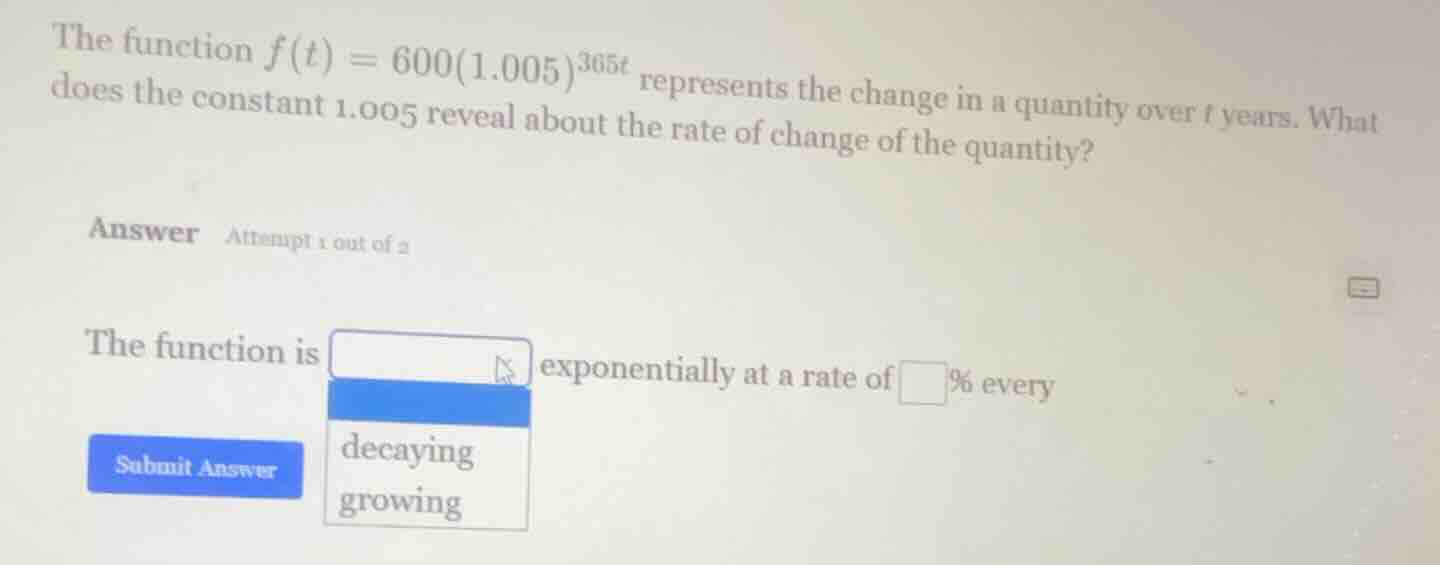
the function $f(t) = 600(1.005)^{365t}$ represents the change in a quantity over $t$ years. what does the constant 1.005 reveal about the rate of change of the quantity?
answer attempt 1 out of 2
the function is exponentially at a rate of % every
options: decaying, growing
Step1: Identify growth/decay factor
The general form of exponential growth is \( f(t) = a(1 + r)^{nt} \), where \( a \) is the initial amount, \( r \) is the growth rate per period, \( n \) is the number of times compounded per year, and \( t \) is time in years. Here, the base of the exponent is \( 1.005 \), which is greater than 1. In exponential functions, if the base \( b>1 \), it represents growth; if \( 0 < b < 1 \), it represents decay. So since \( 1.005>1 \), the function is growing.
Step2: Find the growth rate
In the form \( f(t) = a(1 + r)^{nt} \), the term \( (1 + r) \) is the growth factor per compounding period. Here, \( 1 + r=1.005 \), so solving for \( r \), we get \( r = 1.005 - 1=0.005 \). To convert this to a percentage, we multiply by 100, so \( r = 0.005\times100 = 0.5\% \). The exponent \( 365t \) implies that the compounding is done 365 times a year (daily compounding), so the growth rate is \( 0.5\% \) per day (since \( n = 365 \), the period is 1 day). But the question is about the rate related to the constant 1.005, which gives a rate of \( 0.5\% \) per compounding period (per day in this case, but the rate from the constant 1.005 is \( 0.5\% \) per the period corresponding to the exponent's base).

Snap & solve any problem in the app
Get step-by-step solutions on Sovi AI
Photo-based solutions with guided steps
Explore more problems and detailed explanations
The function is growing exponentially at a rate of \( 0.5\% \) every day (since the exponent is \( 365t \), meaning 365 times a year, so per day). So filling in the blanks: growing, \( 0.5 \)