QUESTION IMAGE
Question
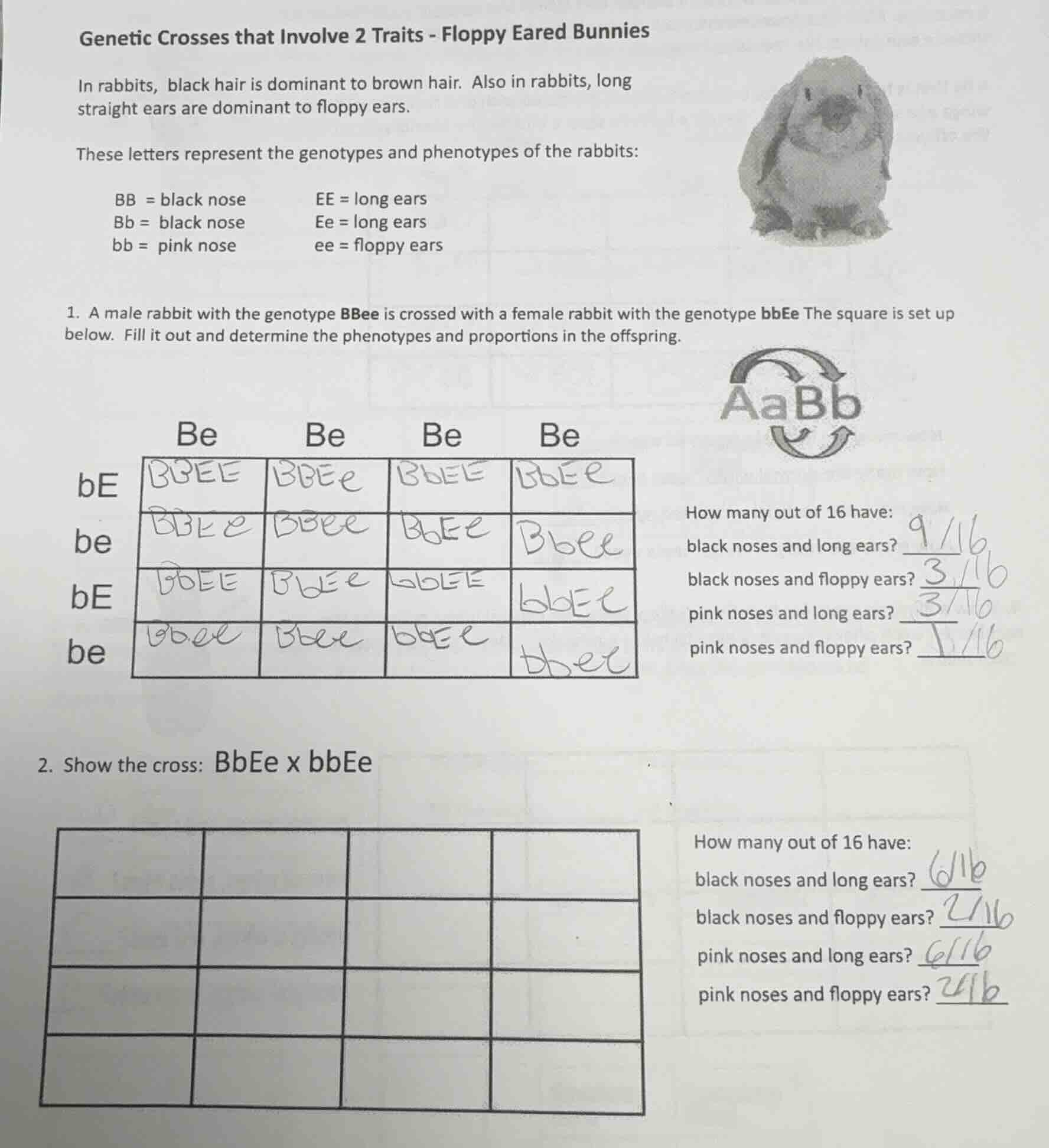
genetic crosses that involve 2 traits - floppy eared bunnies
in rabbits, black hair is dominant to brown hair. also in rabbits, long
straight ears are dominant to floppy ears.
these letters represent the genotypes and phenotypes of the rabbits:
bb = black nose ee = long ears
bb = black nose ee = long ears
bb = pink nose ee = floppy ears
- a male rabbit with the genotype bbee is crossed with a female rabbit with the genotype bbee the square is set up
below. fill it out and determine the phenotypes and proportions in the offspring.
how many out of 16 have:
black noses and long ears?
black noses and floppy ears?
pink noses and long ears?
pink noses and floppy ears?
- show the cross: bbee x bbee
how many out of 16 have:
black noses and long ears?
black noses and floppy ears?
pink noses and long ears?
pink noses and floppy ears?
Problem 1: Cross of \( \text{BBee} \times \text{bbEe} \)
Step 1: Determine Gametes
- Male (\( \text{BBee} \)): Only one type of gamete since \( \text{BB} \) gives \( \text{B} \) and \( \text{ee} \) gives \( \text{e} \). So gametes are \( \text{Be} \) (four times, as shown in the table: \( \text{Be, Be, Be, Be} \)).
- Female (\( \text{bbEe} \)): \( \text{bb} \) gives \( \text{b} \), and \( \text{Ee} \) gives \( \text{E} \) or \( \text{e} \). So gametes are \( \text{bE, be, bE, be} \) (as shown in the table rows: \( \text{bE, be, bE, be} \)).
Step 2: Fill Punnett Square (Correcting the Filled Table)
Let's correctly fill the Punnett square by multiplying the male gametes (\( \text{Be} \)) with female gametes (\( \text{bE, be, bE, be} \)):
| \( \text{Be} \) | \( \text{Be} \) | \( \text{Be} \) | \( \text{Be} \) | |
|---|---|---|---|---|
| \( \text{be} \) | \( \text{Bbee} \) | \( \text{Bbee} \) | \( \text{Bbee} \) | \( \text{Bbee} \) |
| \( \text{bE} \) | \( \text{BbEe} \) | \( \text{BbEe} \) | \( \text{BbEe} \) | \( \text{BbEe} \) |
| \( \text{be} \) | \( \text{Bbee} \) | \( \text{Bbee} \) | \( \text{Bbee} \) | \( \text{Bbee} \) |
Wait, the original filled table has errors. Let's do it properly:
- When \( \text{Be} \) (male) and \( \text{bE} \) (female) combine: \( \text{BbEe} \) (black nose, long ears)
- When \( \text{Be} \) and \( \text{be} \) combine: \( \text{Bbee} \) (black nose, floppy ears)
- When \( \text{Be} \) and \( \text{bE} \) (second \( \text{bE} \)): \( \text{BbEe} \)
- When \( \text{Be} \) and \( \text{be} \) (second \( \text{be} \)): \( \text{Bbee} \)
Now, count the phenotypes:
- Black nose (B_) and long ears (E_): Genotypes \( \text{BbEe} \). Let's count: In the table, each \( \text{bE} \) row (two rows) with \( \text{Be} \) columns (four columns) gives \( \text{BbEe} \). Wait, no, the female has two \( \text{bE} \) and two \( \text{be} \) gametes. So total cells: 4 (male gametes) × 4 (female gametes) = 16? Wait, no, the table has 4 columns (male gametes) and 4 rows (female gametes), so 16 cells. Wait, the male has 4 gametes (all \( \text{Be} \)), female has 4 gametes (\( \text{bE, be, bE, be} \)). So:
- \( \text{bE} \times \text{Be} \): \( \text{BbEe} \) (black, long) – 4 cells (first row: 4 cells)
- \( \text{be} \times \text{Be} \): \( \text{Bbee} \) (black, floppy) – 4 cells (second row: 4 cells)
- \( \text{bE} \times \text{Be} \): \( \text{BbEe} \) (black, long) – 4 cells (third row: 4 cells)
- \( \text{be} \times \text{Be} \): \( \text{Bbee} \) (black, floppy) – 4 cells (fourth row: 4 cells)
Wait, no, the female's gametes are \( \text{bE, be, bE, be} \) (rows: 1: bE, 2: be, 3: bE, 4: be). So:
- Row 1 (bE) × Columns (Be, Be, Be, Be): \( \text{BbEe, BbEe, BbEe, BbEe} \) (4 cells: black, long)
- Row 2 (be) × Columns (Be, Be, Be, Be): \( \text{Bbee, Bbee, Bbee, Bbee} \) (4 cells: black, floppy)
- Row 3 (bE) × Columns (Be, Be, Be, Be): \( \text{BbEe, BbEe, BbEe, BbEe} \) (4 cells: black, long)
- Row 4 (be) × Columns (Be, Be, Be, Be): \( \text{Bbee, Bbee, Bbee, Bbee} \) (4 cells: black, floppy)
Wait, but the female is \( \text{bbEe} \), so \( \text{bb} \) means all offspring will have \( \text{Bb} \) (black nose, since \( \text{B} \) is dominant over \( \text{b} \))? Wait, no: male is \( \text{BB} \), so all offspring will have \( \text{Bb} \) (black nose), because \( \text{BB} \times \text{bb} = \text{Bb} \) (all). Then for ears: male…

Snap & solve any problem in the app
Get step-by-step solutions on Sovi AI
Photo-based solutions with guided steps
Explore more problems and detailed explanations
Problem 1: Cross of \( \text{BBee} \times \text{bbEe} \)
Step 1: Determine Gametes
- Male (\( \text{BBee} \)): Only one type of gamete since \( \text{BB} \) gives \( \text{B} \) and \( \text{ee} \) gives \( \text{e} \). So gametes are \( \text{Be} \) (four times, as shown in the table: \( \text{Be, Be, Be, Be} \)).
- Female (\( \text{bbEe} \)): \( \text{bb} \) gives \( \text{b} \), and \( \text{Ee} \) gives \( \text{E} \) or \( \text{e} \). So gametes are \( \text{bE, be, bE, be} \) (as shown in the table rows: \( \text{bE, be, bE, be} \)).
Step 2: Fill Punnett Square (Correcting the Filled Table)
Let's correctly fill the Punnett square by multiplying the male gametes (\( \text{Be} \)) with female gametes (\( \text{bE, be, bE, be} \)):
| \( \text{Be} \) | \( \text{Be} \) | \( \text{Be} \) | \( \text{Be} \) | |
|---|---|---|---|---|
| \( \text{be} \) | \( \text{Bbee} \) | \( \text{Bbee} \) | \( \text{Bbee} \) | \( \text{Bbee} \) |
| \( \text{bE} \) | \( \text{BbEe} \) | \( \text{BbEe} \) | \( \text{BbEe} \) | \( \text{BbEe} \) |
| \( \text{be} \) | \( \text{Bbee} \) | \( \text{Bbee} \) | \( \text{Bbee} \) | \( \text{Bbee} \) |
Wait, the original filled table has errors. Let's do it properly:
- When \( \text{Be} \) (male) and \( \text{bE} \) (female) combine: \( \text{BbEe} \) (black nose, long ears)
- When \( \text{Be} \) and \( \text{be} \) combine: \( \text{Bbee} \) (black nose, floppy ears)
- When \( \text{Be} \) and \( \text{bE} \) (second \( \text{bE} \)): \( \text{BbEe} \)
- When \( \text{Be} \) and \( \text{be} \) (second \( \text{be} \)): \( \text{Bbee} \)
Now, count the phenotypes:
- Black nose (B_) and long ears (E_): Genotypes \( \text{BbEe} \). Let's count: In the table, each \( \text{bE} \) row (two rows) with \( \text{Be} \) columns (four columns) gives \( \text{BbEe} \). Wait, no, the female has two \( \text{bE} \) and two \( \text{be} \) gametes. So total cells: 4 (male gametes) × 4 (female gametes) = 16? Wait, no, the table has 4 columns (male gametes) and 4 rows (female gametes), so 16 cells. Wait, the male has 4 gametes (all \( \text{Be} \)), female has 4 gametes (\( \text{bE, be, bE, be} \)). So:
- \( \text{bE} \times \text{Be} \): \( \text{BbEe} \) (black, long) – 4 cells (first row: 4 cells)
- \( \text{be} \times \text{Be} \): \( \text{Bbee} \) (black, floppy) – 4 cells (second row: 4 cells)
- \( \text{bE} \times \text{Be} \): \( \text{BbEe} \) (black, long) – 4 cells (third row: 4 cells)
- \( \text{be} \times \text{Be} \): \( \text{Bbee} \) (black, floppy) – 4 cells (fourth row: 4 cells)
Wait, no, the female's gametes are \( \text{bE, be, bE, be} \) (rows: 1: bE, 2: be, 3: bE, 4: be). So:
- Row 1 (bE) × Columns (Be, Be, Be, Be): \( \text{BbEe, BbEe, BbEe, BbEe} \) (4 cells: black, long)
- Row 2 (be) × Columns (Be, Be, Be, Be): \( \text{Bbee, Bbee, Bbee, Bbee} \) (4 cells: black, floppy)
- Row 3 (bE) × Columns (Be, Be, Be, Be): \( \text{BbEe, BbEe, BbEe, BbEe} \) (4 cells: black, long)
- Row 4 (be) × Columns (Be, Be, Be, Be): \( \text{Bbee, Bbee, Bbee, Bbee} \) (4 cells: black, floppy)
Wait, but the female is \( \text{bbEe} \), so \( \text{bb} \) means all offspring will have \( \text{Bb} \) (black nose, since \( \text{B} \) is dominant over \( \text{b} \))? Wait, no: male is \( \text{BB} \), so all offspring will have \( \text{Bb} \) (black nose), because \( \text{BB} \times \text{bb} = \text{Bb} \) (all). Then for ears: male is \( \text{ee} \), female is \( \text{Ee} \). So \( \text{ee} \times \text{Ee} = \text{Ee} \) (long ears) or \( \text{ee} \) (floppy ears), with ratio \( 1:1 \) (since \( \text{Ee} \) gives \( \text{E} \) or \( \text{e} \), so \( \text{Ee} \) (long) and \( \text{ee} \) (floppy) each 50%).
But wait, the Punnett square has 16 cells? No, 4 (male gametes) × 4 (female gametes) = 16? Wait, no, the male has 1 type of gamete (Be) with 4 copies, female has 2 types of gametes (bE, be) with 2 copies each (total 4 gametes). So the Punnett square is 4 (male) × 4 (female) = 16 cells, but genetically, it's a 1 (male gamete type) × 2 (female gamete types) cross, but the table is drawn as 4×4.
Wait, let's use probability:
- Nose: \( \text{BB} \times \text{bb} = \text{Bb} \) (all black nose, 100% or 16/16 black nose? Wait, no: \( \text{BB} \) (male) × \( \text{bb} \) (female) gives \( \text{Bb} \) for all offspring (since \( \text{BB} \) can only give \( \text{B} \), \( \text{bb} \) can only give \( \text{b} \)). So all 16 offspring have black nose (\( \text{Bb} \)).
- Ears: \( \text{ee} \) (male) × \( \text{Ee} \) (female). The cross is \( \text{ee} \times \text{Ee} \). The Punnett square for ears:
| \( \text{E} \) | \( \text{e} \) | |
|---|---|---|
| \( \text{e} \) | \( \text{Ee} \) (long) | \( \text{ee} \) (floppy) |
| \( \text{e} \) | \( \text{Ee} \) (long) | \( \text{ee} \) (floppy) |
| \( \text{e} \) | \( \text{Ee} \) (long) | \( \text{ee} \) (floppy) |
Wait, no, the male has \( \text{ee} \), so gametes are \( \text{e} \) (four times), female has \( \text{Ee} \), gametes \( \text{E} \) and \( \text{e} \) (two times each, total four gametes: \( \text{E, e, E, e} \)). So the ear cross is \( \text{ee} \times \text{Ee} \), which gives:
- \( \text{Ee} \) (long ears): when \( \text{e} \) (male) × \( \text{E} \) (female) → 4 (male gametes) × 2 (female \( \text{E} \) gametes) = 8 cells? Wait, no, the female has two \( \text{E} \) and two \( \text{e} \) gametes (since \( \text{Ee} \) produces \( \text{E} \) and \( \text{e} \) in 1:1 ratio, so 2 \( \text{E} \) and 2 \( \text{e} \) in 4 gametes). So:
- Long ears (\( \text{Ee} \)): number of cells where female gamete is \( \text{E} \) (2 gametes) × male gametes (4) = \( 2 \times 4 = 8 \) cells? Wait, no, the table has 4 rows (female gametes: \( \text{bE, be, bE, be} \)) → \( \text{bE} \) is \( \text{b} + \text{E} \) (two times), \( \text{be} \) is \( \text{b} + \text{e} \) (two times). So:
- Rows with \( \text{bE} \) (female gamete with \( \text{E} \)): 2 rows (first and third). Each row has 4 cells (male gametes \( \text{Be} \)). So cells with \( \text{E} \) (long ears): \( 2 \times 4 = 8 \) cells.
- Rows with \( \text{be} \) (female gamete with \( \text{e} \)): 2 rows (second and fourth). Each row has 4 cells. So cells with \( \text{e} \) (floppy ears): \( 2 \times 4 = 8 \) cells.
But all offspring have black nose (\( \text{Bb} \)), so:
- Black nose and long ears: 8 cells (since 8 have long ears, all have black nose) → \( \frac{8}{16} = \frac{1}{2} \) or 8/16.
- Black nose and floppy ears: 8 cells (8 have floppy ears, all have black nose) → \( \frac{8}{16} = \frac{1}{2} \) or 8/16.
- Pink nose and long ears: 0 (since all have \( \text{Bb} \), no \( \text{bb} \)) → 0/16.
- Pink nose and floppy ears: 0 (same reason) → 0/16.
Wait, the original filled table has wrong numbers (9/16, 3/16, etc.), which is incorrect. The mistake is in the original filled genotypes (e.g., writing \( \text{BBEE} \) which is impossible because male is \( \text{ee} \), so no \( \text{EE} \) or \( \text{Ee} \) from male? Wait, no: male is \( \text{ee} \), so all offspring will have \( \text{ee} \) or \( \text{Ee} \) for ears? Wait, no: male is \( \text{ee} \) (homozygous recessive for ears), female is \( \text{Ee} \) (heterozygous dominant). So the cross for ears is \( \text{ee} \times \text{Ee} \), which gives:
- Genotypes: \( \text{Ee} \) (long ears) and \( \text{ee} \) (floppy ears), each with probability 0.5 (50%).
For nose: male is \( \text{BB} \) (homozygous dominant), female is \( \text{bb} \) (homozygous recessive). So cross is \( \text{BB} \times \text{bb} \), which gives \( \text{Bb} \) (heterozygous, black nose) for all offspring (100% black nose).
Therefore, the phenotypes:
- Black nose (all) and long ears (\( \text{Ee} \)): 50% of 16 = 8.
- Black nose (all) and floppy ears (\( \text{ee} \)): 50% of 16 = 8.
- Pink nose: 0 (no \( \text{bb} \) offspring, since male is \( \text{BB} \)).
- So the correct numbers are:
- Black noses and long ears: \( \boldsymbol{\frac{8}{16} = \frac{1}{2}} \) (8 out of 16)
- Black noses and floppy ears: \( \boldsymbol{\frac{8}{16} = \frac{1}{2}} \) (8 out of 16)
- Pink noses and long ears: \( \boldsymbol{0} \) (0 out of 16)
- Pink noses and floppy ears: \( \boldsymbol{0} \) (0 out of 16)
Problem 2: Cross of \( \text{BbEe} \times \text{bbEe} \)
Step 1: Determine Gametes
- Male (\( \text{BbEe} \)): \( \text{Bb} \) gives \( \text{B} \) or \( \text{b} \), \( \text{Ee} \) gives \( \text{E} \) or \( \text{e} \). So gametes are \( \text{BE, Be, bE, be} \) (each type once, but in a 4×4 table, we can list them as \( \text{BE, Be, bE, be} \) for the four columns).
- Female (\( \text{bbEe} \)): \( \text{bb} \) gives \( \text{b} \), \( \text{Ee} \) gives \( \text{E} \) or \( \text{e} \). So gametes are \( \text{bE, be, bE, be} \) (four rows: \( \text{bE, be, bE, be} \)).
Step 2: Fill Punnett Square
| \( \text{BE} \) | \( \text{Be} \) | \( \text{bE} \) | \( \text{be} \) | |
|---|---|---|---|---|
| \( \text{be} \) | \( \text{BbEe} \) | \( \text{Bbee} \) | \( \text{bbEe} \) | \( \text{bbee} \) |
| \( \text{bE} \) | \( \text{BbEE} \) | \( \text{BbEe} \) | \( \text{bbEE} \) | \( \text{bbEe} \) |
| \( \text{be} \) | \( \text{BbEe} \) | \( \text{Bbee} \) | \( \text{bbEe} \) | \( \text{bbee} \) |
Step 3: Count Phenotypes
- Black nose (B_) and long ears (E_): Genotypes \( \text{BbEE, BbEe} \).
- \( \text{BbEE} \): 2 cells (row 1, col 1; row 3, col 1)
- \( \text{BbEe} \): 4 cells (row 1, col 2; row 2, col 2; row 3, col 2; row 4, col 2)
- Total: \( 2 + 4 = 6 \) cells → \( \frac{6}{16} \)
- Black nose (B_) and floppy ears (ee): Genotype \( \text{Bbee} \).