QUESTION IMAGE
Question
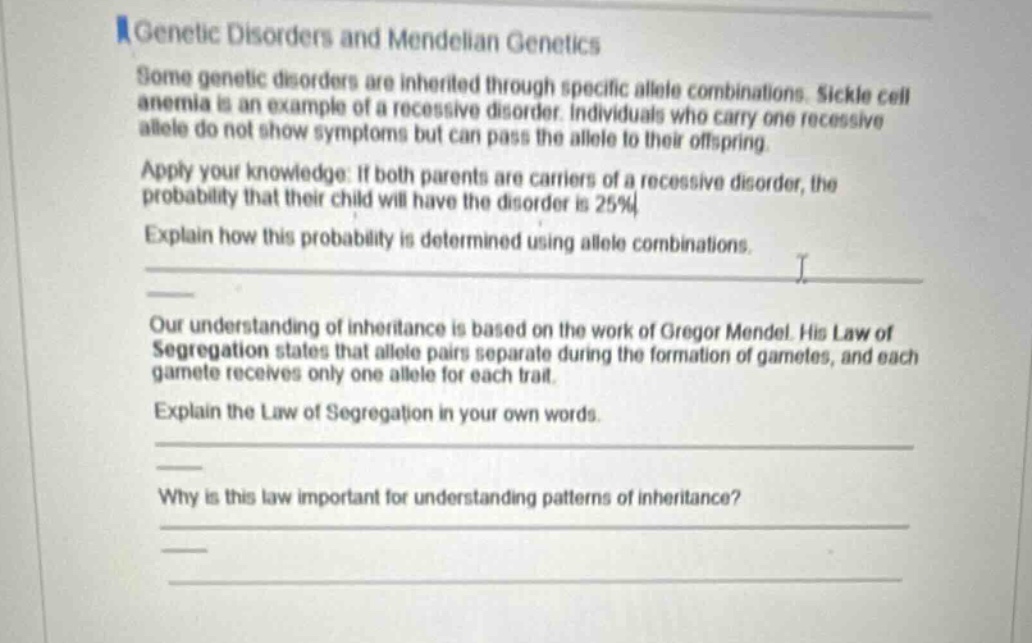
genetic disorders and mendelian genetics
some genetic disorders are inherited through specific allele combinations. sickle cell anemia is an example of a recessive disorder. individuals who carry one recessive allele do not show symptoms but can pass the allele to their offspring.
apply your knowledge: if both parents are carriers of a recessive disorder, the probability that their child will have the disorder is 25%.
explain how this probability is determined using allele combinations.
our understanding of inheritance is based on the work of gregor mendel. his law of segregation states that allele pairs separate during the formation of gametes, and each gamete receives only one allele for each trait.
explain the law of segregation in your own words.
why is this law important for understanding patterns of inheritance?
- For the recessive disorder probability: Use a Punnett square with carrier parents (genotype $Aa$ each). The only combination causing the disorder is inheriting two recessive alleles ($aa$).
- For the Law of Segregation explanation: Rewrite the core idea in simple terms about allele separation in gametes.
- For the importance of the law: Link it to predicting trait inheritance and explaining genetic patterns.

Snap & solve any problem in the app
Get step-by-step solutions on Sovi AI
Photo-based solutions with guided steps
Explore more problems and detailed explanations
- When both parents are carriers with genotype $Aa$, each parent can pass either a dominant $A$ or recessive $a$ allele to their offspring. Using a Punnett square, the possible offspring genotypes are: $AA$, $Aa$, $Aa$, $aa$. Only the $aa$ genotype results in the recessive disorder, which is 1 out of 4 possible combinations. $\frac{1}{4} = 25\%$, so this is the probability the child has the disorder.
- The Law of Segregation means that when a parent makes sex cells (gametes), the two copies of each gene (alleles) split apart. Each sex cell only gets one allele for each trait, not both.
- This law is important because it explains why traits skip generations (like recessive disorders) and allows us to predict the likelihood of offspring inheriting specific traits or genetic disorders. It forms the basic rule for understanding how genetic traits are passed from parents to children.