QUESTION IMAGE
Question
george washington’s farewell address
reading comprehension
read the following passage and answer the questions
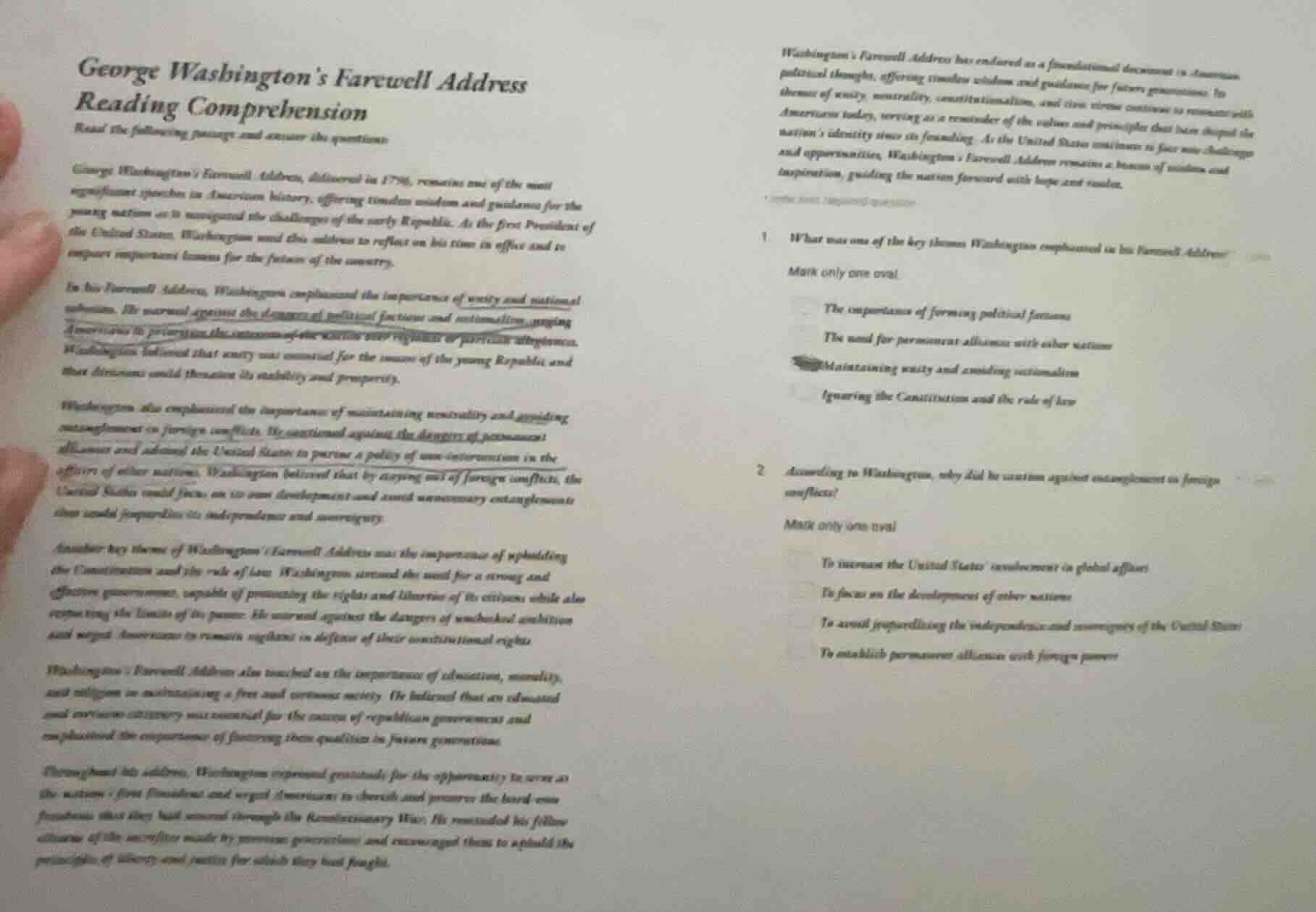
george washington’s farewell address, delivered in 1796, remains one of the most significant speeches in american history, offering timeless wisdom and guidance for the young nation as it navigated the challenges of the early republic. as the first president of the united states, washington used this address to reflect on his time in office and to impart important lessons for the future of the country.
in his farewell address, washington emphasized the importance of unity and national cohesion. he warned against the dangers of political factions and sectionalism, urging americans to prioritize the common good over regional or partisan differences. washington believed that unity was essential for the success of the young republic and that divisions could threaten its stability and prosperity.
washington also emphasized the importance of maintaining neutrality and avoiding entanglement in foreign conflicts. he cautioned against the dangers of permanent alliances and advised the united states to pursue a policy of non - intervention in the affairs of other nations. washington believed that by staying out of foreign conflicts, the united states could focus on its own development and avoid unnecessary entanglements that could jeopardize its independence and sovereignty.
another key theme of washington’s farewell address was the importance of upholding the constitution and the rule of law. washington stressed the need for a strong and effective government, capable of protecting the rights and liberties of its citizens while also respecting the limits of its power. he warned against the dangers of unchecked ambition and urged americans to remain vigilant in defense of their constitutional rights.
washington’s farewell address also touched on the importance of education, morality, and religion in maintaining a free and virtuous society. he believed that an educated and virtuous citizenry was essential for the success of republican governments and emphasized the importance of fostering these qualities in future generations.
throughout his address, washington expressed gratitude for the opportunity to serve as the nation’s first president and urged americans to cherish and preserve the hard - won freedoms that they had secured through the revolutionary war. he reminded his fellow citizens of the sacrifices made by previous generations and encouraged them to uphold the principles of liberty and justice for which they had fought.
washington’s farewell address has endured as a foundational document in american political thought, offering timeless wisdom and guidance for future generations. its themes of unity, neutrality, constitutionalism, and civic virtue continue to resonate with americans today, serving as a reminder of the values and principles that have shaped the nation’s identity since its founding. as the united states continues to face new challenges and opportunities, washington’s farewell address remains a beacon of wisdom and inspiration, guiding the nation forward with hope and resolve.
- what was one of the key issues washington emphasized in his farewell address?
mark only one oval.
the importance of forming political factions
the need for permanent alliances with other nations
maintaining unity and avoiding sectionalism
ignoring the constitution and the rule of law
- according to washington, why did he caution against entanglement in foreign conflicts?
mark only one oval.
to increase the united states’ involvement in global affairs
to focus on the development of other nations
to avoid jeopardizing the independence and sovereignty of the united states
to establish permanent alliances with foreign powers
Question 1
To answer this, we analyze each option:
- "The importance of forming political factions": The passage says Washington warned against political factions, so this is incorrect.
- "The need for permanent alliances with other nations": Washington warned against permanent alliances, so this is incorrect.
- "Maintaining unity and avoiding sectionalism": The passage states "Washington emphasized the importance of unity and national cohesion" and warned against sectionalism, so this matches.
- "Ignoring the Constitution and the rule of law": The passage says he emphasized upholding the Constitution, so this is incorrect.
Analyzing each option:
- "To increase the United States’ involvement in global affairs": The passage says he wanted to avoid entanglement, so this is incorrect.
- "To focus on the development of other nations": The passage says he wanted the US to focus on its own development, not others, so this is incorrect.
- "To avoid jeopardizing the independence and sovereignty of the United States": The passage states "Washington believed that by staying out of foreign conflicts, the United States could focus on its own development and avoid unnecessary entanglements that could jeopardize its independence and sovereignty", so this matches.
- "To establish permanent alliances with foreign powers": Washington warned against permanent alliances, so this is incorrect.

Snap & solve any problem in the app
Get step-by-step solutions on Sovi AI
Photo-based solutions with guided steps
Explore more problems and detailed explanations
C. Maintaining unity and avoiding sectionalism