QUESTION IMAGE
Question
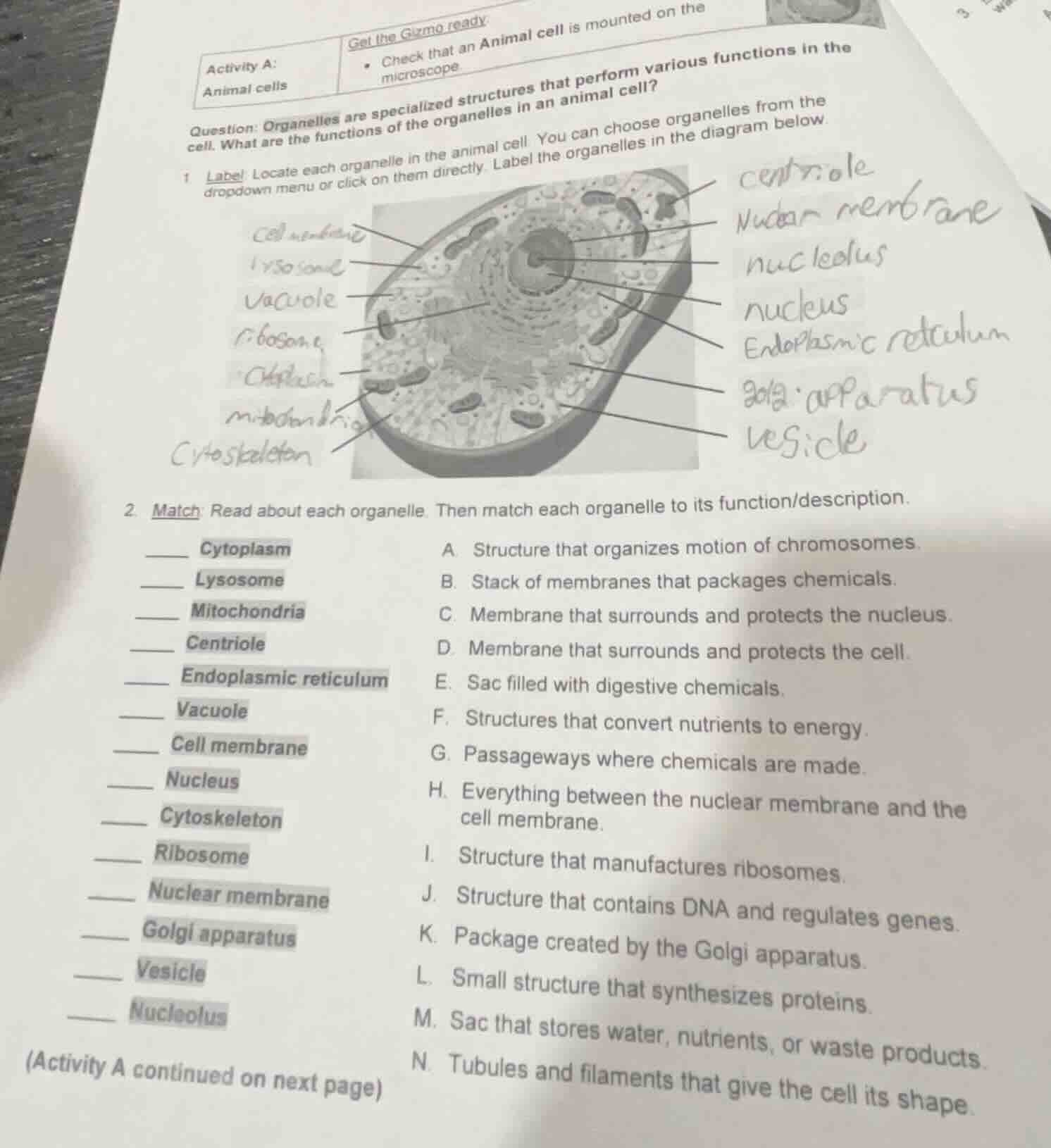
get the gizmo ready: activity a: animal cells - check that an animal cell is mounted on the microscope. question: organelles are specialized structures that perform various functions in the cell. what are the functions of the organelles in an animal cell? 1 label: locate each organelle in the animal cell. you can choose organelles from the dropdown menu or click on them directly. label the organelles in the diagram below. 2 match: read about each organelle. then match each organelle to its function/description. __ cytoplasm a. structure that organizes motion of chromosomes. lysosome b. stack of membranes that packages chemicals. mitochondria c. membrane that surrounds and protects the nucleus. centriole d. membrane that surrounds and protects the cell. endoplasmic reticulum e. sac filled with digestive chemicals. vacuole f. structures that convert nutrients to energy. cell membrane g. passageways where chemicals are made. nucleus h. everything between the nuclear membrane and the cell membrane. cytoskeleton i. structure that manufactures ribosomes. ribosome j. structure that contains dna and regulates genes. nuclear membrane k. package created by the golgi apparatus. golgi apparatus l. small structure that synthesizes proteins. vesicle m. sac that stores water, nutrients, or waste products. __ nucleolus n. tubules and filaments that give the cell its shape. (activity a continued on next page)
To solve the matching, we recall the functions of each organelle:
- Cytoplasm: Everything between the nuclear membrane and cell membrane (H).
- Lysosome: Sac with digestive chemicals (E).
- Mitochondria: Convert nutrients to energy (F).
- Centriole: Organizes chromosome motion (A).
- Endoplasmic reticulum: Passageways for chemical production (G).
- Vacuole: Stores water/nutrients/waste (M).
- Cell membrane: Surrounds and protects cell (D).
- Nucleus: Contains DNA, regulates genes (J).
- Cytoskeleton: Tubules/filaments for cell shape (N).
- Ribosome: Synthesizes proteins (L).
- Nuclear membrane: Surrounds and protects nucleus (C).
- Golgi apparatus: Stacks of membranes that package chemicals (B).
- Vesicle: Package from Golgi apparatus (K).
- Nucleolus: Manufactures ribosomes (I).

Snap & solve any problem in the app
Get step-by-step solutions on Sovi AI
Photo-based solutions with guided steps
Explore more problems and detailed explanations
- Cytoplasm: H
- Lysosome: E
- Mitochondria: F
- Centriole: A
- Endoplasmic reticulum: G
- Vacuole: M
- Cell membrane: D
- Nucleus: J
- Cytoskeleton: N
- Ribosome: L
- Nuclear membrane: C
- Golgi apparatus: B
- Vesicle: K
- Nucleolus: I