QUESTION IMAGE
Question
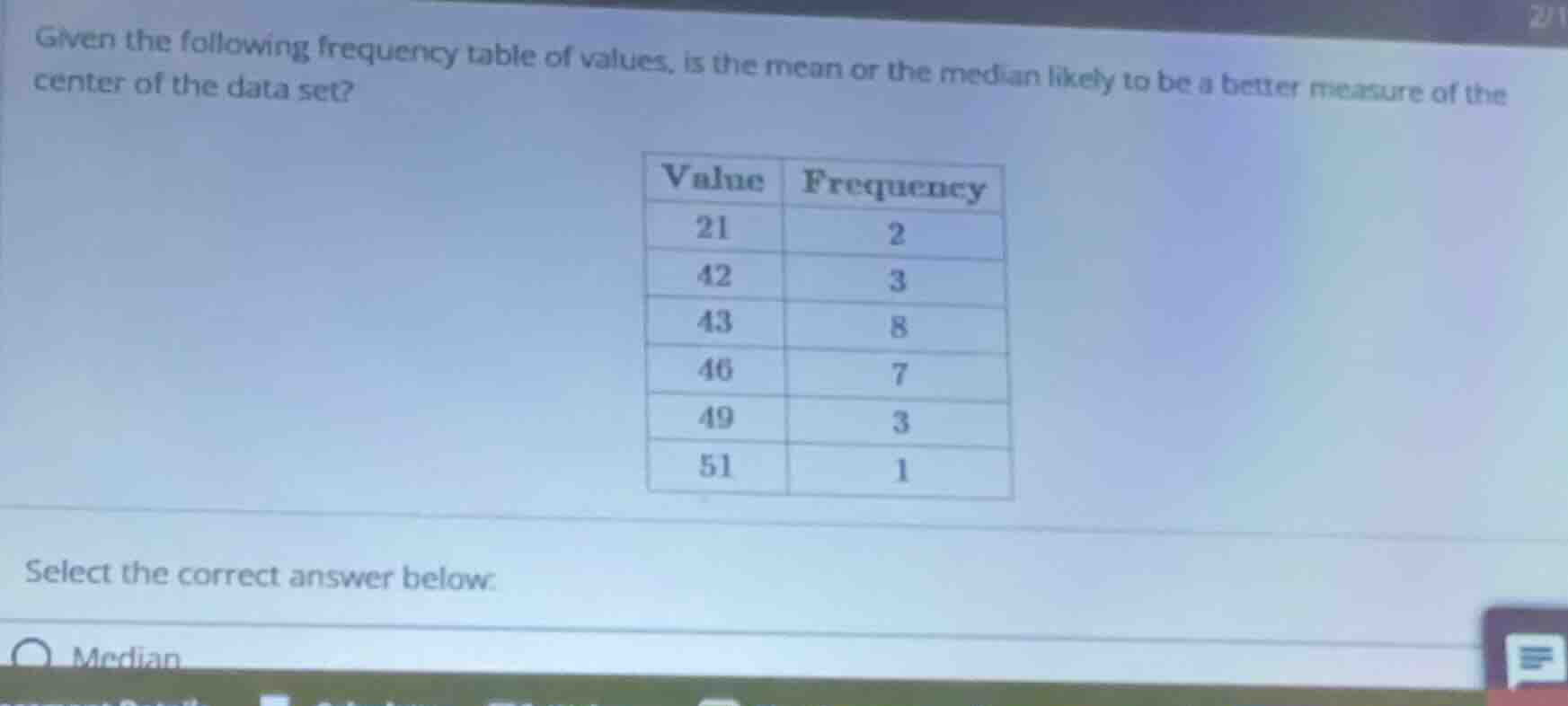
given the following frequency table of values, is the mean or the median likely to be a better measure of the center of the data set?
value frequency
21 2
42 3
43 8
46 7
49 3
51 1
select the correct answer below:
To determine if mean or median is a better measure of center, we analyze the data distribution. The mean is affected by extreme values, while the median is resistant to outliers. First, we check the frequency table: the values are 21 (freq 2), 42 (3), 43 (8), 46 (7), 49 (3), 51 (1). The data is relatively symmetric? Wait, no—wait, let's check the frequencies. The middle values (43, 46) have higher frequencies, and the values at the ends (21, 51) have lower frequencies. Wait, actually, the data doesn't have a strong skew? Wait, no, 21 is a low value with frequency 2, and 51 is a high value with frequency 1. But the main cluster is around 43 - 46. Wait, but actually, in this case, the data is fairly symmetric? Wait, no, let's calculate the total number of data points: 2 + 3 + 8 + 7 + 3 + 1 = 24. The median will be the average of the 12th and 13th values. Let's list the cumulative frequencies: 21 (2), 42 (2+3=5), 43 (5+8=13), 46 (13+7=20), 49 (20+3=23), 51 (23+1=24). So the 12th and 13th values are both 43? Wait, no: cumulative frequency for 43 is 13, so the 12th and 13th values are 43. Wait, but the mean: let's calculate the mean. Sum of (value frequency): (212) + (423) + (438) + (467) + (493) + (511) = 42 + 126 + 344 + 322 + 147 + 51 = let's add: 42+126=168; 168+344=512; 512+322=834; 834+147=981; 981+51=1032. Mean is 1032 / 24 = 43. So the mean and median are both around 43. Wait, but maybe I made a mistake. Wait, the data: 21 is an outlier? Wait, 21 is much lower than the rest (42, 43, etc.). So 21 is a low outlier. The mean is affected by outliers, but in this case, the mean is 43, same as the median? Wait, no, wait my calculation: 212=42, 423=126, 438=344, 467=322, 493=147, 511=51. Sum: 42+126=168; 168+344=512; 512+322=834; 834+147=981; 981+51=1032. 1032 divided by 24 is 43. So the mean is 43, and the median is also 43 (since 12th and 13th values are 43). Wait, but why? Because the outlier (21) has a low frequency, and the data is symmetric around 43? Wait, 21 is 22 less than 43, and 51 is 8 more than 43. Wait, no, that's not symmetric. But the frequency of 21 is 2, and 51 is 1. Hmm. Wait, maybe the question is expecting that since there's a low outlier (21) with frequency 2, but the mean is still 43, same as median. Wait, maybe I miscalculated. Wait, 212=42, 423=126 (total 168), 438=344 (total 512), 467=322 (total 834), 493=147 (total 981), 51*1=51 (total 1032). 1032/24=43. So mean is 43. Median: 24 data points, median is average of 12th and 13th. Cumulative frequency: 21 (2), 42 (5), 43 (13). So the 12th and 13th values are 43. So median is 43. So in this case, the mean and median are the same. But wait, the question is whether mean or median is better. Wait, maybe the data is symmetric, so mean is good. But wait, the original table: maybe I misread. Wait, the values are 21, 42, 43, 46, 49, 51. The frequencies: 2,3,8,7,3,1. So the distribution is symmetric? Let's check the frequencies around the center. The middle values (43, 46) have frequencies 8 and 7, then 42 (3) and 49 (3), 21 (2) and 51 (1). So it's almost symmetric, with a slight skew towards the lower end (21 has frequency 2, 51 has 1). But since the mean and median are equal, both are good, but maybe the question is expecting that since there's no strong skew, mean is okay. Wait, but the options are "Median" or "Mean"? Wait, the user's image shows "Median" as an option, but maybe I made a mistake. Wait, no—wait, maybe the data is actually symmetric, so mean is a good measure. Wait, but let's think again: the mean is affected by outliers, but in this ca…

Snap & solve any problem in the app
Get step-by-step solutions on Sovi AI
Photo-based solutions with guided steps
Explore more problems and detailed explanations
Mean