QUESTION IMAGE
Question
grade 8 - u.s. history
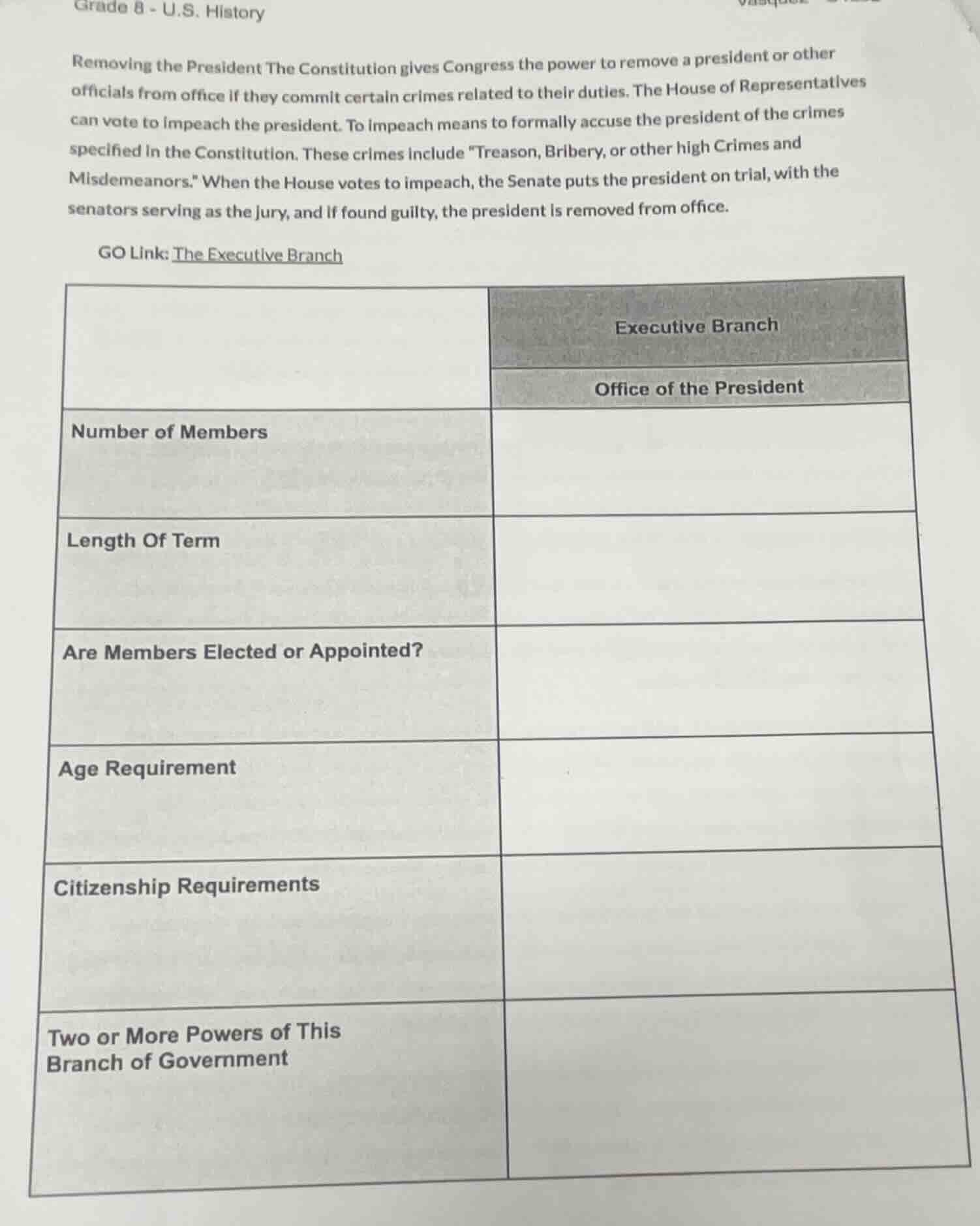
removing the president the constitution gives congress the power to remove a president or other officials from office if they commit certain crimes related to their duties. the house of representatives can vote to impeach the president. to impeach means to formally accuse the president of the crimes specified in the constitution. these crimes include \treason, bribery, or other high crimes and misdemeanors.\ when the house votes to impeach, the senate puts the president on trial, with the senators serving as the jury, and if found guilty, the president is removed from office.
go link: the executive branch
| | executive branch
| | office of the president
| number of members |
| length of term |
| are members elected or appointed? |
| age requirement |
| citizenship requirements |
| two or more powers of this branch of government |
To complete the table about the Office of the President (part of the Executive Branch) in U.S. Government, we analyze each row:
1. Number of Members
The Office of the President (the president and their administration, but the president themselves is 1 individual for the office of the President of the United States). So: 1 (for the president; the executive branch includes more, but the “Office of the President” here refers to the president’s office, with the president as the key member).
2. Length of Term
The President of the United States serves a term of 4 years, and can be re - elected for 1 additional term (so up to 8 years total, or 10 years in special cases). So: 4 years per term, up to 2 terms (or 10 years maximum).
3. Are Members Elected or Appointed?
The President is elected by the Electoral College (based on popular vote results in states). Other key positions in the Office of the President (like the Vice - President) are also elected. So: Elected (the President and Vice - President are elected; some staff may be appointed, but the core “members” of the Office of the President (president, vice - president) are elected).
4. Age Requirement
To be President, a person must be at least 35 years old. So: At least 35 years old.
5. Citizenship Requirements
To be President, a person must be a natural - born U.S. citizen. So: Natural - born U.S. citizen.
6. Two or More Powers of This Branch of Government
- The President is the Commander - in - Chief of the armed forces, meaning they have authority over the military.
- The President can veto legislation passed by Congress (though Congress can override the veto with a 2/3 vote in both houses).
- The President can appoint federal judges, ambassadors, and other high - level officials (with Senate confirmation for many positions).
Filling the table:
| Office of the President | |
|---|---|
| Length of Term | 4 years per term, up to 2 terms (or 10 years max) |
| Are Members Elected or Appointed? | Elected (President, Vice - President); some staff appointed |
| Age Requirement | At least 35 years old |
| Citizenship Requirements | Natural - born U.S. citizen |
| Two or More Powers of This Branch of Government | 1. Commander - in - Chief of the armed forces <br> 2. Can veto legislation <br> 3. Appoint federal officials (with Senate confirmation) |

Snap & solve any problem in the app
Get step-by-step solutions on Sovi AI
Photo-based solutions with guided steps
Explore more problems and detailed explanations
To complete the table about the Office of the President (part of the Executive Branch) in U.S. Government, we analyze each row:
1. Number of Members
The Office of the President (the president and their administration, but the president themselves is 1 individual for the office of the President of the United States). So: 1 (for the president; the executive branch includes more, but the “Office of the President” here refers to the president’s office, with the president as the key member).
2. Length of Term
The President of the United States serves a term of 4 years, and can be re - elected for 1 additional term (so up to 8 years total, or 10 years in special cases). So: 4 years per term, up to 2 terms (or 10 years maximum).
3. Are Members Elected or Appointed?
The President is elected by the Electoral College (based on popular vote results in states). Other key positions in the Office of the President (like the Vice - President) are also elected. So: Elected (the President and Vice - President are elected; some staff may be appointed, but the core “members” of the Office of the President (president, vice - president) are elected).
4. Age Requirement
To be President, a person must be at least 35 years old. So: At least 35 years old.
5. Citizenship Requirements
To be President, a person must be a natural - born U.S. citizen. So: Natural - born U.S. citizen.
6. Two or More Powers of This Branch of Government
- The President is the Commander - in - Chief of the armed forces, meaning they have authority over the military.
- The President can veto legislation passed by Congress (though Congress can override the veto with a 2/3 vote in both houses).
- The President can appoint federal judges, ambassadors, and other high - level officials (with Senate confirmation for many positions).
Filling the table:
| Office of the President | |
|---|---|
| Length of Term | 4 years per term, up to 2 terms (or 10 years max) |
| Are Members Elected or Appointed? | Elected (President, Vice - President); some staff appointed |
| Age Requirement | At least 35 years old |
| Citizenship Requirements | Natural - born U.S. citizen |
| Two or More Powers of This Branch of Government | 1. Commander - in - Chief of the armed forces <br> 2. Can veto legislation <br> 3. Appoint federal officials (with Senate confirmation) |