QUESTION IMAGE
Question
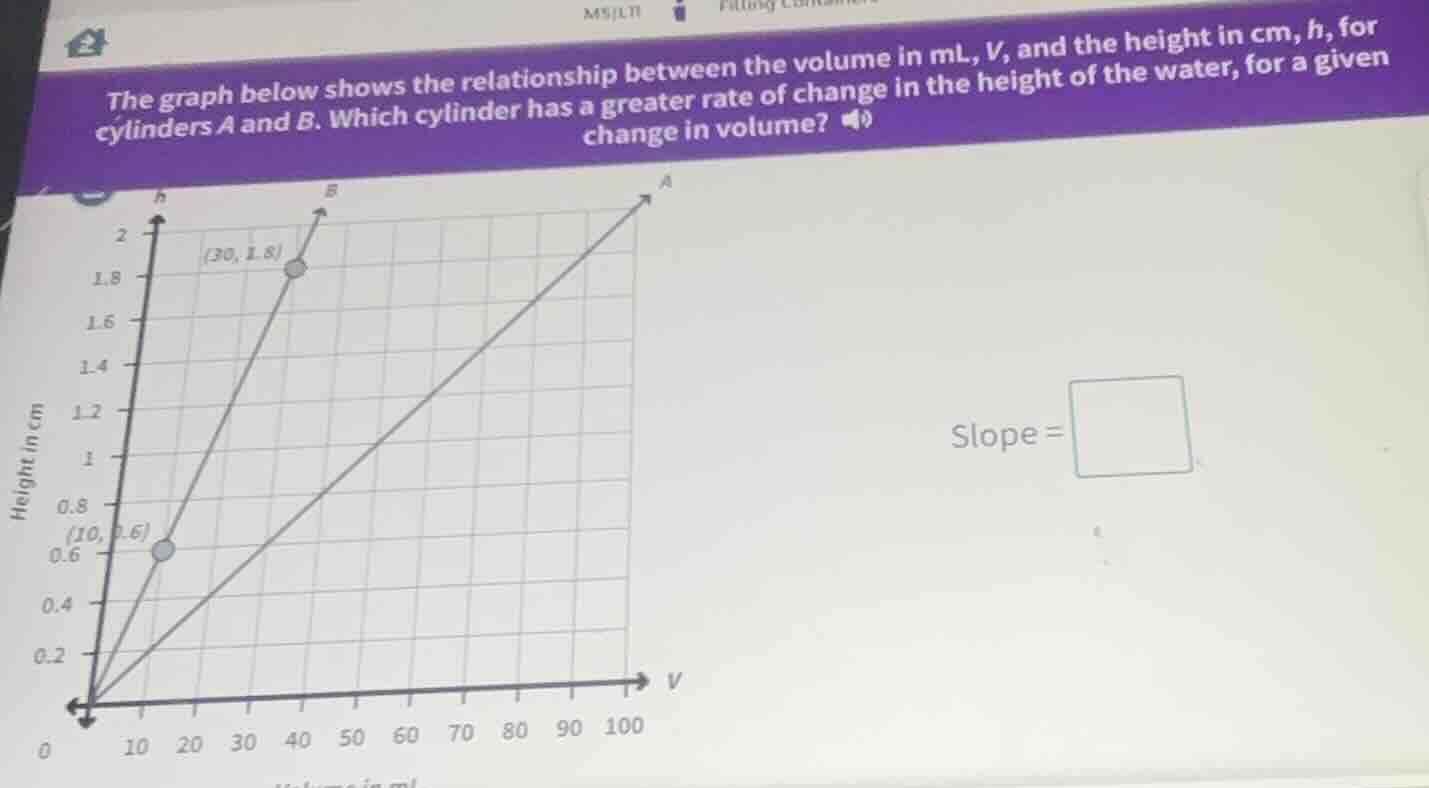
the graph below shows the relationship between the volume in ml, v, and the height in cm, h, for cylinders a and b. which cylinder has a greater rate of change in the height of the water, for a given change in volume?
height in cm
volume in ml
Step1: Recall the slope formula
The slope \( m \) between two points \((x_1, y_1)\) and \((x_2, y_2)\) is given by \( m=\frac{y_2 - y_1}{x_2 - x_1} \). For the relationship between volume \( V \) (x - axis) and height \( h \) (y - axis), the rate of change of height with respect to volume is the slope of the line. We can also think of the rate of change of volume with respect to height as the reciprocal of the slope (since if \( h = mV + b \), then \( V=\frac{1}{m}h-\frac{b}{m} \), so the rate of change of \( V \) with respect to \( h \) is \( \frac{1}{m} \) when \( b = 0 \) as both lines pass through the origin).
First, let's find the slope for cylinder B. We have two points for cylinder B: \((10, 0.6)\) and \((30, 1.8)\).
Step2: Calculate the slope for cylinder B
Using the slope formula \( m_B=\frac{h_2 - h_1}{V_2 - V_1} \), where \( (V_1, h_1)=(10, 0.6) \) and \( (V_2, h_2)=(30, 1.8) \)
\( m_B=\frac{1.8 - 0.6}{30 - 10}=\frac{1.2}{20}=0.06 \)
Now, let's find the slope for cylinder A. Let's assume a point on cylinder A. Let's take the point where \( V = 100 \) (we can see from the graph that the line for A goes towards \( (100, 2) \) approximately, since when \( h = 2 \), \( V = 100 \) as the line passes through the origin \((0,0)\) and \((100, 2)\)). So for cylinder A, \( (V_1, h_1)=(0, 0) \) and \( (V_2, h_2)=(100, 2) \)
Step3: Calculate the slope for cylinder A
Using the slope formula \( m_A=\frac{h_2 - h_1}{V_2 - V_1} \)
\( m_A=\frac{2 - 0}{100 - 0}=\frac{2}{100}=0.02 \)
Now, the rate of change of volume with respect to height is the reciprocal of the slope (since \( V=\frac{1}{m}h \) when \( h = mV \)). So for cylinder B, the rate of change of volume with respect to height is \( \frac{1}{m_B}=\frac{1}{0.06}=\frac{100}{6}\approx16.67 \) (mL per cm). For cylinder A, the rate of change of volume with respect to height is \( \frac{1}{m_A}=\frac{1}{0.02} = 50 \) (mL per cm)? Wait, no, wait. Wait, actually, the rate of change of volume with respect to height: if \( h = mV \), then \( V=\frac{1}{m}h \), so the derivative \( \frac{dV}{dh}=\frac{1}{m} \). But we can also think of the rate of change of height with respect to volume as \( m=\frac{dh}{dV} \), so the rate of change of volume with respect to height is \( \frac{dV}{dh}=\frac{1}{m} \). But maybe a better way: the rate of change of volume with respect to height is how much volume changes per unit height. So for cylinder B, when \( h \) changes from 0.6 to 1.8 (a change of \( \Delta h=1.8 - 0.6 = 1.2 \) cm), the volume changes from 10 to 30 (a change of \( \Delta V = 30 - 10=20 \) mL). So \( \frac{\Delta V}{\Delta h}=\frac{20}{1.2}=\frac{50}{3}\approx16.67 \) mL per cm. For cylinder A, when \( h = 2 \) cm, \( V = 100 \) mL, so \( \frac{\Delta V}{\Delta h}=\frac{100}{2}=50 \) mL per cm? Wait, no, that's not right. Wait, no, the slope of the line \( h \) vs \( V \) is \( \frac{dh}{dV} \). So for cylinder B, \( \frac{dh}{dV}=\frac{1.8 - 0.6}{30 - 10}=\frac{1.2}{20}=0.06 \) cm per mL. So the rate of change of volume with respect to height is \( \frac{dV}{dh}=\frac{1}{0.06}=\frac{50}{3}\approx16.67 \) mL per cm. For cylinder A, \( \frac{dh}{dV}=\frac{2 - 0}{100 - 0}=0.02 \) cm per mL, so \( \frac{dV}{dh}=\frac{1}{0.02}=50 \) mL per cm. Wait, but that would mean A has a higher rate? But that contradicts. Wait, maybe I mixed up. Let's re - express. The question is "Which cylinder has a greater rate of change in the height of the water, for a given change in volume?" Wait, no, the question is "Which cylinder has a greater rate of change in the height of the water, for a gi…

Snap & solve any problem in the app
Get step-by-step solutions on Sovi AI
Photo-based solutions with guided steps
Explore more problems and detailed explanations
Cylinder B