QUESTION IMAGE
Question
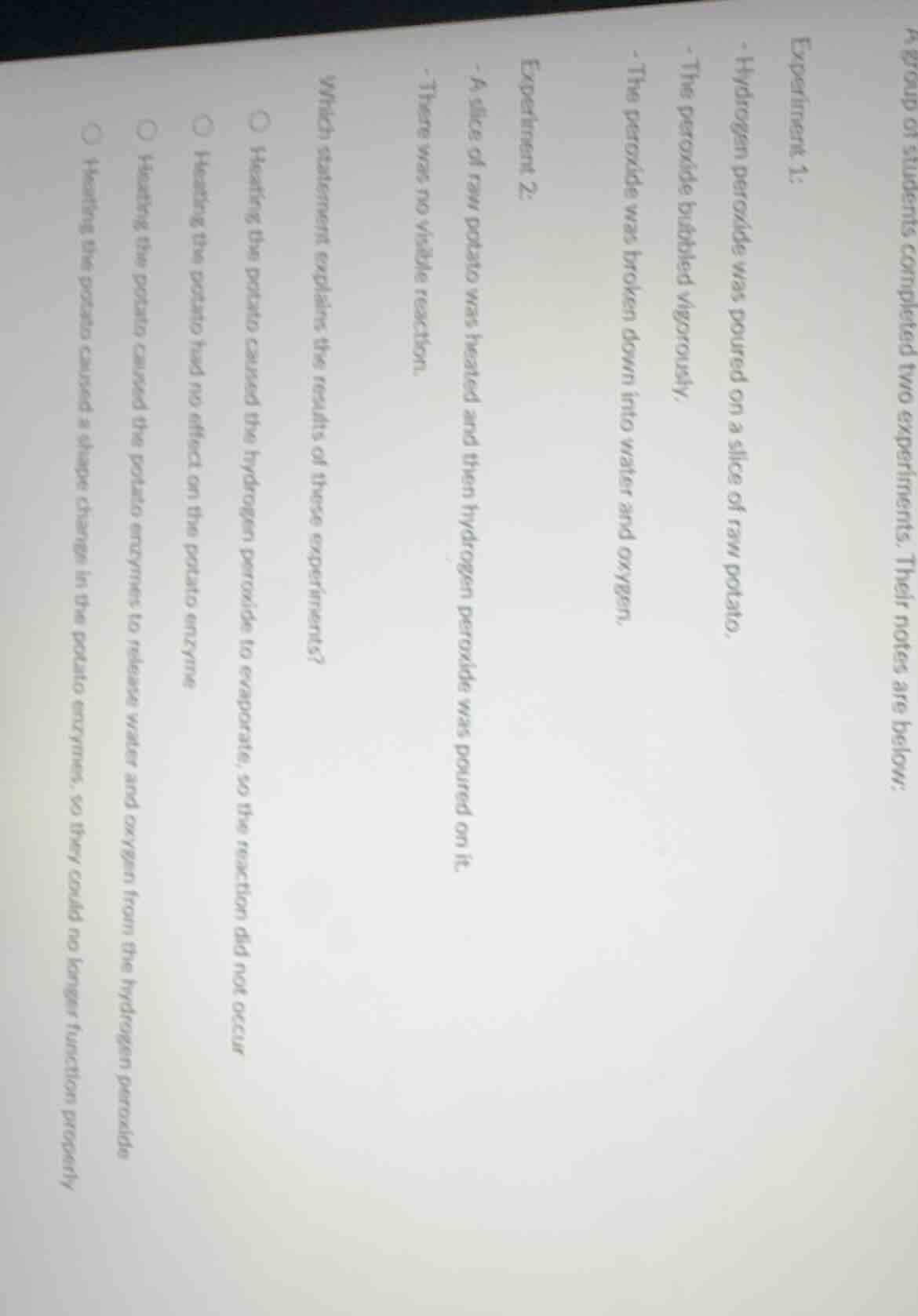
a group of students completed two experiments. their notes are below:
experiment 1:
- hydrogen peroxide was poured on a slice of raw potato.
- the peroxide bubbled vigorously.
- the peroxide was broken down into water and oxygen.
experiment 2:
- a slice of raw potato was heated and then hydrogen peroxide was poured on it.
- there was no visible reaction.
which statement explains the results of these experiments?
○ heating the potato caused the hydrogen peroxide to evaporate, so the reaction did not occur
○ heating the potato had no effect on the potato enzyme
○ heating the potato caused the potato enzyme to release water and oxygen from the hydrogen peroxide
○ heating the potato caused a shape change in the potato enzyme, so they could no longer function properly
Raw potato contains catalase (an enzyme) that speeds up hydrogen peroxide breakdown (seen in Experiment 1: vigorous bubbling). Heating denatures enzymes like catalase—changing their 3D structure (including the active site). A denatured enzyme loses its catalytic activity, so no reaction occurred in Experiment 2. The other options are incorrect: heating does not evaporate hydrogen peroxide instantly, heating does affect potato enzymes, and the reaction in Experiment 1 is enzyme-catalyzed breakdown, not water/oxygen release from the potato itself.

Snap & solve any problem in the app
Get step-by-step solutions on Sovi AI
Photo-based solutions with guided steps
Explore more problems and detailed explanations
Heating the potato caused a shape change in the potato enzyme, so they could no longer function properly