QUESTION IMAGE
Question
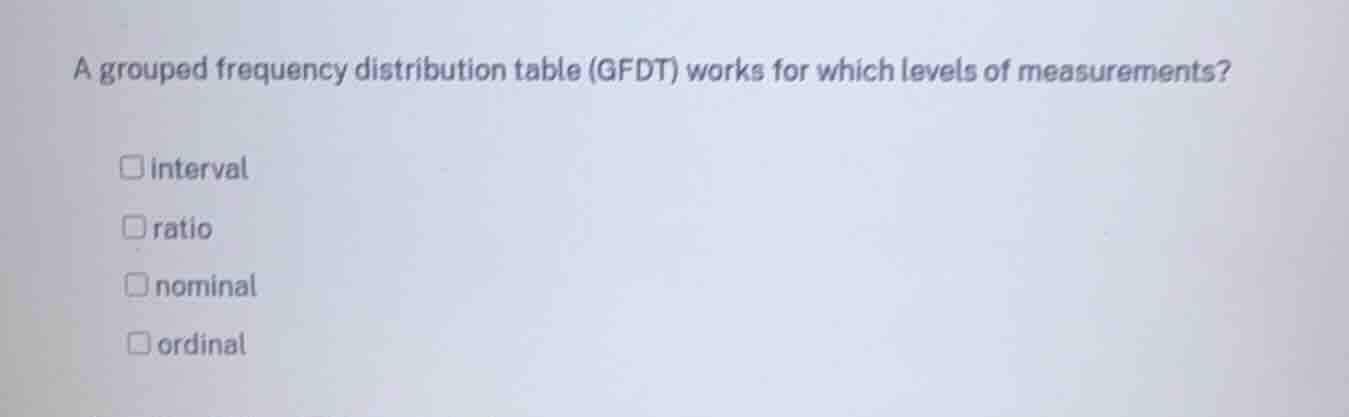
a grouped frequency distribution table (gfdt) works for which levels of measurements? interval ratio nominal ordinal
- Interval: Interval data has ordered categories with equal intervals between values (e.g., temperature in °C). Grouped frequency distribution tables (GFDTs) can group interval data into classes (e.g., 0 - 10, 11 - 20) to summarize.
- Ratio: Ratio data has a true zero and equal intervals (e.g., height, weight). GFDTs are suitable as we can group ratio data into intervals (e.g., 0 - 50 cm, 51 - 100 cm) for frequency analysis.
- Nominal: Nominal data is categorical with no order (e.g., gender, eye color). GFDTs are not used for nominal data as grouping would not make sense (categories are distinct, not numerical intervals).
- Ordinal: Ordinal data has ordered categories but unequal intervals (e.g., satisfaction levels: low, medium, high). While ordinal data can sometimes be grouped in a GFDT (e.g., grouping "low" and "medium" as a class), it is less typical than for interval/ratio. However, the primary levels where GFDTs are most applicable and standard are interval and ratio, but ordinal can also be considered in some cases. But the key levels where GFDTs work well (with numerical intervals) are interval and ratio. Wait, actually, the correct answer here is that GFDT works for interval, ratio, and ordinal? Wait no, let's recall:
Wait, the levels of measurement:
- Nominal: Categorical, no order. GFDT is not used (we use frequency tables for nominal, listing categories and their frequencies, not grouped into intervals).
- Ordinal: Ordered categories. GFDT can be used if we treat the ordinal levels as intervals (e.g., grouping "low" and "medium" as a class, but this is less precise). However, the standard application of GFDT is for numerical data (interval and ratio) where we can create numerical intervals. But the question is which levels GFDT works for. Let's check:
Actually, the correct answer is that GFDT works for interval, ratio, and ordinal? Wait no, let's check the definitions:
A grouped frequency distribution table is used when the data is numerical (continuous or discrete) and we want to group it into intervals. Interval and ratio data are numerical with intervals (ratio has a true zero). Ordinal data is categorical but ordered. Can we group ordinal data? For example, if we have ordinal data like "1 = low, 2 = medium, 3 = high", we could group 1 - 2 as "low - medium" and 3 as "high", so ordinal can be grouped. Nominal data cannot be grouped into intervals as there's no numerical order or interval. So the correct options are interval, ratio, and ordinal? Wait, but the standard answer for this question (I recall) is that GFDT works for interval, ratio, and ordinal. Wait no, let's check a reference: Grouped frequency distribution tables are used for data that can be organized into intervals, which includes interval, ratio, and ordinal (since ordinal has an order, and we can group the ordered categories into intervals, even if the intervals are not equal). Nominal data, being unordered categories, cannot be grouped into intervals, so GFDT is not used for nominal.
So the correct options are interval, ratio, and ordinal? Wait, but the question's options: let's re-express:
- Interval: Yes, because we can group into numerical intervals.
- Ratio: Yes, same as interval (has numerical values with intervals).
- Nominal: No, as categories are not numerical intervals.
- Ordinal: Yes, because we can group the ordered categories (even if the intervals between them are not equal) into groups (e.g., grouping "low" and "medium" as a class).
Wait, but maybe the intended answer here is interval, ratio, and ordinal? Or…

Snap & solve any problem in the app
Get step-by-step solutions on Sovi AI
Photo-based solutions with guided steps
Explore more problems and detailed explanations
A. interval, B. ratio, D. ordinal