QUESTION IMAGE
Question
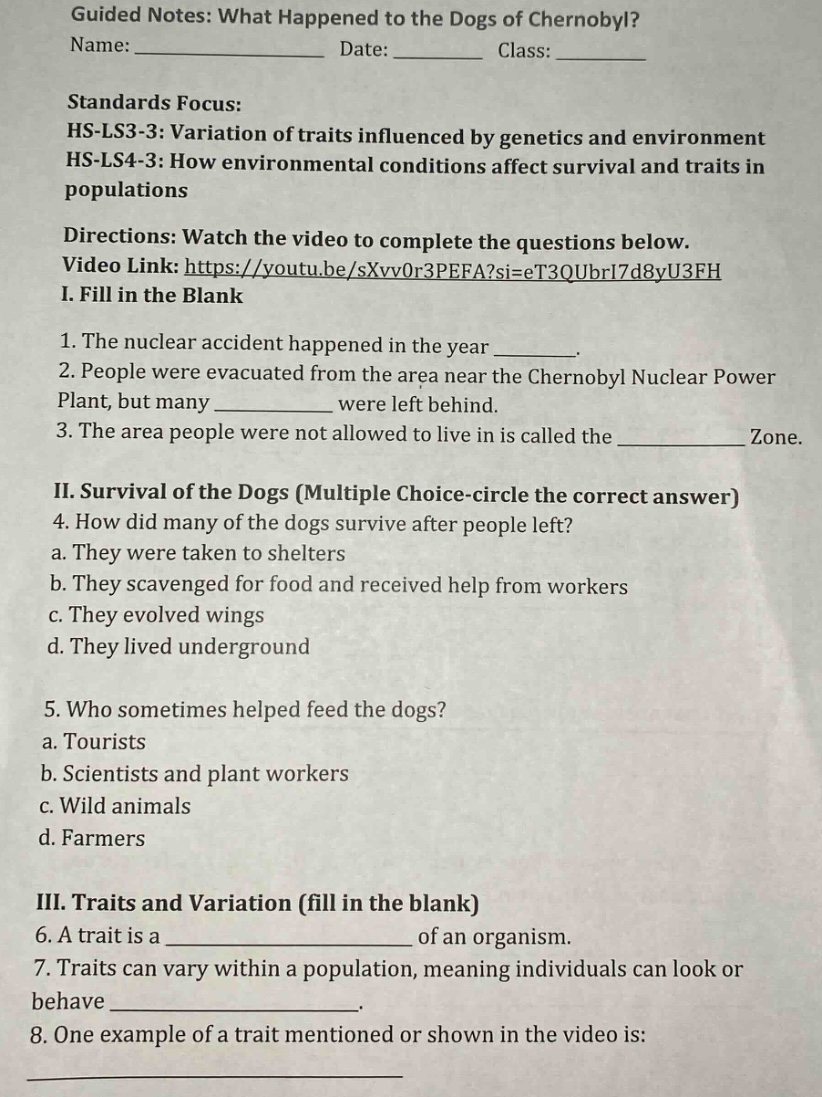
guided notes: what happened to the dogs of chernobyl?
name: _____________ date: ___ class: _____
standards focus:
hs - ls3 - 3: variation of traits influenced by genetics and environment
hs - ls4 - 3: how environmental conditions affect survival and traits in
populations
directions: watch the video to complete the questions below.
video link: https://youtu.be/sxvv0r3pefa?si=et3qubri7d8yu3fh
i. fill in the blank
- the nuclear accident happened in the year ______.
- people were evacuated from the area near the chernobyl nuclear power
plant, but many ________ were left behind.
- the area people were not allowed to live in is called the ________ zone.
ii. survival of the dogs (multiple choice - circle the correct answer)
- how did many of the dogs survive after people left?
a. they were taken to shelters
b. they scavenged for food and received help from workers
c. they evolved wings
d. they lived underground
- who sometimes helped feed the dogs?
a. tourists
b. scientists and plant workers
c. wild animals
d. farmers
iii. traits and variation (fill in the blank)
- a trait is a _______________ of an organism.
- traits can vary within a population, meaning individuals can look or
behave _______________.
- one example of a trait mentioned or shown in the video is:
_____________________
To solve these questions, we can use general knowledge about the Chernobyl disaster and the context of the video (though for some, prior knowledge of Chernobyl helps):
I. Fill in the Blank
- The nuclear accident at Chernobyl happened in 1986.
- When people evacuated, many pets (or dogs) were left behind (the video focuses on dogs, so "dogs" is also appropriate).
- The restricted area is called the Exclusion Zone.
II. Survival of the Dogs (Multiple Choice)
- After people left, dogs survived by scavenging for food and receiving help from workers. So the correct answer is b. They scavenged for food and received help from workers (options a is incorrect as they were not taken to shelters en masse, c is impossible, d is not how dogs survived).
- Scientists and plant workers sometimes helped feed the dogs. So the correct answer is b. Scientists and plant workers (tourists were not common early on, wild animals don’t feed dogs, farmers evacuated).
III. Traits and Variation (Fill in the Blank)
- A trait is a characteristic of an organism (e.g., physical or behavioral feature).
- Traits can vary within a population, meaning individuals can look or behave differently (variation implies differences).
- One example of a trait (from Chernobyl dog context) could be fur color (or size, behavior like scavenging, etc.—depends on the video, but common traits include physical features or behaviors).
Final Answers (Keyed to Questions)
- 1986
- dogs (or pets)
- Exclusion
- b. They scavenged for food and received help from workers
- b. Scientists and plant workers
- characteristic (or feature)
- differently
- (Example) fur color (or other trait like size, behavior)

Snap & solve any problem in the app
Get step-by-step solutions on Sovi AI
Photo-based solutions with guided steps
Explore more problems and detailed explanations
To solve these questions, we can use general knowledge about the Chernobyl disaster and the context of the video (though for some, prior knowledge of Chernobyl helps):
I. Fill in the Blank
- The nuclear accident at Chernobyl happened in 1986.
- When people evacuated, many pets (or dogs) were left behind (the video focuses on dogs, so "dogs" is also appropriate).
- The restricted area is called the Exclusion Zone.
II. Survival of the Dogs (Multiple Choice)
- After people left, dogs survived by scavenging for food and receiving help from workers. So the correct answer is b. They scavenged for food and received help from workers (options a is incorrect as they were not taken to shelters en masse, c is impossible, d is not how dogs survived).
- Scientists and plant workers sometimes helped feed the dogs. So the correct answer is b. Scientists and plant workers (tourists were not common early on, wild animals don’t feed dogs, farmers evacuated).
III. Traits and Variation (Fill in the Blank)
- A trait is a characteristic of an organism (e.g., physical or behavioral feature).
- Traits can vary within a population, meaning individuals can look or behave differently (variation implies differences).
- One example of a trait (from Chernobyl dog context) could be fur color (or size, behavior like scavenging, etc.—depends on the video, but common traits include physical features or behaviors).
Final Answers (Keyed to Questions)
- 1986
- dogs (or pets)
- Exclusion
- b. They scavenged for food and received help from workers
- b. Scientists and plant workers
- characteristic (or feature)
- differently
- (Example) fur color (or other trait like size, behavior)