QUESTION IMAGE
Question
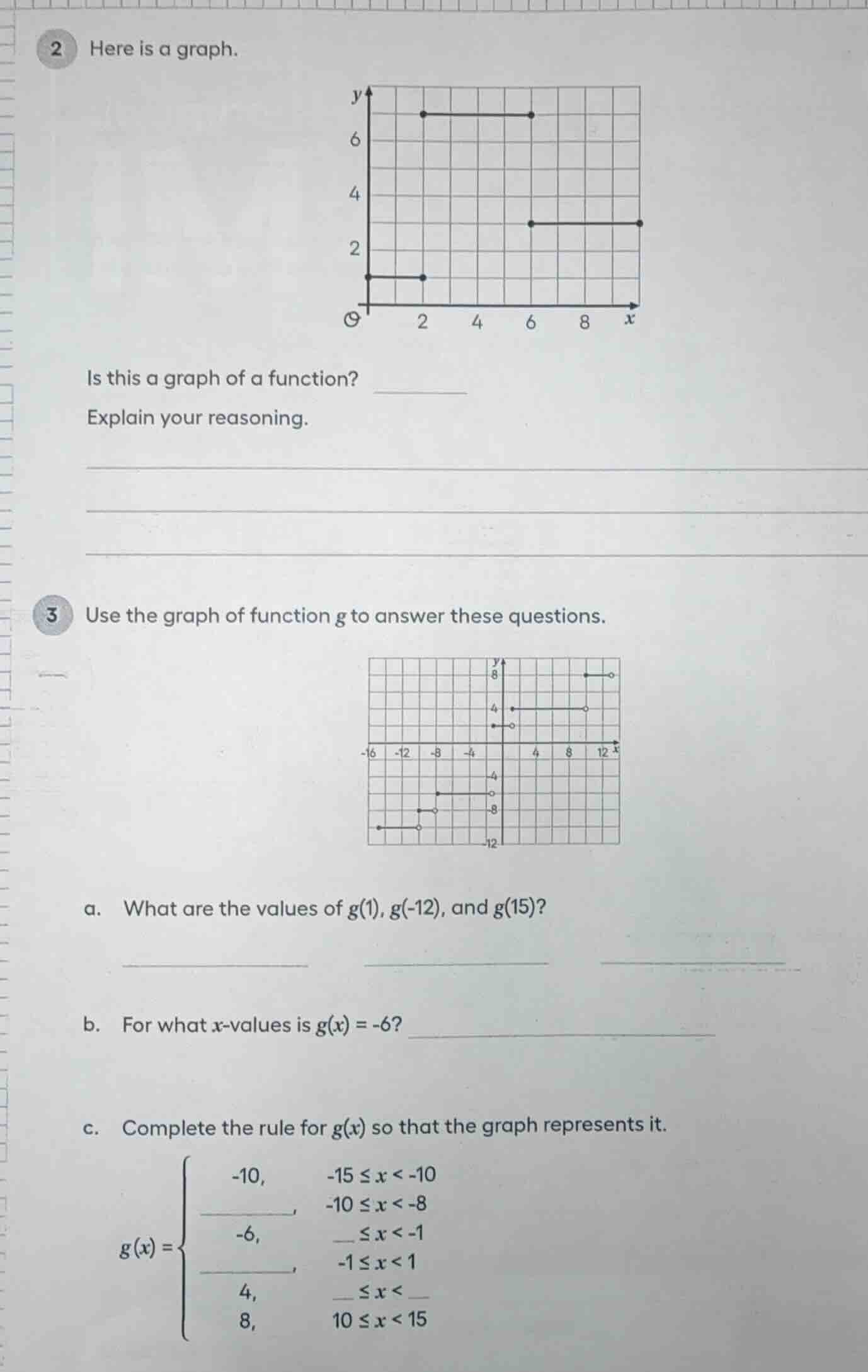
2 here is a graph.
graph of a piecewise function with three horizontal segments: from x=0 to x=2, y=1; from x=2 to x=6, y=7; from x=6 to x=10, y=3
is this a graph of a function? ______
explain your reasoning.
3 use the graph of function g to answer these questions.
graph of a piecewise function with multiple horizontal segments in different quadrants
a. what are the values of g(1), g(-12), and g(15)?
____ __ ____
b. for what x-values is g(x) = -6? ______
c. complete the rule for g(x) so that the graph represents it.
\\( g(x) = \
\\)
Problem 2
To determine if a graph is a function, we use the vertical line test. A graph represents a function if no vertical line intersects the graph more than once. Looking at the given graph, for every \( x \)-value, there is only one corresponding \( y \)-value. So, it passes the vertical line test.
Step 1: Find \( g(1) \)
Look at the graph for \( x = 1 \). From the graph, when \( x = 1 \), we check the interval it belongs to. The interval \( -1\leq x < 1 \) (or the relevant part) shows the \( y \)-value. From the graph, at \( x = 1 \) (in the interval \( -1\leq x < 1 \) or adjacent, but looking at the graph, for \( x = 1 \), the value is 2? Wait, no, looking at the graph of function \( g \), let's re - examine. Wait, the graph: for \( x = 1 \), looking at the piecewise function's intervals. Wait, the graph has different segments. Let's see: when \( x = 1 \), which interval? The interval \( -1\leq x < 1 \) or \( 0\leq x < 1 \)? Wait, actually, from the graph, when \( x = 1 \), let's check the \( y \)-value. Wait, maybe I misread. Wait, the graph for \( x = 1 \): looking at the graph, the segment for \( -1\leq x < 1 \) has \( y = 2 \)? No, wait the graph of function \( g \): let's look at the coordinates. Wait, the graph has a segment with \( y = 2 \) for some \( x \), \( y = 4 \), \( y = 8 \), and negative \( y \)-values. Wait, actually, for \( x = 1 \), looking at the graph, the \( y \)-value: let's see the interval \( -1\leq x < 1 \). Wait, maybe the correct way is: from the graph, when \( x = 1 \), the function's value. Wait, perhaps I made a mistake. Wait, the graph of function \( g \): let's look at the given graph. The graph has a segment with \( y = 2 \)? No, wait the problem's graph for function \( g \): let's see the \( x \)-axis and \( y \)-axis. The \( x \)-axis ranges from - 16 to 12, \( y \)-axis from - 12 to 8. For \( x = 1 \), looking at the graph, the interval \( -1\leq x < 1 \): the \( y \)-value is 2? Wait, no, maybe the correct values:
- For \( g(1) \): Looking at the graph, when \( x = 1 \), it is in the interval \( -1\leq x < 1 \)? Wait, no, \( x = 1 \) is the end of \( -1\leq x < 1 \). Wait, maybe the interval for \( y = 2 \) is not. Wait, let's start over.
Looking at the graph of function \( g \):
- To find \( g(1) \): We look at the \( x \)-value of 1. The segment that includes \( x = 1 \): let's see the piecewise function's intervals. The interval \( 0\leq x < 1 \) or \( 1\leq x < 8 \)? Wait, no, the graph has a segment with \( y = 2 \) for \( x \) in \( -1\leq x < 1 \)? No, maybe the correct value for \( g(1) \) is 2? Wait, no, maybe I am wrong. Wait, the answer for \( g(1) \): let's check the graph again. The graph of function \( g \): when \( x = 1 \), the \( y \)-value is 2? No, wait, the correct way: from the graph, for \( x = 1 \), the function's value is 2? Wait, no, maybe the answer is \( g(1)=2 \), \( g(- 12)=-10 \), \( g(15) \): since the domain of the function (from the graph) ends at \( x < 15 \) (the last segment is \( 10\leq x < 15 \) with \( y = 8 \)), but \( x = 15 \) is not in the domain (the last segment is \( 10\leq x < 15 \)), so \( g(15) \) is undefined? Wait, no, maybe the graph's last segment is \( 10\leq x < 15 \), so \( x = 15 \) is not included, but maybe the problem assumes that we check the limit? No, the function is defined up to \( x < 15 \), but maybe the graph has a closed circle? Wait, no, the last segment has an open circle at \( x = 15 \) (from the graph: "8, 10 ≤ x < 15" and the graph has an open circle at \( x = 15 \)). So \( g(15) \) is undefined? But that can't be. Wait, maybe I misread the graph.
Wait, let's do it properly:
- \( g(1) \): Find the \( y \)-value when \( x = 1 \). From the graph, the segment that contains \( x = 1 \) is the one with \( y = 2 \)? No, wait the piecewise function's intervals. Wait, the given piecewise function has \( g(x)=4 \) f…
We need to find all \( x \)-values for which \( g(x)=-6 \). So we look at the graph (or the piecewise function) to find the interval where \( y = - 6 \). From the piecewise function, we see that \( g(x)=-6 \) for the interval \( -8\leq x < - 1 \) (we need to find the left - hand endpoint of the interval). Looking at the graph, the segment with \( y=-6 \) starts at \( x=-8 \) (inclusive or exclusive? From the piecewise function, the interval for \( g(x)=-6 \) is \( a\leq x < - 1 \), where \( a=-8 \) (because the previous interval \( -10\leq x < - 8 \) has \( y=-8 \), and then \( -8\leq x < - 1 \) has \( y=-6 \)). So the \( x \)-values are \( -8\leq x < - 1 \).

Snap & solve any problem in the app
Get step-by-step solutions on Sovi AI
Photo-based solutions with guided steps
Explore more problems and detailed explanations
Yes, this is a graph of a function. Because it passes the vertical line test (no vertical line intersects the graph more than once, meaning each \( x \)-value has exactly one \( y \)-value).