QUESTION IMAGE
Question
1 a home is purchased for $170,000. since then, its value has increased 5% per year
a. what is the approximate value of the home 3 years after it was purchased?
b. write an equation, in function notation, to represent the value of the home as a function of time in years since it was purchased, t.
c. will the value of the home be more than $500,000 30 years after it was purchased (assuming that the trend continues)?
show your reasoning.
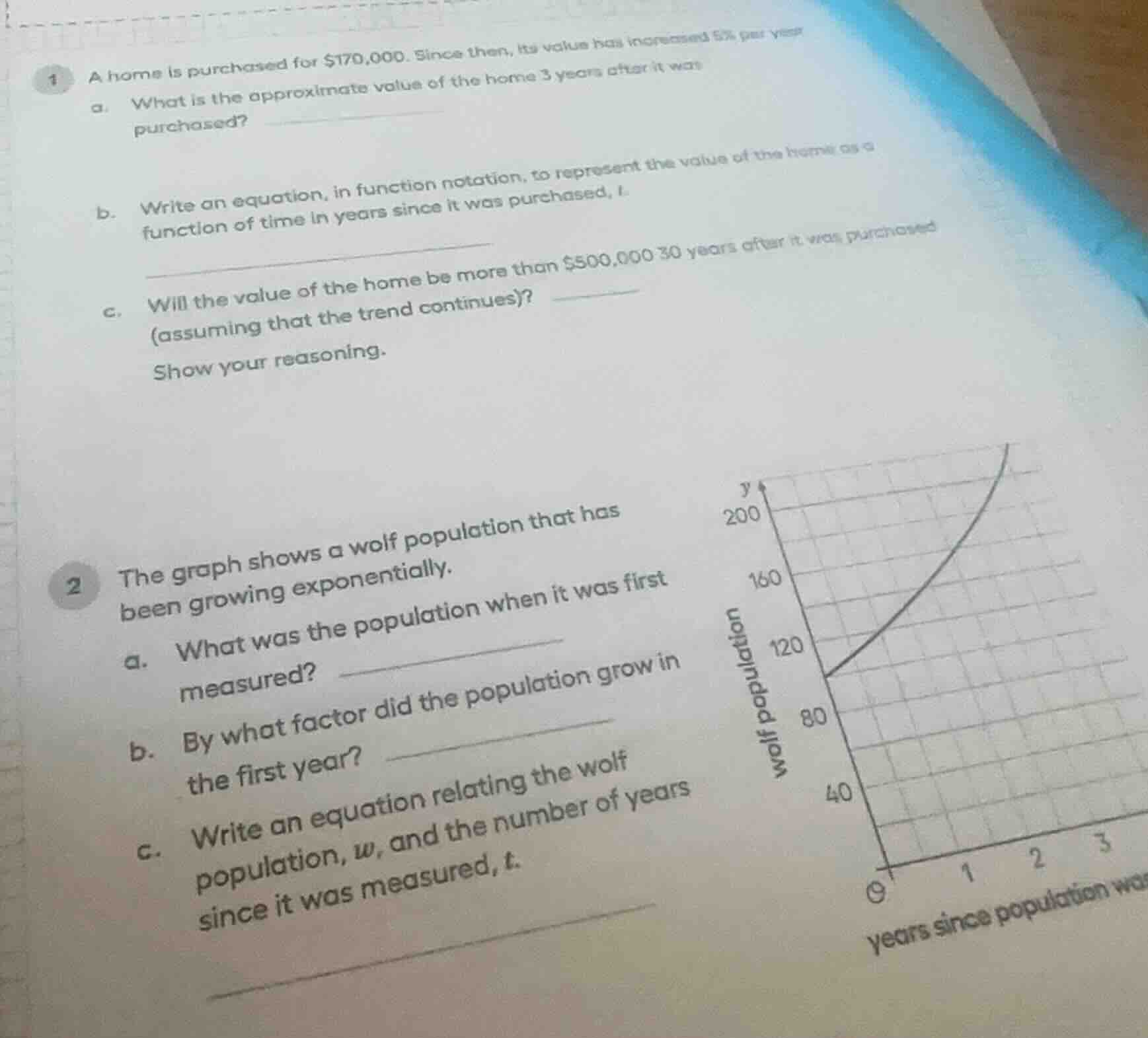
2 the graph shows a wolf population that has been growing exponentially.
a. what was the population when it was first measured?
b. by what factor did the population grow in the first year?
c. write an equation relating the wolf population, w, and the number of years since it was measured, t.
(graph: y-axis labeled wolf population with values 40, 80, 120, 160, 200; x-axis labeled years since population was measured with 0, 1, 2, 3)
Problem 1 (Home Value)
Part a: Step1: Identify growth formula
Use compound growth formula: $V = P(1+r)^t$
Part a: Step2: Plug in given values
$P=170000, r=0.05, t=3$
$V = 170000(1+0.05)^3$
Part a: Step3: Calculate step-by-step
First, $1.05^3 = 1.05\times1.05\times1.05 = 1.157625$
Then, $V = 170000\times1.157625$
Part b: Step1: Define function notation
Let $V(t)$ = home value after $t$ years.
Part b: Step2: Write growth function
$V(t) = 170000(1.05)^t$
Part c: Step1: Calculate value at t=30
$V(30) = 170000(1.05)^{30}$
Part c: Step2: Compute $1.05^{30}$
$1.05^{30} \approx 4.321942$
Part c: Step3: Find final value
$V(30) = 170000\times4.321942 \approx 734730.14$
Problem 2 (Wolf Population)
Part a: Step1: Identify initial population
Initial population is at $t=0$, from graph: $w=100$
Part b: Step1: Find population at t=1
From graph, at $t=1$, $w=120$
Part b: Step2: Calculate growth factor
$\text{Factor} = \frac{120}{100} = 1.2$
Part c: Step1: Write exponential function
Use $w(t) = w_0(b)^t$, $w_0=100, b=1.2$
$w(t) = 100(1.2)^t$

Snap & solve any problem in the app
Get step-by-step solutions on Sovi AI
Photo-based solutions with guided steps
Explore more problems and detailed explanations
Problem 1
a. $\$196,796.25$
b. $V(t) = 170000(1.05)^t$
c. Yes, the value will be approximately $\$734,730.14$, which is more than $\$500,000$.
Problem 2
a. 100
b. 1.2
c. $w(t) = 100(1.2)^t$