QUESTION IMAGE
Question
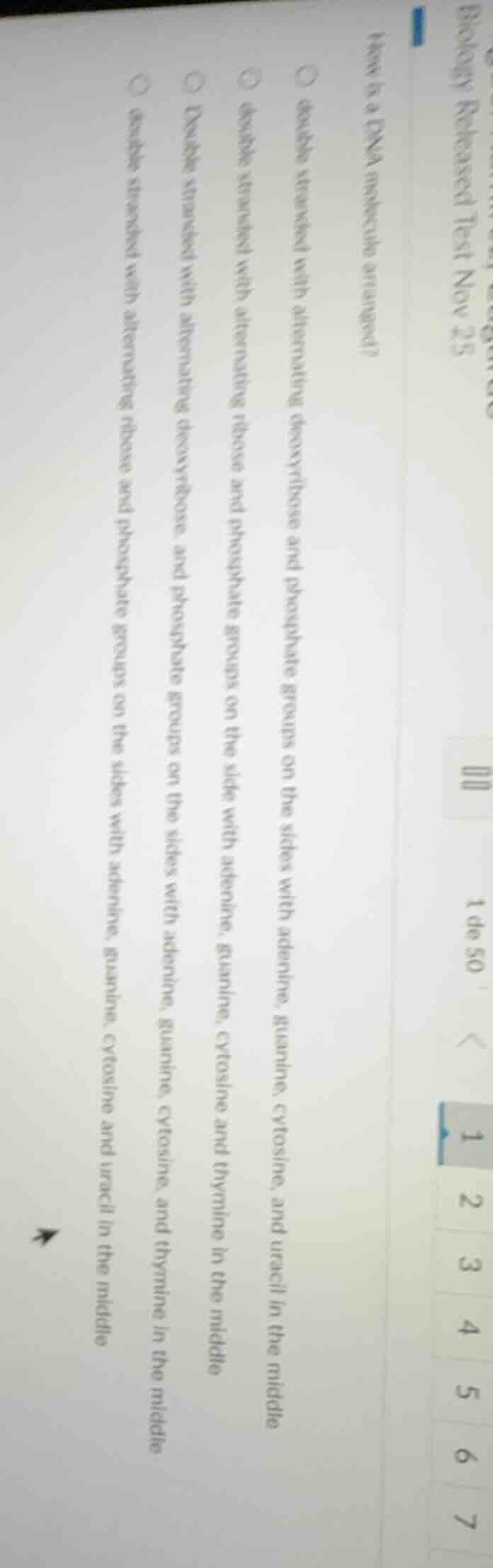
how is a dna molecule arranged?
- double - stranded with alternating deoxyribose and phosphate groups on the sides with adenine, guanine, cytosine, and uracil in the middle
- double - stranded with alternating ribose and phosphate groups on the side with adenine, guanine, cytosine and thymine in the middle
- double - stranded with alternating deoxyribose and phosphate groups on the sides with adenine, guanine, cytosine, and thymine in the middle
- double - stranded with alternating ribose and phosphate groups on the sides with adenine, guanine, cytosine, and uracil in the middle
Brief Explanations
To determine the correct structure of a DNA molecule, we recall the key features of DNA: it is double - stranded, has a sugar - phosphate backbone (with deoxyribose sugar, not ribose, and phosphate groups on the sides), and the nitrogenous bases in DNA are adenine (A), guanine (G), cytosine (C), and thymine (T) (uracil is found in RNA, not DNA).
- Option 1: Incorrect, as DNA has deoxyribose (not ribose) and uracil is not in DNA.
- Option 2: Incorrect, because DNA has deoxyribose (not ribose) and uracil is not a base in DNA.
- Option 3: Correct. DNA is double - stranded, the sugar in the backbone is deoxyribose, the backbone has phosphate groups on the sides, and the nitrogenous bases are adenine, guanine, cytosine, and thymine.
- Option 4: Incorrect, as DNA has deoxyribose (not ribose) and uracil is not present in DNA.

Snap & solve any problem in the app
Get step-by-step solutions on Sovi AI
Photo-based solutions with guided steps
Explore more problems and detailed explanations
C. double stranded with alternating deoxyribose and phosphate groups on the sides with adenine, guanine, cytosine and thymine in the middle