QUESTION IMAGE
Question
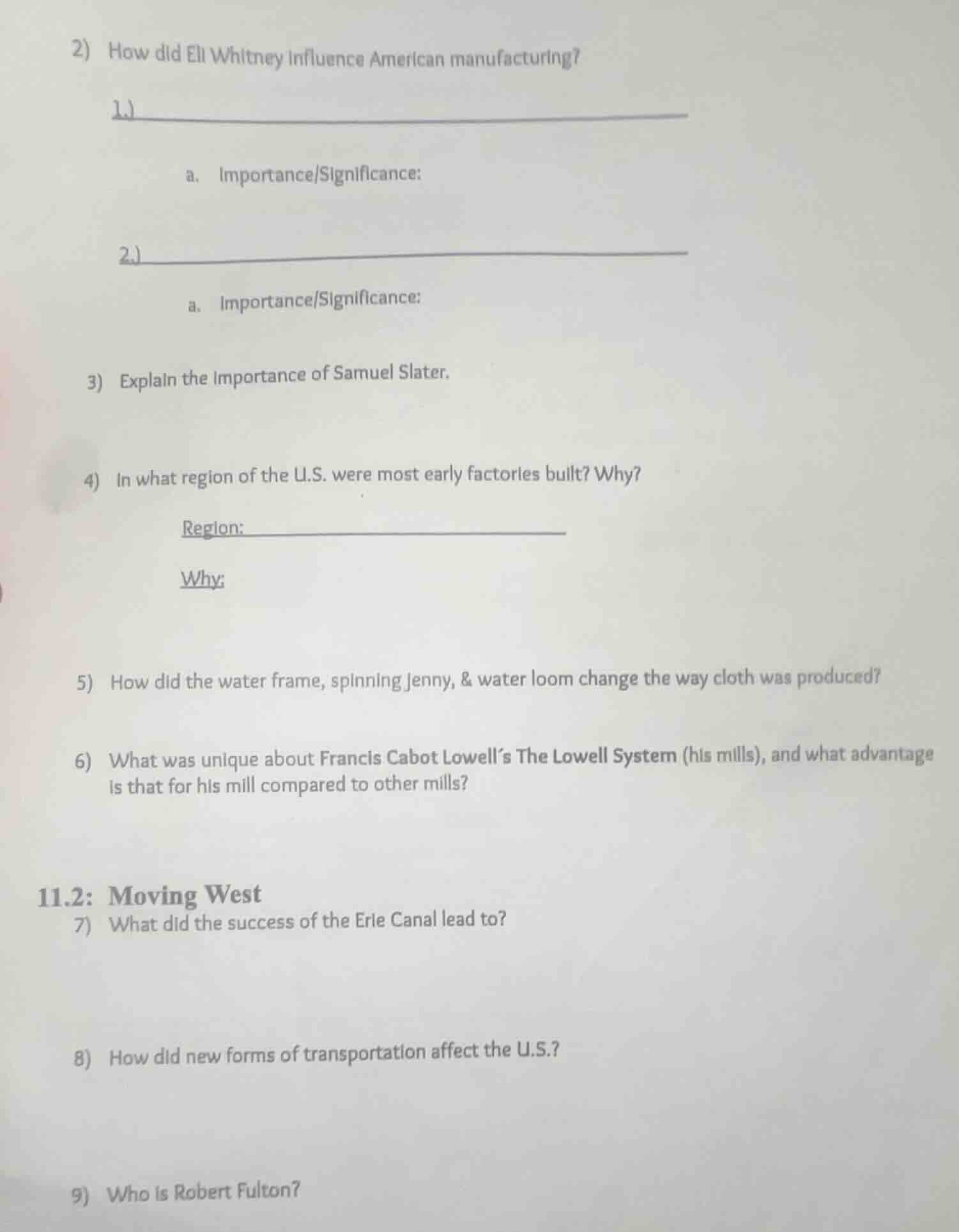
- how did eli whitney influence american manufacturing?
1.)
\ta. importance/significance:
2.)
\ta. importance/significance:
- explain the importance of samuel slater.
- in what region of the u.s. were most early factories built? why?
\tregion:
\twhy:
- how did the water frame, spinning jenny, & water loom change the way cloth was produced?
- what was unique about francis cabot lowell’s the lowell system (his mills), and what advantage is that for his mill compared to other mills?
11.2: moving west
- what did the success of the erie canal lead to?
- how did new forms of transportation affect the u.s.?
- who is robert fulton?
- 1.) Invented the cotton gin:
a. Importance/Significance: Revolutionized cotton processing, made short-staple cotton profitable, expanded cotton production in the American South, and entrenched the system of chattel slavery to meet labor demands for cotton cultivation.
2.) Developed interchangeable parts:
a. Importance/Significance: Laid the foundation for mass production in American manufacturing, allowed for easier repair of machinery and goods, and standardized production processes that boosted industrial efficiency.
- Samuel Slater memorized British textile mill designs and brought them to the U.S., building the first successful water-powered cotton spinning mill in Rhode Island. He is known as the "Father of the American Industrial Revolution" because he launched the U.S. textile industry, spurring early industrialization in the country.
- Region: New England (Northeastern U.S.)
Why: The region had fast-moving rivers to provide water power for mills, a dense population to supply labor, access to coastal ports for shipping raw materials and finished goods, and existing merchant capital to invest in factory ventures.
- These machines shifted cloth production from small-scale, home-based cottage industries to large-scale, factory-based production. They mechanized key steps: the spinning jenny and water frame increased yarn production speed and volume, while the water loom automated weaving. This made cloth cheaper, more abundant, and standardized, replacing hand-spun and hand-woven goods.
- Unique trait: The Lowell System integrated all stages of textile production (spinning, weaving, finishing) under one roof, and it employed young, unmarried women (Lowell Mill Girls) who lived in supervised boarding houses.
Advantage: Vertical integration reduced production costs and streamlined the manufacturing process, while the supervised boarding house system provided a reliable, controlled labor force and addressed concerns about female factory workers in the 19th century.
- The success of the Erie Canal created a cheap, efficient water route between the Great Lakes region and the Atlantic Coast. It spurred westward migration, opened up the Midwest for agricultural and commercial development, made New York City the nation's leading commercial hub, and stimulated growth in canal construction across the U.S.
- New forms of transportation (canals, steamboats, railroads) reduced the cost and time of moving goods and people. They connected regional economies, enabled the growth of national markets, spurred westward expansion, and facilitated the rise of industrial centers by making raw materials and finished products more accessible.
- Robert Fulton was an American engineer and inventor who is most famous for developing the first commercially successful steamboat, the Clermont, in 1807. His steamboat revolutionized water transportation by making upstream travel on rivers feasible and reliable, boosting trade and travel across the U.S.

Snap & solve any problem in the app
Get step-by-step solutions on Sovi AI
Photo-based solutions with guided steps
Explore more problems and detailed explanations
- 1.) Invented the cotton gin
a. Importance/Significance: Revolutionized cotton processing, expanded Southern cotton production, and entrenched chattel slavery.
2.) Developed interchangeable parts
a. Importance/Significance: Founded mass production, standardized manufacturing, and improved repair efficiency.
- Samuel Slater is the "Father of the American Industrial Revolution"; he brought British textile mill technology to the U.S., building the first successful water-powered cotton spinning mill and launching the American textile industry.
- Region: New England (Northeastern U.S.)
Why: Had water power for mills, a large labor pool, coastal ports for trade, and available merchant capital.
- They shifted cloth production from home-based cottage industries to large-scale factories, mechanized key steps to increase speed/volume of production, and made cloth cheaper, more abundant, and standardized.
- Unique trait: Integrated all textile production stages under one roof and employed supervised young, unmarried women.
Advantage: Streamlined production to cut costs, and provided a controlled, reliable labor force.
- It created a cheap, efficient east-west trade route, spurred westward migration, made New York City the nation's commercial hub, and stimulated canal construction and Midwestern economic growth.
- They reduced transportation costs and time, connected regional economies into a national market, facilitated westward expansion, and supported the growth of industrial centers.
- Robert Fulton was an American inventor; he developed the first commercially successful steamboat, the Clermont, which revolutionized U.S. water transportation.