QUESTION IMAGE
Question
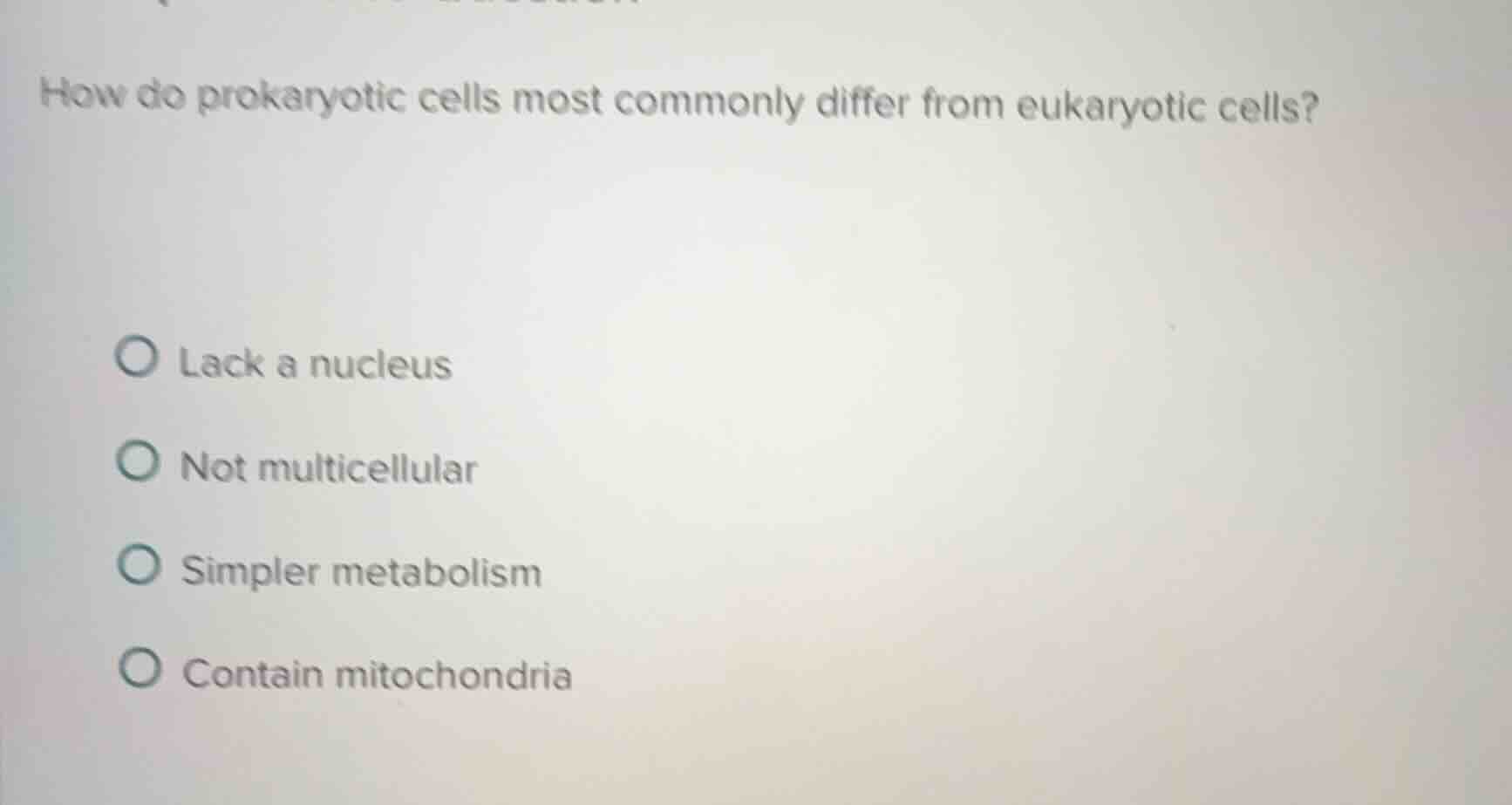
how do prokaryotic cells most commonly differ from eukaryotic cells?
lack a nucleus
not multicellular
simpler metabolism
contain mitochondria
Brief Explanations
To determine the main difference between prokaryotic and eukaryotic cells, we analyze each option:
- "Lack a nucleus": Prokaryotic cells have no membrane - bound nucleus (their genetic material is in a nucleoid), while eukaryotic cells have a true nucleus. This is a fundamental and most common difference.
- "Not multicellular": Some prokaryotes can form colonies, and the key difference is not about multicellularity (many eukaryotes are unicellular too, like yeast).
- "Simpler metabolism": Metabolism complexity varies and is not the most defining difference.
- "Contain mitochondria": Prokaryotic cells lack membrane - bound organelles like mitochondria, while eukaryotic cells have them. So this option is incorrect.

Snap & solve any problem in the app
Get step-by-step solutions on Sovi AI
Photo-based solutions with guided steps
Explore more problems and detailed explanations
A. Lack a nucleus