QUESTION IMAGE
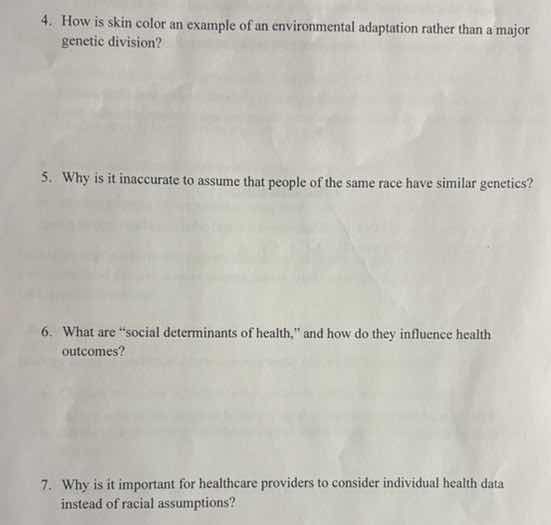
Question
- how is skin color an example of an environmental adaptation rather than a major genetic division?
- why is it inaccurate to assume that people of the same race have similar genetics?
- what are \social determinants of health,\ and how do they influence health outcomes?
- why is it important for healthcare providers to consider individual health data instead of racial assumptions?
Question 4
Skin color variation is linked to environmental factors like UV exposure. Populations in sunnier regions evolved more melanin (darker skin) for UV protection and vitamin D regulation, while those in less sunny areas have lighter skin. Genetically, the alleles for skin color show continuous variation, not distinct racial genetic divisions.
Race is a social construct, not a biological one. Genetic variation within a “race” is often greater than between “races”. For example, two people of the “Black race” may have more genetic differences than a person of “Black race” and a person of “White race” due to diverse ancestral lineages and genetic mixing.
Social determinants of health are conditions in which people are born, grow, live, work, and age (e.g., income, education, housing, access to healthcare). They influence health by affecting exposure to health risks (e.g., poor housing → asthma) and access to resources (e.g., low income → limited healthy food access), leading to health disparities.

Snap & solve any problem in the app
Get step-by-step solutions on Sovi AI
Photo-based solutions with guided steps
Explore more problems and detailed explanations
Skin color is an environmental adaptation (e.g., UV - related melanin production) with continuous genetic variation, not a marker of major genetic divisions between “races”.