QUESTION IMAGE
Question
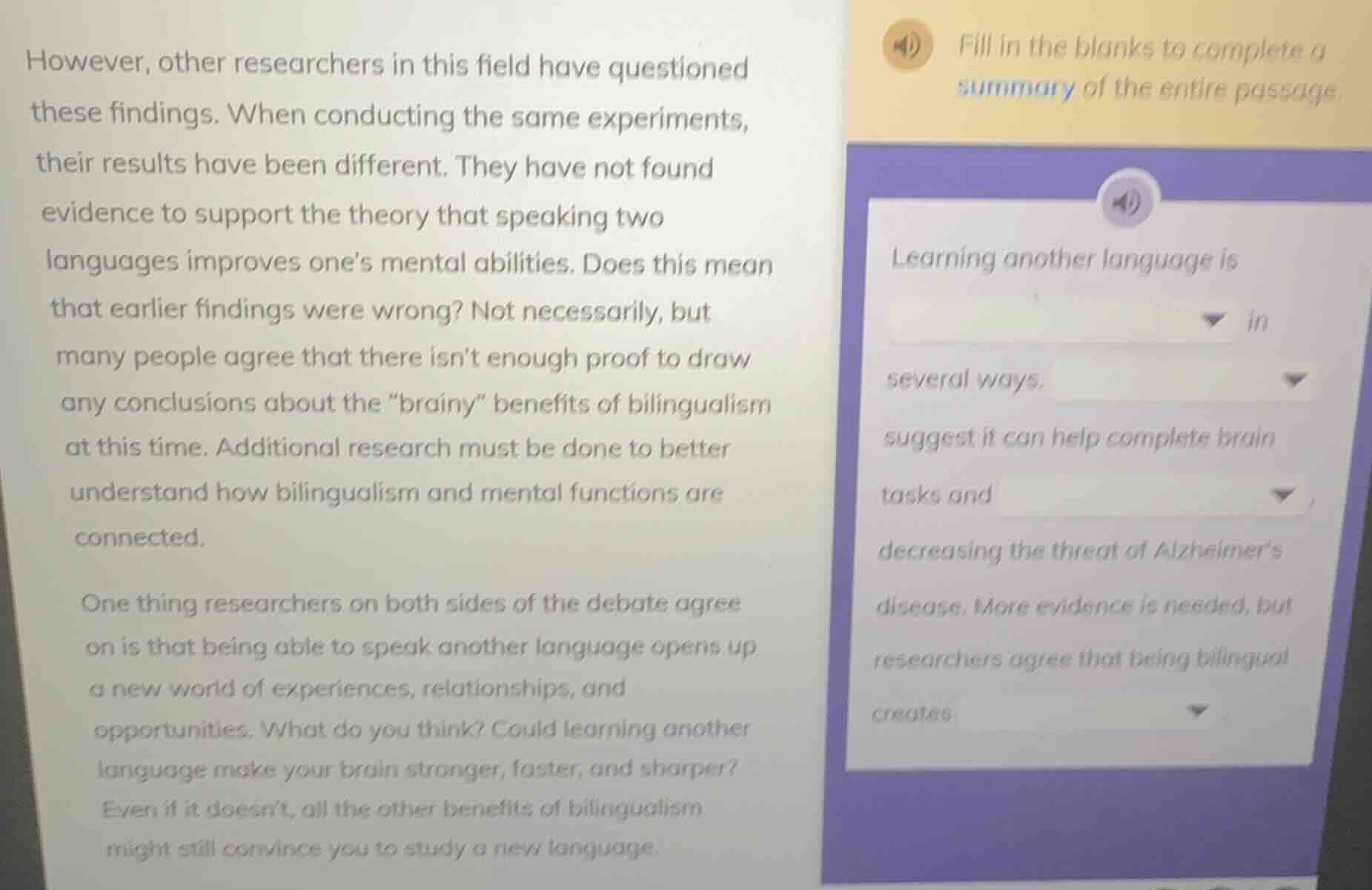
however, other researchers in this field have questioned these findings. when conducting the same experiments, their results have been different. they have not found evidence to support the theory that speaking two languages improves ones mental abilities. does this mean that earlier findings were wrong? not necessarily, but many people agree that there isnt enough proof to draw any conclusions about the \brainy\ benefits of bilingualism at this time. additional research must be done to better understand how bilingualism and mental functions are connected.
one thing researchers on both sides of the debate agree on is that being able to speak another language opens up a new world of experiences, relationships, and opportunities. what do you think? could learning another language make your brain stronger, faster, and sharper? even if it doesnt, all the other benefits of bilingualism might still convince you to study a new language.
- fill in the blanks to complete a summary of the entire passage.
- learning another language is in several ways. suggest it can help complete brain tasks and , decreasing the threat of alzheimers disease. more evidence is needed, but researchers agree that being bilingual creates
- The first blank describes the general value of learning another language, based on the passage's focus on its potential mental and personal benefits.
- The second blank introduces the initial positive claims about bilingualism that some researchers made.
- The third blank matches the proposed mental benefit tied to reduced Alzheimer's risk (delaying cognitive decline related to the disease).
- The final blank reflects the agreed-upon non-mental benefit of bilingualism stated in the passage.

Snap & solve any problem in the app
Get step-by-step solutions on Sovi AI
Photo-based solutions with guided steps
Explore more problems and detailed explanations
Learning another language is beneficial in several ways.
Some studies suggest it can help complete brain tasks and delay cognitive decline, decreasing the threat of Alzheimer's disease. More evidence is needed, but researchers agree that being bilingual creates new experiences, relationships, and opportunities.